Get Full Government Meeting Transcripts, Videos, & Alerts Forever!
Get email alerts on the Criminal Justice Gun Policy topic
No spam. Unsubscribe anytime.
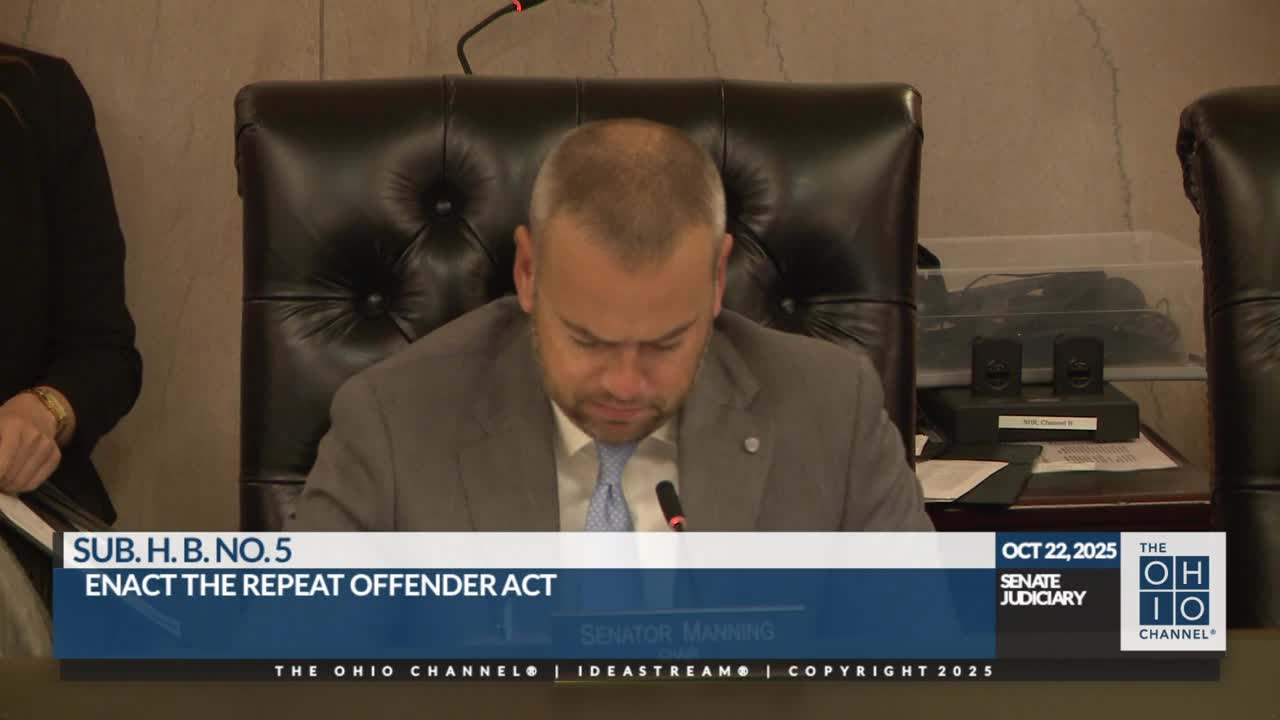
Senate Judiciary Committee holds first hearing on House Bill 5, the Repeat Offender Act
Summary
Sponsors told the Senate Judiciary Committee HB5 would create a repeat-offender firearm specification, raise penalties for weapons-under-disability by violent felons and create a revised expungement pathway; committee members questioned the bills effects on rehabilitation and employment.
At a hearing of the Senate Judiciary Committee, sponsors testified on House Bill 5, the Repeat Offender Act, which they said would create a repeat-offender classification for violent felons who possess firearms and raise penalties for firearm offenses.
Sponsors told the committee the bill would elevate certain weapons-under-disability charges by violent felons from a third-degree felony to a second-degree felony, add a five-year repeat-offender firearm specification that may be imposed alongside an underlying felony sentence, and expand the process by which people can seek relief from firearm disability. Representative Willis said HB5 "creates a repeat offender classification" and described the proposal as a data-driven, bipartisan effort targeting a small group of violent repeat offenders responsible for a large share of gun crime.
The bills co-sponsor, Representative Josh Williams, said the measure would increase penalties and impose mandatory prison time for repeat offenders while preserving the rights of lawful gun owners. Williams cited research he said supported longer sentences as a deterrent, noting studies by the U.S. Sentencing Commission and a University of Pennsylvania review as part of his testimony.
A sizeable portion of the committees exchange focused on the bills sealing and expungement provisions. Sponsors described an "enhanced" expungement pathway that would preserve the existing sealing process but create a distinct expungement route that aims to be recognized under federal standards. Williams described the change as a trade-off: initial eligibility for a true expungement would begin later (sponsors said seven years in current draft) and after a longer period the standard would "tilt in favor of the defendant." Ranking Member Hicks Hudson warned that lengthening the period before expungement eligibility could make it harder for people to secure employment and housing, and asked sponsors to continue discussions.
Committee members and sponsors also discussed how the bill would operate in practice. Sponsors said the proposal includes technical clarifications to align with existing Ohio code and procedures for firearm-disability relief and noted prior iterations of the concept in earlier General Assemblies. No vote was taken; the committee recessed the matter as a first hearing.
Ending: Committee members indicated continued interest in discussing expungement timing and operational details; at the close of the session the chair said HB5 "will stand as the first hearing on House Bill 5."