Get Full Government Meeting Transcripts, Videos, & Alerts Forever!
Get email alerts on the Right To Repair topic
No spam. Unsubscribe anytime.
Ohio PIRG urges right‑to‑repair protections in House Bill 301 to expand repair access and recycling
Summary
A proponent from Ohio PIRG told the House Technology and Innovation Committee that House Bill 301 would give consumers and independent repair shops access to parts, tools and information to repair electronic devices, increase local repair business opportunities and raise the value of components for recyclers.
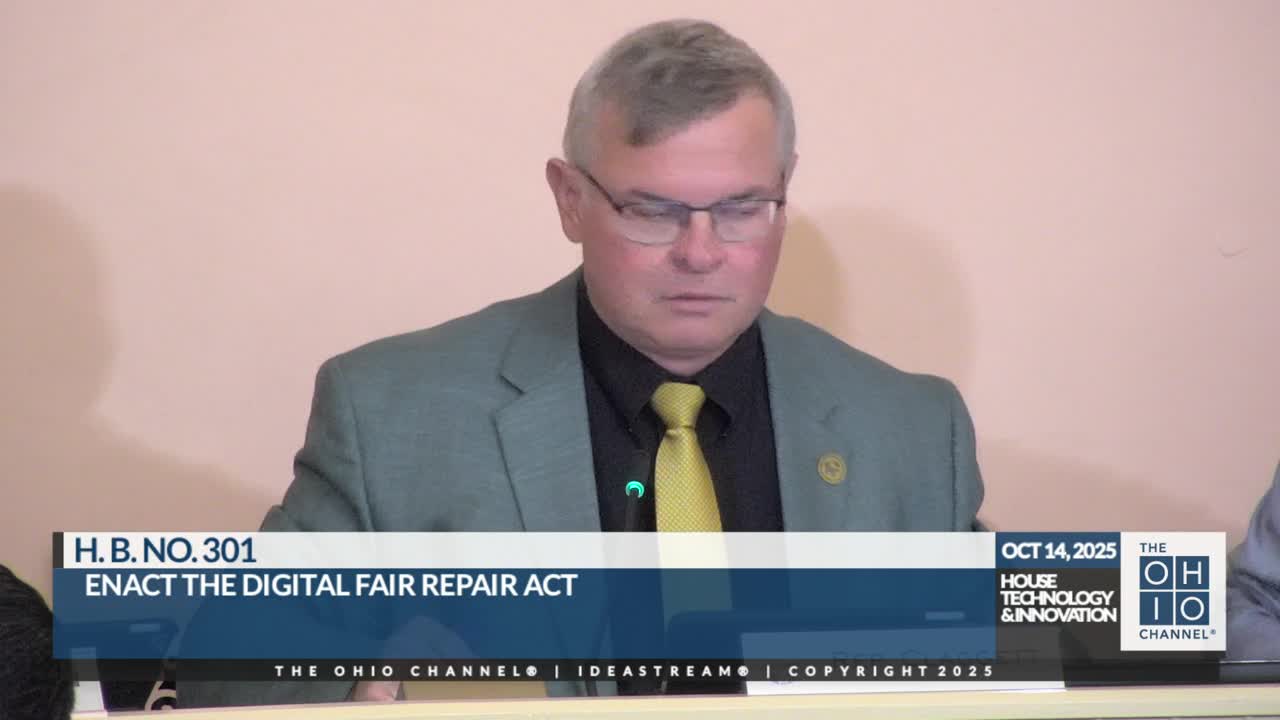
At the House Technology and Innovation Committee's second hearing on House Bill 301, Sarah Klein of Ohio PIRG offered proponent testimony urging lawmakers to give Ohio consumers and independent repair providers better access to parts, tools and documentation needed to repair electronic devices.
Klein said Americans on average have 24 electronic devices at home and that restricted repair access forces consumers to buy replacements. "Our most recent report on consumer electronic spending showed that American households spend over $1,700 each year on new electronic devices," Klein said. "Our report also found that repair could reduce that spending by 21.6%, which would save an average family $382 a year." Klein estimated that broader repair access could save Ohio households up to $1.8 billion annually.
Klein told the committee the bill is intended to help consumers and locally owned repair shops compete with manufacturer repair centers and to strengthen Ohio's electronic recycling industry by increasing the value of salvaged components. She said the bill would provide independent repair providers access to parts and diagnostics and would address "parts pairing" — manufacturer features that can render third‑party parts inoperable — to prevent devices from being "bricked" after a non‑OEM repair.
Committee members asked about technical complexity, intellectual property, software locks and whether the bill would force manufacturers to redesign products. Klein said the bill focuses on giving access to parts and repair information for consumers and independent repair providers and does not require manufacturers to redesign devices or disclose trade secrets. In response to member concerns, she said the bill includes exemptions and is intended to avoid forcing disclosure of proprietary trade secrets while enabling diagnostics and repair information to be available where reasonable.
Klein also said federal and state momentum exists for right‑to‑repair measures; she cited recent state laws and federal work on repair for defense equipment as examples of similar policy activity. The hearing generated committee questions on the balance between consumer access, intellectual property protection and cybersecurity risks; no committee vote was taken.