Get Full Government Meeting Transcripts, Videos, & Alerts Forever!
Get email alerts on the Unclaimed Digital Assets topic
No spam. Unsubscribe anytime.
Ohio committee hears sponsors propose framework to treat unclaimed cryptocurrency as unclaimed property
Summary
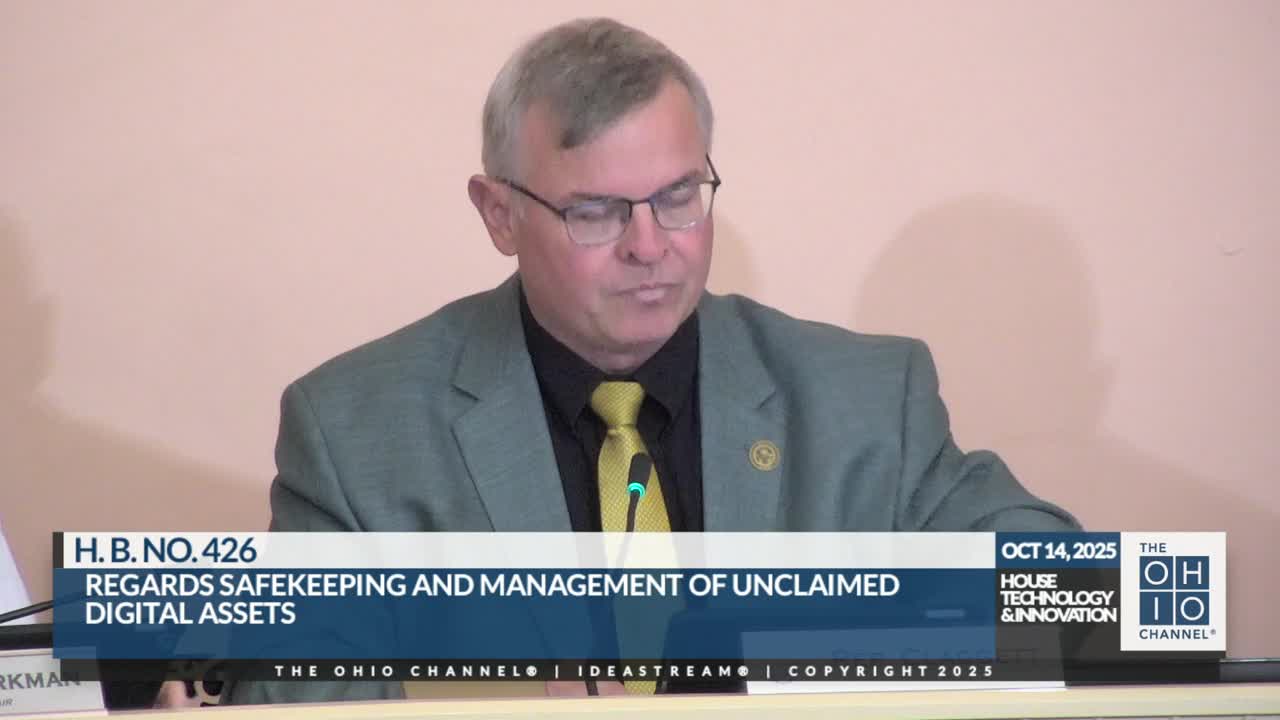
Sponsors of House Bill 426 told the House Technology and Innovation Committee the bill would bring digital assets such as cryptocurrency and NFTs into Ohio’s existing unclaimed‑property system, outlining a two‑plus‑two year custody timeline, a requirement that holders transfer native tokens when possible, and a role for the Department of Commerce.
Members of the Ohio House Technology and Innovation Committee on Wednesday heard sponsor testimony for House Bill 426, a measure to extend Ohio's unclaimed‑property framework to digital assets such as cryptocurrency and non‑fungible tokens.
Representatives sponsoring the bill said HB 426 would require holders — exchanges or wallet providers — to transfer presumed‑abandoned digital assets in their native form to a qualified custodian designated by the Ohio Department of Commerce and would require the Department to maintain those assets for additional periods before sale.
The sponsors said the bill uses time frames similar to existing unclaimed property law. "An account is presumed abandoned after 2 years of no owner activity or undelivered communications," Representative Demetrio said, adding that when an asset is transferred it must be maintained "in its native form for at least 2 years before any sale can occur." Representative Williams described the measure as "a necessary modernization of Ohio's laws" so that digital assets receive the same custody and recovery protections as traditional financial holdings.
Why it matters: Sponsors said the proposal aims to protect owners who lose access to wallets or credentials while preserving the possibility that owners can reclaim assets that may have appreciated in value. Under the bill as described, proceeds from any eventual sale of unclaimed digital assets would be deposited into Ohio's existing unclaimed funds trust fund, and the Department of Commerce would contract with a qualified custodian to hold native tokens.
Committee members pressed sponsors on implementation details. Representative White and others raised concerns about the state taking custody of "hot" wallets (custodial accounts on exchanges) and about liability if the state or a state‑designated custodian holds volatile assets. Sponsors replied that the bill distinguishes between accounts where a custodian holds private keys and situations where private keys are unavailable, and that custodians who retain control must continue custody until transfer is possible. Representative McLean asked whether the state could convert assets to U.S. dollars or hold them indefinitely; sponsors responded that after the two‑plus‑two year process the state could sell at market value or continue to hold the asset.
Members also asked about probate and heirs. Sponsors said the bill does not change Ohio probate law and that current probate claims processes should apply to digital assets transferred to state custody; they offered to add clarifying language if the committee wanted.
Several members raised additional drafting questions the sponsors said the committee should address in follow‑up sessions, including whether the bill should be retroactive to assets already dormant and the safeguards the Department of Commerce should use when selecting qualified custodians. The committee chair said the sponsors and agency representatives (including the treasurer's office) would be invited back to answer outstanding questions at a future hearing.
The hearing produced no committee vote. The sponsors characterized HB 426 as an administrative update to the Ohio Revised Code to close a gap in the treatment of unclaimed property and to allow owners to recover native digital assets when possible.