Get Full Government Meeting Transcripts, Videos, & Alerts Forever!
Get email alerts on the Technology And Innovation topic
No spam. Unsubscribe anytime.
Sponsors introduce 'Ohio Right to Compute Act' to set AI safeguards for critical infrastructure
Summary
Representatives introduced House Bill 392 in the House Technology and Innovation Committee, proposing state-level risk-management requirements for artificial intelligence systems that interface with critical infrastructure and seeking to create regulatory certainty to attract investment to Ohio.
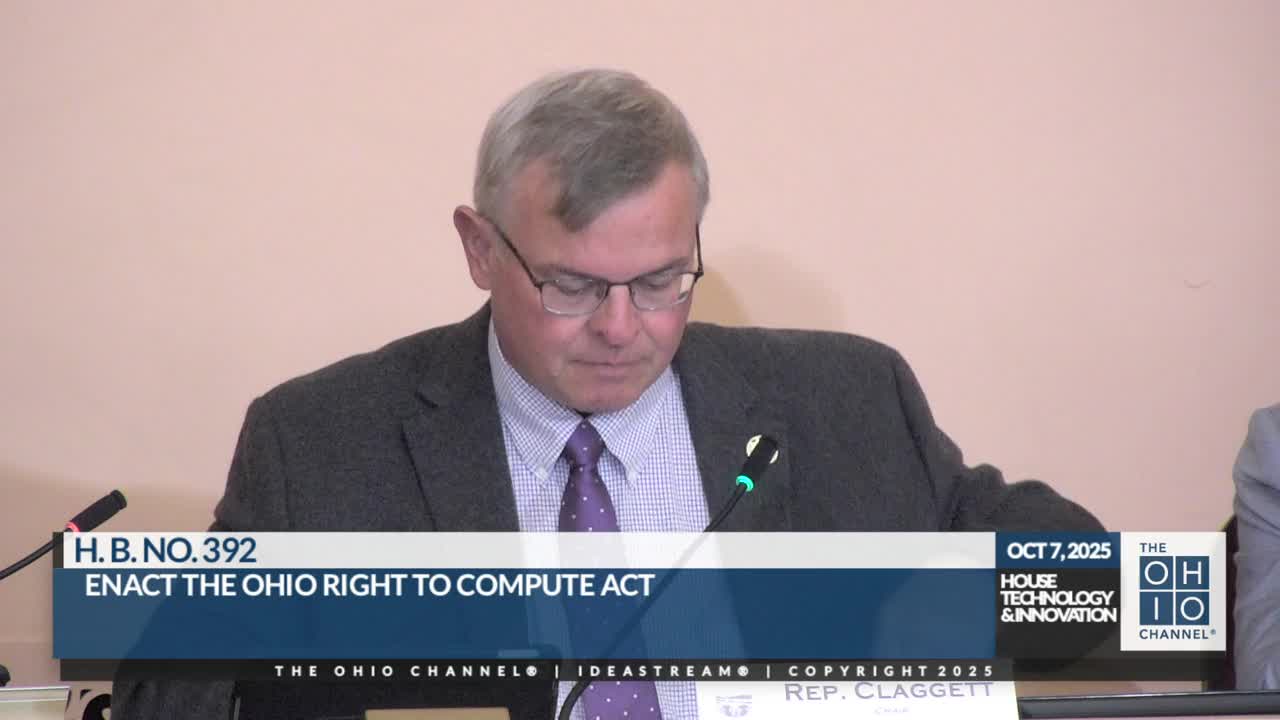
Representatives Fisher and Demetrio introduced House Bill 392, the Ohio Right to Compute Act, at a first hearing of the Ohio House Technology and Innovation Committee. The bill would require entities that implement or operate artificial intelligence that interfaces with the state's critical infrastructure to adopt a risk-management policy aligned with federal guidelines.
"Our goal with this bill is simple, to put the necessary safeguards in place around AI while simultaneously creating regulatory certainty that will encourage investments in this space to come to Ohio," Representative Fisher said in sponsor testimony.
The bill defines a narrow set of "compelling government interests" that could justify regulation, sponsors said. During testimony Representative Demetrio said those interests include protecting critical infrastructure, addressing deceptive practices and fraud, protecting minors and vulnerable populations, and preventing nuisances linked to physical data center infrastructure. "We want to define what a compelling government interest is as far as allowing certain regulations and empowering them," Demetrio said.
Committee members pressed sponsors for specifics. Representative Hockley asked what prompted the bill; sponsors pointed to a mix of stakeholder input, differing state approaches, and a lack of an "overriding federal regulatory regime." Representatives noted other states, such as Texas and Virginia, are pursuing policies to attract investment and that California proposals have at times been more restrictive.
Ranking Member Mohammed asked which state agency would oversee and enforce the new requirements. Sponsors said the Department of Commerce was their initial thought but emphasized the bill is a starting point and that they welcome stakeholder and member feedback on where oversight should reside. "We're certainly open to that," a sponsor said when asked about enforcement placement.
Committee members also raised practical questions sponsors said they will refine: how to define the scope of systems that "interface" with critical infrastructure, what federal guidelines will be referenced, whether the bill would preempt local rules, and how to protect minors and address deepfakes. Sponsors repeatedly described the legislation as a framework to be adjusted as technology and other states' approaches evolve.
The first hearing concluded with no formal action. Sponsors said they expect follow-up conversations with stakeholders and other members of the legislature before further committee consideration.