Ohio bill would allow verified app tracking to replace part of teen supervised driving hours, lower permit age to 15
Loading...
Summary
House Bill 463, a proposal to modernize Ohio’s driver education rules, received sponsor testimony and extensive committee questions during a first hearing Tuesday before the Ohio House Transportation Committee.
House Bill 463, a proposal to modernize Ohio’s driver education rules, received sponsor testimony and extensive committee questions during a first hearing Tuesday before the Ohio House Transportation Committee.
Representative Klopfenstein, sponsor of the bill, told the committee the measure would add an option to the current affidavit system by permitting a state‑approved smartphone or in‑car system to verify practice hours. “This legislation seeks to modernize driver education in Ohio by incorporating emerging technologies that track and verify practice hours through smartphones or in car systems,” Klopfenstein said. He said such tools “provide real time feedback to student drivers and offer a more accessible and affordable path to safe driving.”
The bill preserves existing paths for driver education while adding an electronic verification option. Under current law, students submit an affidavit attesting to 50 hours of supervised driving with a parent or guardian. HB463 would allow students to complete 40 verified hours using a state‑approved app instead of the affidavit. The proposal also would permit parents to count up to four of the eight required in‑car instruction hours if those hours are verified through an approved electronic tool; approval and safety review authority would remain with the Ohio Department of Public Safety.
Representative Lorenz, a joint sponsor, said the measure “is about modernizing Ohio's driver's education to ensure that we as a state are increasing the accessibility for our youth to get quality supervised experience behind the wheel.” He and Klopfenstein emphasized the change is optional and intended to expand capacity where certified driver‑training programs have long wait lists, particularly in rural areas.
Committee members raised verification and safety questions throughout the hearing. Ranking Member Grimm said he had “a lot of questions” about how the app verifies that a supervising adult actually is a parent or guardian and whether the state app exists and can be reviewed. Klopfenstein said the bill would let the Department of Public Safety evaluate and approve private‑sector or state apps, and that the committee could arrange a demonstration; he said he had seen a private‑sector demonstration previously but had not personally reviewed a state app.
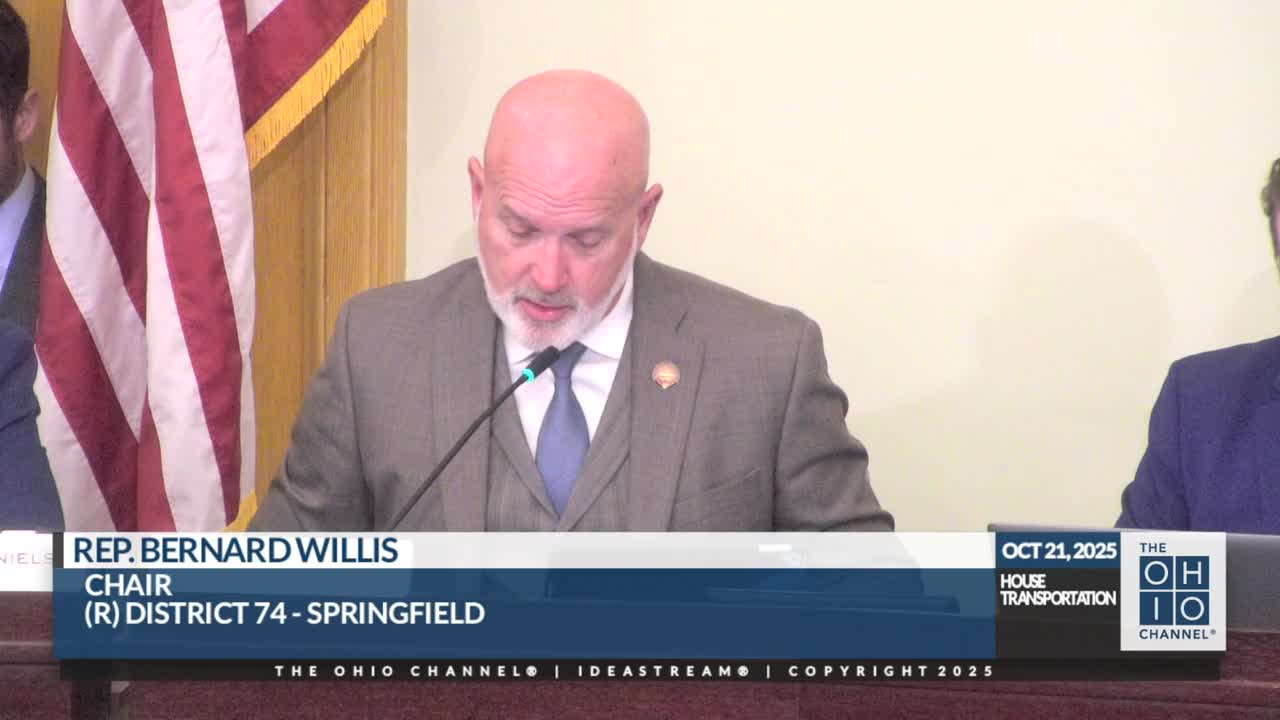
Chairman Willis noted the governor has announced a state app called Road Ready Ohio; in committee discussion Willis said he had downloaded the Road Ready Ohio app and confirmed it was available. Sponsors said the bill would allow either state or approved private apps to be used if DPS certifies they meet safety and performance standards.
Members also pressed broader safety questions about lowering the permitting age to 15, which HB463 proposes so drivers gain experience in all four seasons before licensing. Representative McLean asked whether the state has examined the content and scoring of the driving test itself and whether simulation or other testing changes should accompany earlier permitting. Sponsors said those are policy choices the committee could address later but that the bill’s intent is to increase supervised behind‑the‑wheel time and relieve pressure on overloaded training schools.
Ranking Member Grimm cited crash statistics during questioning, noting that fatal crashes involving 15‑ to 20‑year‑olds rose in 2023 and that teenage drivers historically have higher crash rates and lower seat‑belt use; he asked how the bill would help address those risks. Sponsors responded that verified, high‑quality supervised hours are intended to improve practical training and that parental responsibility remains central.
The measure is a reintroduction of a similar bill from the last general assembly, sponsors said, and they asked the committee to set the bill for further consideration after follow‑up demonstrations and clarifying information from the Department of Public Safety. The committee did not vote on HB463 at the hearing.
Next steps: sponsors offered to arrange an app demonstration for the committee and said they would provide comparative language and background material to staff. The hearing officially concluded as a “first hearing” with no formal action taken.