Get Full Government Meeting Transcripts, Videos, & Alerts Forever!
Get email alerts on the Vehicle Taxation topic
No spam. Unsubscribe anytime.
Sponsors seek to remove $100 registration fee for traditional hybrid vehicles
Summary
Rep. Joe Miller and co-sponsors urged the Transportation Committee to eliminate an added $100 registration fee for traditional hybrids, saying it unfairly penalizes families and small-mileage drivers; the committee heard fiscal projections showing a growing budget impact in 2026–27.
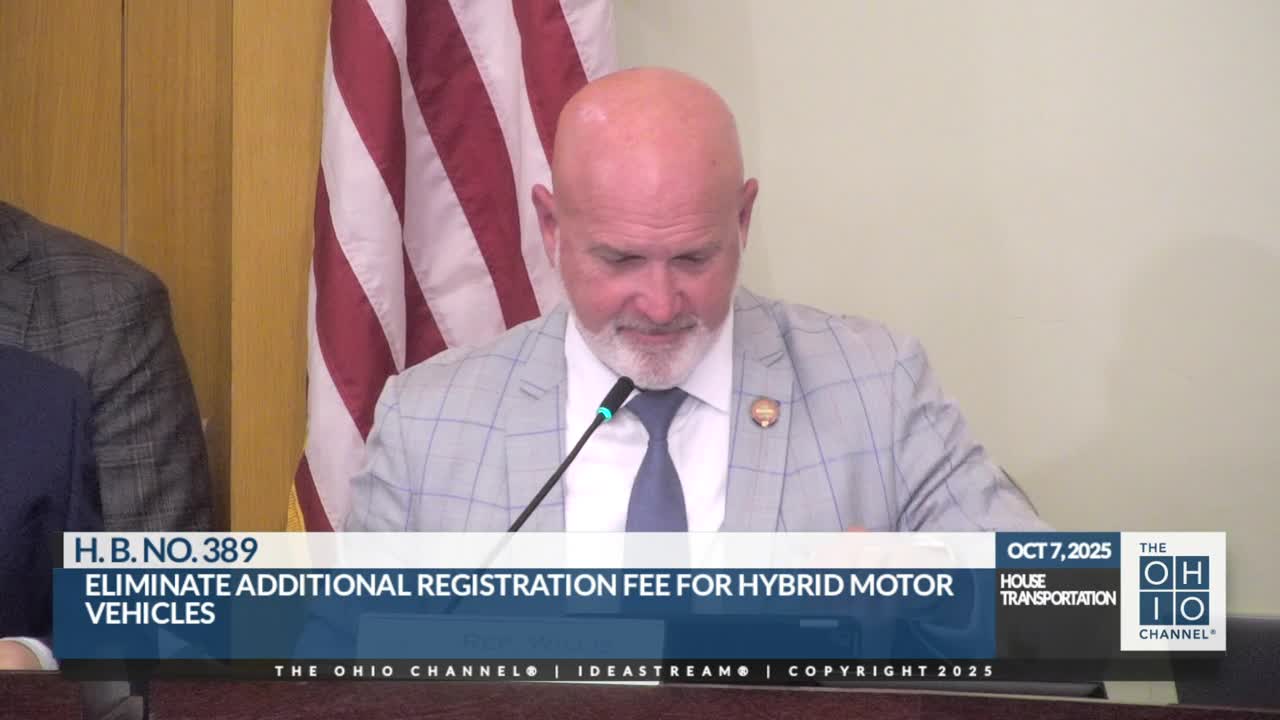
Representatives Joe Miller and David Thomas gave sponsor testimony on Oct. 7 for House Bill 389, a proposal to eliminate an additional $100 annual registration fee imposed on traditional (non‑plug‑in) hybrid vehicles in Ohio.
Miller told the committee that owners of traditional hybrids should not be “double taxed” when their vehicles rely primarily on gasoline and offer only modest fuel‑efficiency improvements through internal hybrid mechanisms. “We cannot afford to let any vehicle contribute to the wear and tear of our roads and bridges without also contributing to their maintenance,” Miller said, but added that the $100 fee applied to some hybrids is unfair when those vehicles still rely on gasoline and pay the state gas tax.
Co‑sponsor Representative Thomas framed the bill as a taxpayer‑fairness measure and recounted constituent complaints, including one example of an older driver who bought a fuel‑efficient older model that was coded as a hybrid and then faced the extra charge. Sponsors emphasized the bill would not change fees for fully electric vehicles or reduce the fee for plug‑in hybrids; it would only remove the additional charge on traditional hybrids.
Committee members asked about fiscal impacts. Staff estimates cited in committee materials forecast an estimated revenue reduction of roughly $13.8 million in fiscal year 2026 and approximately $30 million in fiscal year 2027 if the additional fee were eliminated — a rise sponsors attributed to projected growth in hybrid vehicle sales. Representatives noted market signals — including automakers shifting more models (for example, the Toyota RAV4) to hybrid power — that could increase the impact over time.
Sponsors said the proposal would relieve households that pay both gas tax and the added hybrid registration fee and that they aim to encourage efficient vehicle choices without creating what they described as an unfair penalty for certain hybrid owners. The bill received its first hearing; no committee vote occurred during the Oct. 7 meeting.