Get Full Government Meeting Transcripts, Videos, & Alerts Forever!
Get email alerts on the Driver Licensing topic
No spam. Unsubscribe anytime.
House panel advances bill to exempt certain foreign and military drivers from new driver-training mandate
Summary
The Ohio House Transportation Committee unanimously reported H.B. 434, which would exempt some military and foreign-driver applicants from recently added driver-education requirements and add townships and counties to a drone-for-first-responders grant program. Sponsors asked for an emergency clause to speed the fix.
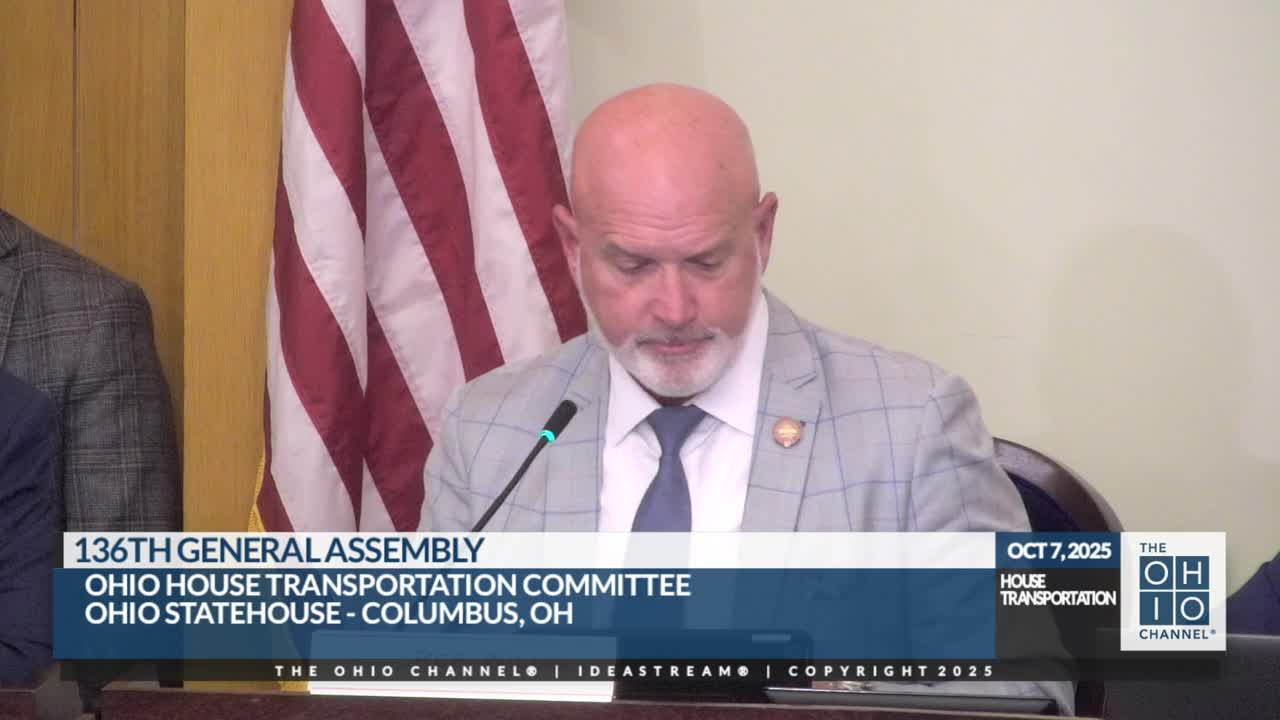
Chairman Willis and his co-sponsors told the House Transportation Committee on Oct. 7 that House Bill 434 is a targeted fix to unintended consequences from this year’s transportation budget that have impeded visiting foreign military personnel and some limited-term license applicants from obtaining Ohio driver’s licenses.
The measure, sponsored by Representative Willis and co‑sponsored by Representative Lampton, would exempt certain limited-term license applicants — notably visiting foreign military personnel who hold valid driver credentials from their home countries and are in Ohio on specific visas — from the newly added driver‑education hours and other driver-training requirements in the prior budget bill. Sponsors also requested an emergency clause to make the change effective immediately.
Committee members were told the rule change in the earlier budget unintentionally required visiting personnel, including foreign military officers assigned to Wright‑Patterson Air Force Base, to complete driver training that is impractical for short‑term visitors. “Who are they going to ride around with? They don’t have any other licensed drivers in their household,” Representative Lampton said, describing why the sponsors consider the training requirement infeasible for many limited‑term arrivals.
David Cordanier, manager of engagement at the Dayton Development Coalition, said the change would particularly affect the Air Force’s Foreign Military Sales (FMS) activity at Wright‑Patterson. He described the program as supporting international partners and said it has a significant economic footprint in the region. Cordanier said the FMS cohort at Wright‑Patterson includes “a little over 100 folks … from approximately 40 countries” and that the program is primarily funded through international contracts rather than state taxpayer dollars.
While presenting the bill, the sponsors also offered amendment 1360851 to correct a separate, related oversight in the transportation budget: the statewide “drone for first responders” grant program was limited to municipalities and did not explicitly allow counties and townships to apply. Vice Chair Daniels moved the amendment, which the committee adopted without objection. The chair explained the amendment would allow townships and counties to apply for Drive Ohio/UAS center grants so local governments outside municipal boundaries can participate in the statewide drone infrastructure build‑out.
After the testimony and brief questions from committee members, Vice Chair Daniels moved that H.B. 434 be favorably reported and recommended for passage. Clerk roll call recorded all voting members present as voting yes and several members excused; the committee reported the bill out unanimously.
Supporters emphasized the change is procedural and aimed at avoiding an administrative barrier to foreign and military personnel who are here for short‑term duties while keeping other safety standards intact. Sponsors said the change should be budget‑neutral and that the primary cost is administrative.
The committee did not hear opposition testimony. With the amendment adopted and the favorable report, H.B. 434 now proceeds out of committee to the next stage of consideration.