Get Full Government Meeting Transcripts, Videos, & Alerts Forever!
Get email alerts on the Education Policy topic
No spam. Unsubscribe anytime.
State Board outlines code changes and funding priorities; committee opens single bill file to review requests
Summary
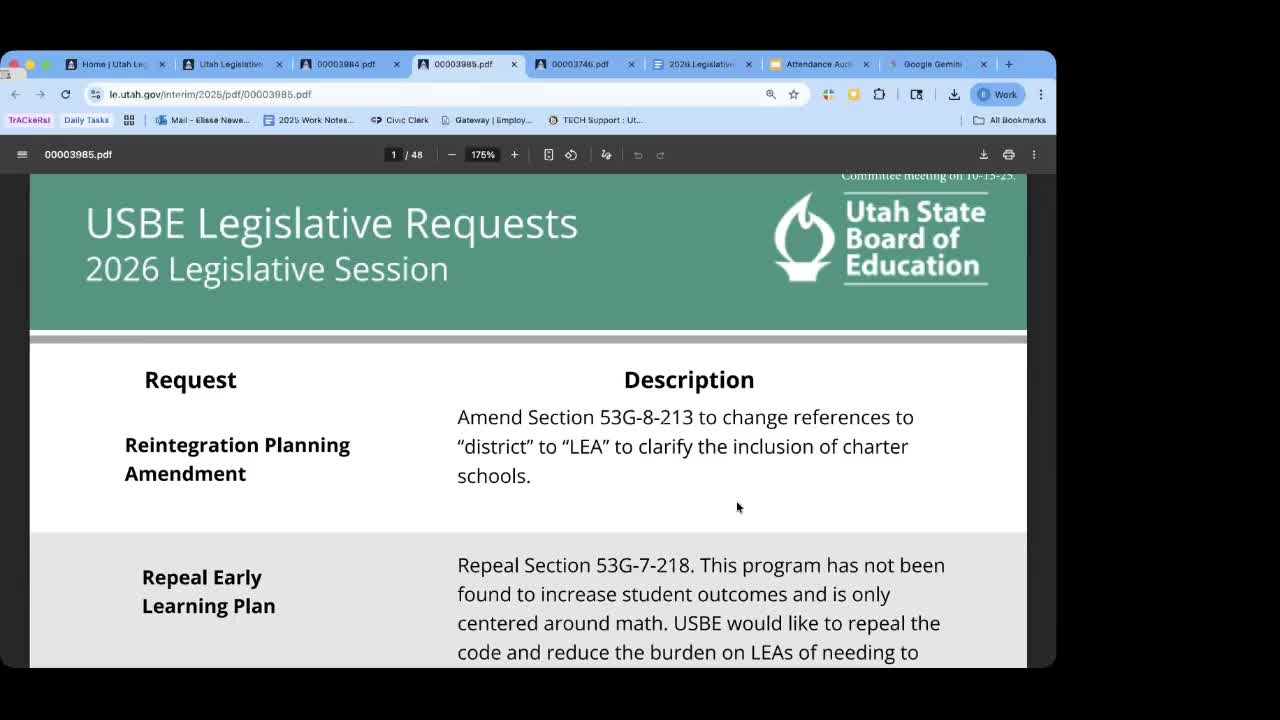
Utah State Board of Education presented a list of code amendments and ranked funding requests to the Education Interim Committee; the committee voted to open a single committee bill file to pursue many of the board’s recommendations while reserving the option to split items later.
The Utah State Board of Education on-site presentation to the Education Interim Committee outlined a package of proposed code amendments and ranked funding requests, and committee members voted to open one committee bill file to review and potentially draft legislation addressing those items.
The presentation was delivered by Matt Hymas, chair of the Utah State Board of Education, and Elise Nooyi, deputy superintendent for policy. Hymas and Nooyi outlined a broad set of requests that ranged from technical code cleanups to program repeals, clarifications of LEA (local education agency) responsibilities, and several funding priorities the board placed in ranked order.
Why it matters: The board’s list proposes changes to statutory language that would affect how districts and charter schools comply with state education law. Committee sponsorship and a committee bill file mean lawmakers will further evaluate, amend, and potentially package several of the board’s items into legislation during the upcoming session.
Key proposals and code changes - Reintegration planning: Amend section 53G-8-213 to standardize references to “LEA” so requirements apply consistently to districts and charter schools. Nooyi said the change is intended to eliminate inconsistent references in separate code sections. - Repeal early learning plan and math-plan requirements: The board proposed repealing code sections (including 53G-7-218 and another math-plan section) the board staff said have not demonstrably increased student outcomes and impose reporting burdens on LEAs. - Suicide prevention and driver education: Minor code tweaks to allow the Utah State Board of Education (USBE) flexibility in distributing appropriated funds for school-based suicide-prevention programs and to dedicate driver education tax-account revenue to driver education administration. - School discipline and seclusion: Continue work with legislators to clarify rules on seclusion rooms and emergency safety interventions (reference: 53G-8-301). - Transportation and USDB funding separation: Request to separate funding for the Utah Schools for the Deaf and the Blind (USDB) from district transportation formulas. - Title program continuation and federal funds: The board asked staff to work with legislators on a revenue-neutral plan to ensure federal Title funds continue to serve intended students and are not reduced in practice. - Charter School Land Trust and school community councils: Amendments to exempt new charters from holding school land trust elections in their first year and clarifications to school community council duties, including documentation when membership is changed and digital-citizenship role alignment. - Students with disabilities: Amend WPU (weighted pupil unit) funding formula language and distribution for students with disabilities and provide language to allow discretion in distributing special-education stipends for additional work days.
Ranked funding requests Nooyi presented USBE’s ranked funding requests (listed from highest priority). Highlights included: - Increase in WPU value: USBE proposed increasing WPU value above the estimated inflationary adjustment (USBE listed a $100 million-plus target to raise the base WPU value). - K–3 paraprofessional classroom excellence grant: A competitive, matching-grant program to hire and train paraprofessionals for K–3 classrooms. - Beverly Taylor Sorensen (BTS) arts program continuation and expansion: Funding to sustain existing BTS schools and expand to up to 23 additional schools from the FY26 wait list. - K–8 literacy and numeracy initiative: Build on science-of-reading work and expand supports for early math; the board described teacher preparation, coaching, and regional supports as components. - USBE internal FTE for capacity and service: Additional staff request linked to audit findings and increased program responsibilities. - Master teacher pilot extension, pupil transportation funding increases, early mathematics assessment contract funding, and continuation of statewide Adobe Creative Cloud licensing.
Committee response and next steps Committee members asked for more detail on multiple items, including the mechanics of the LEA/charter distinction in code, the rationale and evidence for repealing specific programs, and changes to special-education funding. Representative Peterson asked whether changing the term “district” to “LEA” would inadvertently create new requirements for charter schools; Nooyi replied the intent is consistency rather than adding new obligations.
Senator Johnson moved to open a committee bill file to address the board’s requests and invited members with specific concerns to participate in drafting. The motion passed by voice vote; the committee chair announced the motion carried unanimously. Committee staff and USBE will provide more detailed backup materials and staff will coordinate the bill-drafting process with legislators and interested committee members.
What’s next: The committee will use the bill file as a vehicle to work with USBE staff and interested legislators to clarify, revise, or remove items before any final bill is drafted for the legislative session. Nooyi and Hymas indicated USBE is available for follow-up conversations and said detailed backup documents are posted with the committee materials.
Ending: The committee’s decision to open a single bill file does not guarantee all listed items will become legislation; committee members said items that prompt broader debate could be split into separate bills during drafting.