Get Full Government Meeting Transcripts, Videos, & Alerts Forever!
Get email alerts on the Sewer Rates topic
No spam. Unsubscribe anytime.
Greenfield workshop outlines $111.3 million plan to replace aging wastewater plant; rate study goes to council Oct. 14
Summary
City staff told a community workshop the wastewater treatment plant is over capacity and aging, and presented funding scenarios that would require a large sewer rate increase and a Prop 218 protest process if the council approves the rate study at its Oct. 14 meeting.
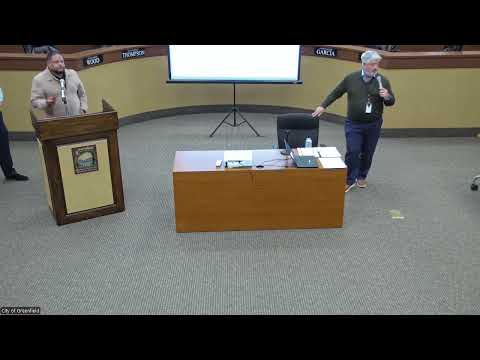
Greenfield City staff told roughly two dozen residents at a community workshop that the city needs to replace its nearly 50-year-old wastewater treatment plant and is seeking a funding package that could total about $111.3 million.
Paul, a city staff presenter, said the proposals are intended to fix failing treatment basins and meet state water-quality permits. “We need $111,300,000,” Paul said, describing two broad funding scenarios and noting the city must pass a sewer rate study to be eligible for large state grants.
Why it matters: the existing plant, built about 1978, is beyond its expected useful life and is operating at or above its permitted daily average. City staff said the plant’s daily permitted flow is about 1.2 million gallons; current average flows are at or slightly above that limit and two developments coming online would add an estimated 89,000 gallons per day when built. Workshop participants repeatedly pressed officials on how the cost and the protest-ballot process would affect renters and people who do not receive utility bills directly.
City staff described three financing scenarios. The “best case” assumes a large state grant of about $75 million plus a low-interest state loan of roughly $36 million; staff called that the lowest-cost outcome for ratepayers. Under a “worst case” scenario staff said the city would rely mainly on loans: a state loan up to $50 million plus additional market-rate borrowing. The exact market-rate loan amount was not specified at the workshop. Paul said the city will still have to borrow money under any scenario and that passing the rate study is required to be eligible for major grants.
How payors would be affected: the rate study proposes replacing the current fixed-only structure with a combination of a fixed charge and a usage-based charge tied to water consumption. Staff said single-family residential accounts would be capped in the rate calculation at 5,000 gallons per month (the study’s estimate of average sewer-relevant use for single-family homes). Examples shown at the workshop: a proposed fixed charge of $34.99 plus a variable charge of $11.25 per 1,000 gallons would produce a bill of about $91.24 for a single-family home using the 5,000-gallon cap — roughly $27.88 more than current charges under the study’s Year‑1 numbers. Workshop presenters said the aggregate effect would be a very large first-year increase (staff estimated roughly a 60–65% increase across categories in year one under the scenarios shown).
Staff said multifamily and commercial accounts have no comparable usage cap in the proposed structure and therefore would generally see much larger increases if their measured water usage is high; workshop examples showed significantly higher bills for large multifamily or commercial meters. Staff emphasized the study aims to align charges with contribution to flows through the treatment plant so users who generate more wastewater pay more of the upgrade costs.
Process and timeline: the workshop reiterated the next steps. City staff said the City Council is scheduled to consider and possibly adopt the sewer rate study at its Oct. 14 council meeting. If the council adopts the study, the city would proceed with a Prop 218 protest-ballot process (staff described it as a 45-day protest period during which property owners and utility account holders may return a protest ballot); the process is commonly used in California to challenge property-related fee increases. Staff said the city clerk counts the protest ballots and that prior Prop 218 procedures have been used by the city.
Residents’ concerns: many speakers asked about fairness for renters, who typically do not receive utility bills directly. Multiple commenters said landlords, not tenants, often receive bills and ballots; residents worried tenants could be responsible for higher rents without having the ability to participate in the protest process. Staff’s response was that the Prop 218 protest ballots are mailed to property owners and to utility-billing account holders and that state law prescribes the protest-ballot mechanics; staff said the city cannot compel landlords and tenants to resolve internal rent-billing arrangements. Residents also raised the clarity of Spanish interpretation at the meeting and requested clearer, written breakdowns for how the proposed rates were calculated.
Technical and compliance background: staff described recurring overflows, eroding berms, and other operational strains. Jamie, a city operations staff member, and Tony Nisich, an engineer on the study team, explained the proposed replacement would be a modular membrane bioreactor (MBR) plant. Tony said the MBR design was selected because it has a smaller footprint, produces a higher-quality effluent and recycled water that the State Water Board favors, and can be expanded modularly in future decades. Staff estimated construction completion under current planning assumptions by 2029.
Grants and other funding: staff said the city is preparing a state grant application and pursuing other grant opportunities (including a state climate bond referenced during the workshop). Paul told attendees the city has already invested in planning and design and has spent about $4 million on design and environmental work to reach 90% plans. Staff said they will finalize the grant application after council action and return to the public with updated cost and rate estimates once grant/loan award amounts are known.
What was not decided: no final council approval or rate adoption occurred at the workshop. The council’s Oct. 14 consideration is the next formal decision point; the workshop was an informational and public-comment session. Several residents asked for additional public meetings and for the city to publish the underlying account-level data used in the study; staff said some of those data are available and that the firm that prepared the study can provide details upon request.
Ending note: city staff urged residents to attend or watch the Oct. 14 council meeting to hear the formal council action. Staff also repeated that failing to adopt a rate study would forfeit eligibility for the large state grant the city has targeted, which staff said would make the upgrade considerably more expensive for ratepayers.