Get Full Government Meeting Transcripts, Videos, & Alerts Forever!
Get email alerts on the Ica Remediation topic
No spam. Unsubscribe anytime.
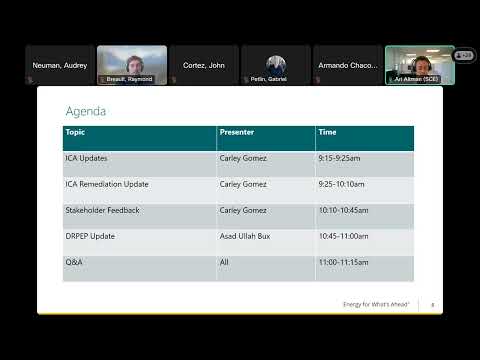
SCE outlines remediation schedule for inactive ICA circuits, previews portal changes
Summary
Southern California Edison presented a remediation plan for inactive Integrated Capacity Analysis (ICA) circuits, reported progress on clearing several criteria that caused missing ICA results, and previewed updates to its DRP external portal (Doctor Pepp). SCE said most remaining inactive circuits will be cleared by year-end 2025 or in 2026 for a
Southern California Edison told a California Public Utilities Commission workshop that it has proposed an aggressive remediation plan to fix known causes of missing or erroneous Integrated Capacity Analysis results and has already cleared many affected circuits.
SCE case manager Ari Altman and engineer Carly Gomez described a five‑category “inactive criteria” list SCE developed after a 2023 systemwide refresh and root‑cause analysis. The company said it submitted the remediation plan in Advice 56‑14‑E on Aug. 26 and that the advice letter established a schedule SCE is now using as a baseline for monthly and biannual reporting.
SCE said it has reactivated substantial numbers of circuits since submitting the advice letter. The company reported that as of Sept. 30 it had 689 inactive circuits remaining and that it had fully remediated and republished 325 circuits since the prior update. SCE listed the following counts and target dates for the five criteria it cited: child‑substation data gaps (177 circuits identified at filing; 64 circuits cleared as of Sept. 30; SCE targets full remediation by Dec. 31, 2025), loop‑fed child substations (243 circuits identified; 1 cleared; new long‑term tooling planned with target availability in Q3 2026), primary‑meter customer data (356 circuits cleared as of Sept. 30; remaining instances targeted for Dec. 31, 2025), and technical/run‑time limitations (56 circuits identified at filing; 1 cleared as of Sept. 30; remaining cases targeted by Dec. 31, 2025). SCE told the workshop it has already reactivated 272 primary‑meter circuits, 44 child‑substation circuits and 18 circuits that had both issues. SCE also said 10 circuits became ICA‑ineligible and two were reclassified as no longer part of loop systems.
SCE presenters emphasized that “reactivation” of a circuit does not automatically mean immediate publication of ICA results. Carly Gomez explained that reactivated circuits are queued for analysis and publication after modeling and validation are completed.
SCE also addressed stakeholder comments about ICA accuracy and the frequency of zero‑capacity results. “We affirmed the accuracy of the published ICA results,” Gomez told attendees, and added that SCE’s results‑validation process uses automated and manual checks of each zero‑capacity hour against the adopted CPUC methodology. SCE said that the ICA methodology, as adopted by the commission, is conservative by design and that the company is developing a forward‑looking “forecast load ICA” capability to produce more planning‑oriented ("as‑planned") results; SCE said that capability is targeted for deployment in 2026.
Doctor Pepp (SCE’s DRP external portal) updates: SCE product lead Assad Bucks previewed recent and upcoming portal changes. SCE said it has changed downloadable ICA load‑profile units to megawatts, added a publish‑date field to downloads, introduced a megawatt/amp toggle on profile widgets, and added a disclaimer on the available load capacity (ALC) layer to flag circuits with duct‑bank constraints. SCE also said it repaired several bugs since August (including a broken bulk‑download link and an outdated support email), removed legacy or redundant fields from certain reports, and is targeting a fix for distribution‑socket omissions by Oct. 17. Bucks said SCE will add a sub‑transmission line capacity layer by 2026 and additional ICA sublayers and widget improvements later this year.
Why it matters: SCE’s update provides a detailed schedule and per‑criteria counts that stakeholders and the commission can use to track remediation progress. The company’s timeline ties short‑term fixes to longer‑term tool development (for example, the long‑term planning and system‑modeling tool SCE is building to analyze looped networks), while portal refinements aim to make results and provenance clearer to developers and local planners.
What remains open: Stakeholders repeatedly pressed the company on the interpretation of certain zero‑capacity results and on how quickly changed circuits are refreshed on the portal; multiple stakeholders urged clearer reporting that ties ICA results to interconnection or energization outcomes. SCE said it will continue monthly QA/QC and the biannual reporting required by the commission and described the advice‑letter filing as the baseline for that work.
Speakers quoted in this article are all from the meeting transcript and include Ari Altman, SCE case manager; Carly Gomez, engineer, SCE ICA team; Assad Bucks, SCE product lead (Doctor Pepp).