Get Full Government Meeting Transcripts, Videos, & Alerts Forever!
Get email alerts on the School Schedule Pathways topic
No spam. Unsubscribe anytime.
Stillwater schools propose modified 7x2 schedule to expand pathways, add credits and staff
Summary
Stillwater Area High School leaders presented a proposal to the Stillwater Area Public Schools Board of Education on expanding student opportunities by moving from the current six-period (6x2) day to a modified seven-period, two-semester (7x2) schedule.
Stillwater Area High School leaders presented a proposal to the Stillwater Area Public Schools Board of Education on expanding student opportunities by moving from the current six-period (6x2) day to a modified seven-period, two-semester (7x2) schedule.
The proposal, delivered by Principal Rob Bach and assistant principal Matt Craft, aims to add two credit-bearing course slots per student year (14 course slots under 7x2 versus 12 under 6x2), create more access to pathways sequences (introductory → intermediate → advanced), offer an option for students to graduate with an Associate of Arts degree on campus and launch a district-run online academy. "We are gonna be talking about expanding opportunities at Stillwater Area High School," Chair Sherman said when the study session opened.
Why it matters: district staff said the schedule change would give students more elective choices, allow dedicated flex time for tutoring, internships and social-emotional learning, improve recapture of students now taking outside college courses, and support workforce-aligned programming such as healthcare certifications and cybersecurity. School counselors and pathway leads told the board that students entering college are more successful when they have embedded early college or transcripted credits in high-school pathways.
What the school presented: Rachel Stile, Journalism Teacher and Career Pathways Coordinator, described a reworked Pathways model that now lists six pathways and a need for more entry-level course options (for example in computer science) so students need not jump straight into AP. School Counselor Sydney Pyra outlined progress toward offering an on-site Associate of Arts (AA) degree by coordinating courses that meet the Minnesota Transfer Curriculum and local concurrent-enrollment partnerships. Bach and Craft said the modified 7x2 preserves year-long courses such as U.S. history while increasing daily block-style time for deeper instruction and a regular flex period for interventions and experiential learning.
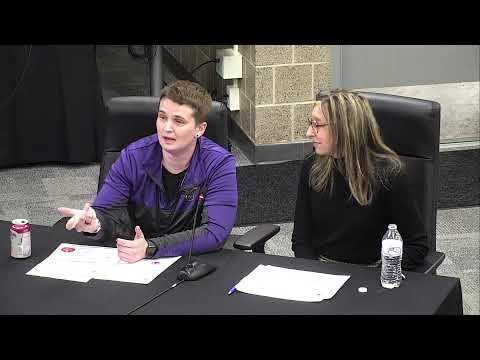
Student reaction: Students on the panel said they favored the increased elective access. "I think it gives the opportunity not only to have more electives but then also to stretch it out so it's less stressful," Katie (student council junior) said. Student Zach, a band and language student, said longer periods felt manageable during site visits and that flex blocks could make it easier for students with after-school athletics to join clubs.
Costs and staffing: District staff told the board the schedule will require additional staffing. Using current enrollment (about 2,700 students) and projected class-request math, administrators estimated an increase of roughly six full-time equivalent teachers to run the schedule as modeled, producing a ballpark annual personnel cost of about $800,000. The administration also estimated about $1,000 per new course for curriculum writing (they have identified about 18 priority new courses, roughly $18,000 total for writing), material/resource start-up costs (ballpark $35,000), and potential concurrent-enrollment fees (which administrators said can often be offset by grants such as Perkins or Office of Higher Education opportunities).
Performance and recapture: The presentation cited internal pass-rate contrasts for online coursework: on-campus concurrent/PSEO online non-passing rates were estimated at about 2.7%, while PSEO online sections (outside vendors) were failing at roughly 15% and outside vendors at about 19%. District leaders argued that offering more on-campus concurrent enrollment and an online academy run by the district could improve student success and keep funding and credit opportunities inside the district.
Next steps and governance: Administrators said they will bring formal proposals to the board for updated graduation requirements and specific course approvals. The district plans to vet course proposals with the District Advisory Council (meeting referenced as Monday the 13th in the presentation) before returning to the board. Dr. Fung noted that schedule design is normally implemented at the school/administrative level while the board retains oversight of graduation requirements and budget implications. No board vote was taken during the study session.
Discussion highlights and outstanding questions: Board members pressed on student workload, how colleges will view course percentages, professional development needs to teach longer blocks well, and the budgetary trade-offs. Administrators said the district will need to define power standards for instruction to avoid breadth-for-breadth's-sake reductions in rigor and will use built-in professional-development days and targeted training/site visits to support teachers. Director Parker asked how the change might affect high-performing students' course loads and sought a clear timeline and process for public feedback and a formal proposal.
What remains unresolved: The board has not adopted graduation requirement changes; administrators said any change would need to account for cohorts being on mixed schedules during a transition year (seniors through ninth graders would have different schedules during the roll-out). Details such as precise bell times, where flex and lunch fall, and exact staffing ratios remain to be finalized.
The board closed the study session without action. Administrators said they will return with a package that includes a proposed graduation requirement update, finalized course proposals for concurrent enrollment and pathway sequences, professional-development plans and a budget impact analysis to be considered in upcoming budget-priority conversations.