Get Full Government Meeting Transcripts, Videos, & Alerts Forever!
Get email alerts on the Healthcare Insurance Claims topic
No spam. Unsubscribe anytime.
Chesapeake Healthcare urges state help as insurers delay FQHC claims, warns of funding gap
Summary
Chesapeake Healthcare CEO told the Eastern Shore delegation on Feb. 21 that commercial insurers and Medicaid managed-care plans have repeatedly delayed or denied claims, that rate negotiations with CareFirst stalled and that chronic federal underfunding leaves the federally qualified health center financially exposed.
Brian Holland, CEO of Chesapeake Healthcare, told the Eastern Shore delegation on Feb. 21 that his federally qualified health center is facing prolonged unpaid claims, stalled rate negotiations with CareFirst and chronic federal underfunding that together threaten service access on the Lower Shore.
Holland said the clinic had the ‘‘same old responses’’ from insurers after an initial burst of attention: billing questions routed elsewhere, long timelines for resolution and repeated denials for administrative reasons. He said ‘‘we still haven’t received an answer about the behavioral health claims for their Medicare Advantage product’’ and that roughly 10 months of claims remained unpaid because the insurer did not advise the clinic of required billing steps.
The problem, Holland said, extends beyond CareFirst to a range of commercial carriers and Medicaid managed-care organizations (MCOs). He described coordination-of-benefits denials where carriers refuse claims because a secondary policy is present or because a patient’s coverage has lapsed; demographic mismatches (wrong birth date, name punctuation) that carriers refuse to let the health center correct; and MCOs not following state Department of Health transmittals on vaccine payments and minor behavioral-health services performed in primary care.
‘‘A lot of carriers are kicking back claims saying you need to build a primary carrier,’’ Holland said. ‘‘A lot of the MCOs aren’t following the rules with coordination of benefits…they’re not following the timelines for doing those take-backs.’’ He added that some companies’ payment-integrity divisions have attempted recoupments as old as six years, beyond the timeframes he said are required.
Holland reported that recent rate negotiations with CareFirst stalled after CareFirst provided a proposed fee schedule that, when analyzed, reduced total payments: ‘‘the fees that they were proposing were actually a thousand dollar decrease than what we were already getting,’’ he said. He said he had revised the schedule and followed up multiple times without substantive response and that Chesapeake is considering ‘‘unsigning’’ the plan — a move Holland said would negatively affect many patients.
He also outlined structural pressures on the health center: Chesapeake said it provides roughly $8,760,000 in uncompensated care while receiving approximately $3,000,000 in federal grant funding, and that its federal funding works out to about $50 per patient — compared with other centers that receive more than $1,400 per patient in federal grants, Holland said. He told the delegation that the federal grant supplies only about 3% of the center’s budget and that reductions in Medicaid coverage or increases in uninsured rates would exacerbate an already ‘‘dire situation’’ on the shore.
Holland raised a separate federal/ state licensure problem affecting recruitment: he said CMS will not recognize certain out-of-state licenses for providers who live in neighboring Delaware but work at the Maryland-based clinic, while Maryland will not issue a Maryland license because the clinician resides in Delaware. ‘‘We pull providers from the Eastern Shore of Virginia and Delaware, so that’s an issue for us in recruiting and retaining providers on the Lower Shore,’’ he said.
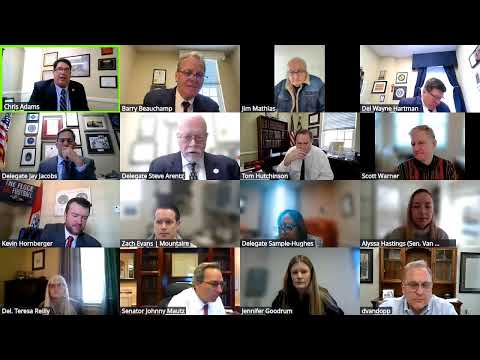
Delegation members said they would follow up. Delegate Hutchinson asked about the two pending dental compact bills (House Bill 45 and House Bill 534) and requested the clinic’s view on how compact language affects billing; Holland said he would follow up. Chair Adams and other members said the delegation would work with Chesapeake and draft a letter to appropriate parties within 7–10 days.
Why it matters: Chesapeake Healthcare is a primary provider on the Lower Shore; payment delays, contract disputes and chronic underfunding can reduce access to primary and behavioral-health services for rural residents. Delegates said they would pursue follow-up meetings and potential advocacy with insurers and state and federal partners.
The transcript shows the presentation began after the meeting call and concluded before later agenda items; the delegation recorded questions from Delegates Hutchinson, Sample Hughes and others about reimbursement, compacts and recruitment.
Ending: Delegation members promised to draft a joint letter and meet with Chesapeake and other stakeholders; Chesapeake said it would provide requested analyses and follow up on the dental-compact bills.