Get Full Government Meeting Transcripts, Videos, & Alerts Forever!
Get email alerts on the Residential Development topic
No spam. Unsubscribe anytime.
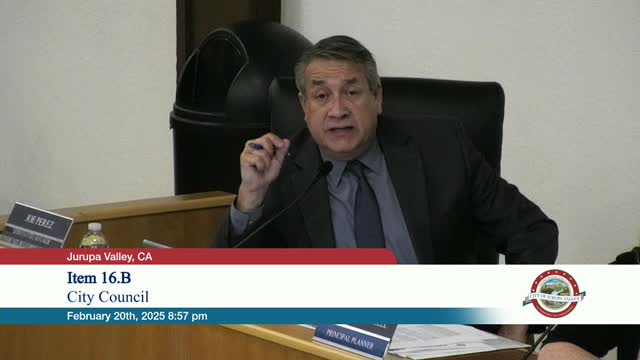
Council upholds planning commission denial of 67‑unit Wilmington residential plan at Camino Real
Summary
After months of debate, the council voted unanimously to deny a proposed 67‑unit development at Camino Real and Jurupa Road, citing pedestrian safety, traffic and neighborhood character; staff estimated at least $2.5 million in off‑site road and railroad‑related improvements would be needed if the project were approved.
The Jurupa Valley City Council on Thursday voted unanimously to deny Warmington Residential’s proposed 67‑unit development at the southwest corner of Camino Real and Jurupa Road, rejecting the developer’s request for two‑story units and related waivers.
Councilmembers said safety, traffic and neighborhood character drove their decision. Councilmember Armando Carmona noted that multiple residents had reported traffic collisions and near‑misses in the area: "The safety of our children is nonnegotiable," he said during public comment, repeating several speakers’ appeals to delay or reject the project until a comprehensive safety plan is in place.
Nut graf: The project had been partially entitled under previous rezonings, but the planning commission denied the proposal. The developer asked the council to overrule that denial and to grant waivers to allow denser, two‑story construction; the council instead directed staff to return a denial resolution after extensive public testimony and staff briefings.
Traffic, railroad and cost concerns: City staff and councilmembers cited significant off‑site work the city would need to pay or manage if the development moved forward without negotiated mitigation. Public works staff gave a rough cost estimate for widening and signal/railroad work at the intersection and for spillway/road widening south of the site: "Rough numbers…we are looking at over $1.6 to $1.8 million" for intersection/railroad‑signal work, and roughly $800,000 to $900,000 for the spillway portion, Paul Toor, principal engineer, told council—"so you're gonna go over $2.5 million at the bare minimum just to get out the door." Council members repeatedly said those costs underscored the project's local impacts.
Developer response and council reasoning: The applicant said it would build frontage improvements across its parcel—adding sidewalks, landscaping and widening where it can—but that the spillway and some railroad‑adjacent work lie off the applicant's property and are identified in the city's capital improvement program. The developer's representative asked the council to approve the project but said removing the two‑story component would make the project infeasible. Council members said the combination of the site’s constrained geometry, existing traffic patterns, proximity to schools (Camino Real, Patriot and Harupa Middle School) and rail crossings made the waivers and density requested unacceptable without stronger, guaranteed mitigation.
Vote and next steps: The council directed staff to prepare a formal denial resolution that would reflect the concerns heard from residents and staff. The motion to deny passed unanimously on a roll call vote. Staff will return a formal resolution for the council record.
Ending: Councilmembers said the decision reflected both local safety priorities and caution about state density incentives that can accelerate development without local infrastructure funding. Councilmembers urged staff to study site‑by‑site mitigation priorities and return with options to address corridor safety.