Get Full Government Meeting Transcripts, Videos, & Alerts Forever!
Get email alerts on the Hunger Survey topic
No spam. Unsubscribe anytime.
New statewide survey: 1 in 5 Minnesota households experience food insecurity, Second Harvest Heartland tells Senate committee
Summary
Second Harvest Heartland and The Food Group presented results from a 20,000-household Wilder Research survey showing 20% of Minnesota households face food insecurity and highlighting gaps in federal data and regional disparities across the state.
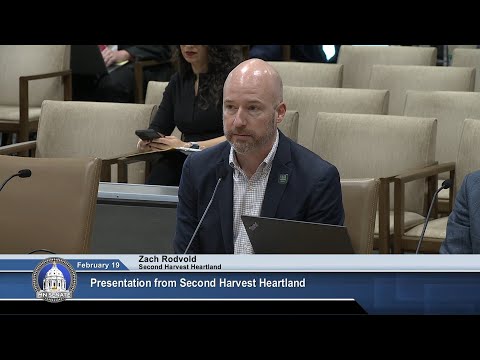
Zach Rodvold, director of public affairs at Second Harvest Heartland, told the Minnesota Senate Health and Human Services Committee on Feb. 19 that a new household survey shows 1 in 5 Minnesota households are food insecure.
Rodvold said the food bank and partner Wilder Research surveyed 20,000 randomly selected households around the state and found food insecurity is larger than USDA figures suggest because federal data lag and use smaller samples. “1 in 5 Minnesota households are food insecure, meaning that they, weren't able to receive enough food without assistance,” Rodvold said.
Nut graf: The Wilder household survey gives committee members more recent and more granular data than the USDA releases, and it frames the emergency food demands that lawmakers and hunger-relief organizations are trying to address this legislative session.
Rodvold and Peter Whytock, government relations manager with The Food Group, described a three-part continuum revealed by the survey: about 2% of households experienced hunger in the past year and received no emergency food or benefits; 5% experienced hunger but did receive some services; and 13% had enough food only because of assistance from the hunger relief network or public programs — a combined 18% of households that the hunger-relief network is supporting. Rodvold called the third group “new to the conversation” and said the data show many Minnesotans have enough food only because of assistance.
The survey also highlighted disparities: households in which English is not a primary language reported lower food security (48% food secure by the survey), households including at least one person of color were 60% food secure, and households with children were 74% food secure. Rodvold said the hunger challenge is widespread across regions, with some differences in the Northwest, Northland and Southwest regions.
Whytock added that food-shelf visits are a real-time measure of need: Minnesota food shelves recorded nearly 9 million visits in 2024, up from 7.5 million in 2023 and 5.5 million in 2022, and that children were the fastest-growing group visiting shelves. “The number of food shelf visits are really a measure of the size of the response of hunger,” Whytock said.
Both presenters warned that possible federal cuts to nutrition programs, including SNAP, could drive more people to food shelves. Rodvold noted that SNAP provides far more meals statewide than food banks do and that reductions in federal benefits would increase demand on emergency food providers and local economies.
Ending: Committee members heard the presentations ahead of several hunger-related bills on the committee agenda and laid multiple bills over for possible inclusion; the survey data were cited by several testifiers during those bill discussions.