Get Full Government Meeting Transcripts, Videos, & Alerts Forever!
Get email alerts on the Public Safety Police Hiring topic
No spam. Unsubscribe anytime.
Dallas leaders hear plan to recruit 300 police officers; officials flag $10 million near‑term budget gap
Summary
City staff briefed the Dallas City Council on a proposal to increase police recruiting to 300 officers this fiscal year, describing retention incentives and recruiting gains while warning of a roughly $10 million cumulative budget gap to fund the expansion without additional offsets or grants.
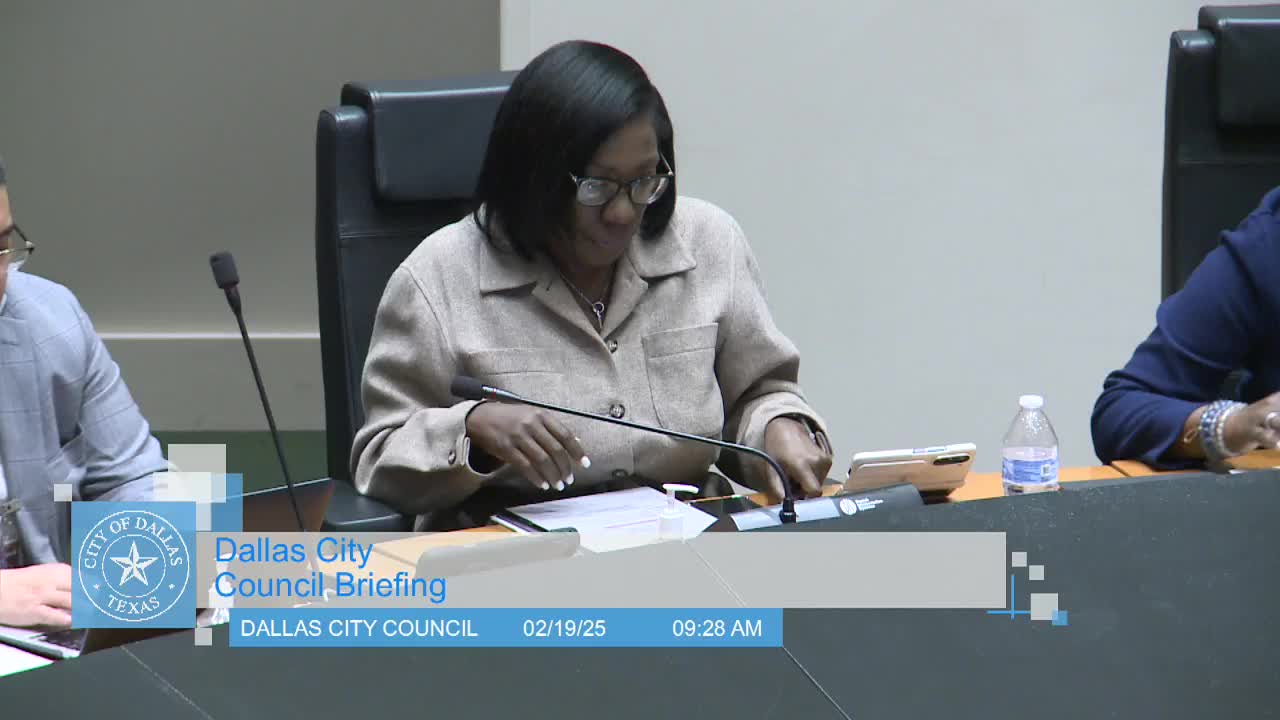
Interim Police Chief Mike Igoe told the Dallas City Council on Feb. 19 that he will seek approval to recruit 300 officers in the current fiscal year as part of a phased approach to growing the department.
Igoe said the goal balances immediate workforce needs with fiscal responsibility: "I'm gonna propose the hiring of 300 officers for this fiscal year," he said during the briefing, and asked the council to back the step as a strategic, measurable next phase.
The council was presented data by Martin Rios Jr., a city finance director supporting the department, who said departmental incentives and recruiting changes have increased class sizes and reduced overtime. Rios said, "we are using less overtime hours, 9.3% less than last year," and described a current-year operating shortfall tied to higher-than-budgeted headcount: "Our current financial gap is $5,400,000," he said, and projected the cumulative cost of moving from the budgeted hiring goal to 300 officers at about $10,000,000.
Why it matters: Dallas Police Department (DPD) leaders said more sworn officers would aim to improve response times and community presence in a city that continues to add residents. Staff described a phased hiring plan to minimize service disruptions while expanding recruits, combined with retention pay and referral bonuses to stabilize attrition.
What officials told council - Rios and other staff outlined several recruiting and retention initiatives: a pilot career‑path program for patrol officers to rotate through investigative, professional development and operational tracks; a sick‑leave exchange that allows officers with accrued sick time to convert some hours to pay; and a uniform referral pilot that pays officers when recruits they refer finish training and probation. - Chief Igoe said promotions and investments in training and gate/security maintenance are part of keeping overtime and station security costs down. He noted that filling more positions now changes near‑term budget needs because the adopted budget had planned for fewer officers.
Costs and timing - Staff showed three budget scenarios: the adopted hiring goal (250) carries a current-year gap of about $5.4 million; increasing to 300 carries an estimated cumulative impact of about $10.0 million; increasing to 325 would raise the cumulative impact to about $12.3 million. The presentation noted those figures exclude some additional support staff and onboarding overtime that could be required as headcount grows. - Staff described a hiring cadence of roughly six academy classes per year and said recent recruiting changes raised average class size from about 26 to about 50 recruits, putting the department on pace for about 300 hires annually if current trends hold.
Operational considerations and council questions - Council members repeatedly asked how quickly new recruits can affect patrol strength. Staff explained the academy plus field‑training timeline (academy followed by phased field training) and emphasized there will be a lag between hires and independent patrol capacity. Chief Igoe said parts of training (field training officer phases and reality‑based training) require sworn instructors; if the city scales above 300 quickly, the department would need to reassign roughly 40 sworn personnel from patrol to training in the near term to staff the expanded classes unless additional instructors are hired or the training facility capacity changes. - Council members pressed for fuller, synchronized budget estimates that include support staff, kit/uniform costs and vehicle needs. Staff said those additional costs would be modeled during the budget cycle and that some one‑time needs (uniforms, equipment) and recurring costs (instructors, FTOs, professional support staff) are likely to rise as sworn headcount grows.
What’s next - The briefing was informational; no vote was taken. City staff said they will return with detailed budget and implementation requests during the upcoming budget cycle and recommended treating 300 hires this fiscal year as a pilot phase to be reassessed before committing to larger multi‑year increases.
Ending note - Council members expressed support for hiring growth but also urged careful fiscal modeling and clear public communication about timing and tradeoffs (for example, temporary reassignments from patrol for training). Chief Igoe and his team said they will continue refining projections and return with more detail for the budget process.