Get Full Government Meeting Transcripts, Videos, & Alerts Forever!
Get email alerts on the School Restrooms topic
No spam. Unsubscribe anytime.
Committee advances bill requiring sex‑designated multi‑occupancy restrooms in public schools after heated testimony
Summary
Senate File 62, sponsored by Sen. Dan Larson, would require public school districts to designate multi‑occupancy restrooms and changing rooms by sex assigned at birth and offer reasonable single‑occupancy accommodations; the House Labor, Health & Social Services Committee advanced the bill after amendment.
Senator Dan Larson told the House Labor, Health & Social Services Committee that Senate File 62 would require each public school district to designate multiple‑occupancy restrooms and changing rooms for exclusive use by the male or female sex as defined in existing state statute, and to provide reasonable accommodations such as single‑occupancy restrooms.
Larson described the bill as a response to incidents in his area, saying a parent reported that “there was a male student that was in the bathroom” and that some girls “would just not even go to the restroom, you know, all day almost.” He acknowledged the proposal resembles measures adopted in other states and noted litigation is pending in some jurisdictions that adopted similar laws.
The bill defines “multiple‑occupancy restroom or changing room” and borrows the statute’s definition of sex assigned at birth to read: “biological, physical condition of being male or female, determined by an individual's genetics and anatomy at birth,” as cited in the sponsor’s remarks. The Senate added several provisions, Larson said, including conditions under which an adult (coach or staff) may enter opposite‑sex locker rooms for custodial, maintenance or emergency reasons, and a section allowing coaches to enter locker rooms for school‑sponsored athletic activities if certain conditions are met.
Senator Larson told the committee the Senate removed a proposed accreditation penalty but retained a private right of action: “a parent or legal guardian of a student… shall have cause of action if the school board doesn't do this,” he said. He added the Senate had debated penalties and removed an accreditation‑loss provision as likely to jeopardize the bill.
Public testimony was sharply divided. Carrie Peters, a parent from Powell, testified in support and urged the committee to “keep some teeth in there,” saying local school officials ignored parent suggestions and that without state action “the safety and comfort of girls and young women in Wyoming will continue to be ignored.”
Santi Murillo, communications coordinator for Wyoming Equality and a high‑school coach, testified in opposition. Murillo said the bill “would require transgender individuals like me to use the restrooms that align with our sex at birth” and argued the measure would undermine local control and could force transgender coaches to use facilities where they feel unsafe.
Tina Johnson of Moms for Liberty testified in support and urged adding a clear complaint and investigation process so schools face accountability for violations.
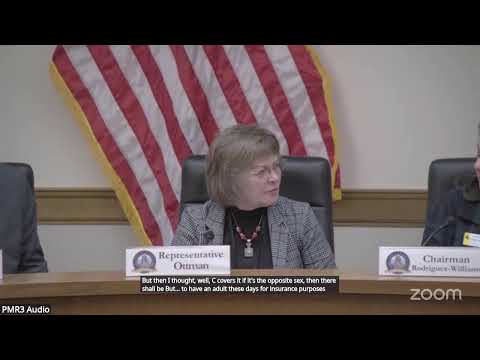
Committee debate focused on specific language. Representative Bien moved to strike lines 12–13 on page 4 (a Senate amendment that changed “shall” to “may” regarding whether a coach may be accompanied by an additional adult); that deletion motion failed on voice vote. Later Representative Otman moved to restore “shall” (making the accompaniment a requirement); that amendment passed and was folded into the committee’s version of the bill.
Representative Guggenhaus moved the bill from the committee; Representative McCann seconded. On the roll call the committee approved the amended Senate File 62: 6 ayes, 1 no, 2 excused. Committee discussion and the record show continued concern about potential legal challenges, local control, and practical implementation (for example, visiting teams and co‑ed athletic programs), and senators and representatives proposed multiple drafting clarifications to address those operational concerns.
The committee sent the bill to the House floor with the sponsor’s request that a House member carry the measure and with the record showing both supportive and opposing public testimony.