Get Full Government Meeting Transcripts, Videos, & Alerts Forever!
Get email alerts on the Cdbg Funding Recommendations topic
No spam. Unsubscribe anytime.
Committee recommends CDBG public-service allocations, opts to prioritize rental assistance over down-payment funding
Summary
The committee recommended staff’s funding scenario for CDBG public services, heard presentations from applicants including Tulsa United Way, Youth at Heart and Housing Solutions, and directed contingencies that would favor rental assistance over down-payment assistance if allocations decrease.
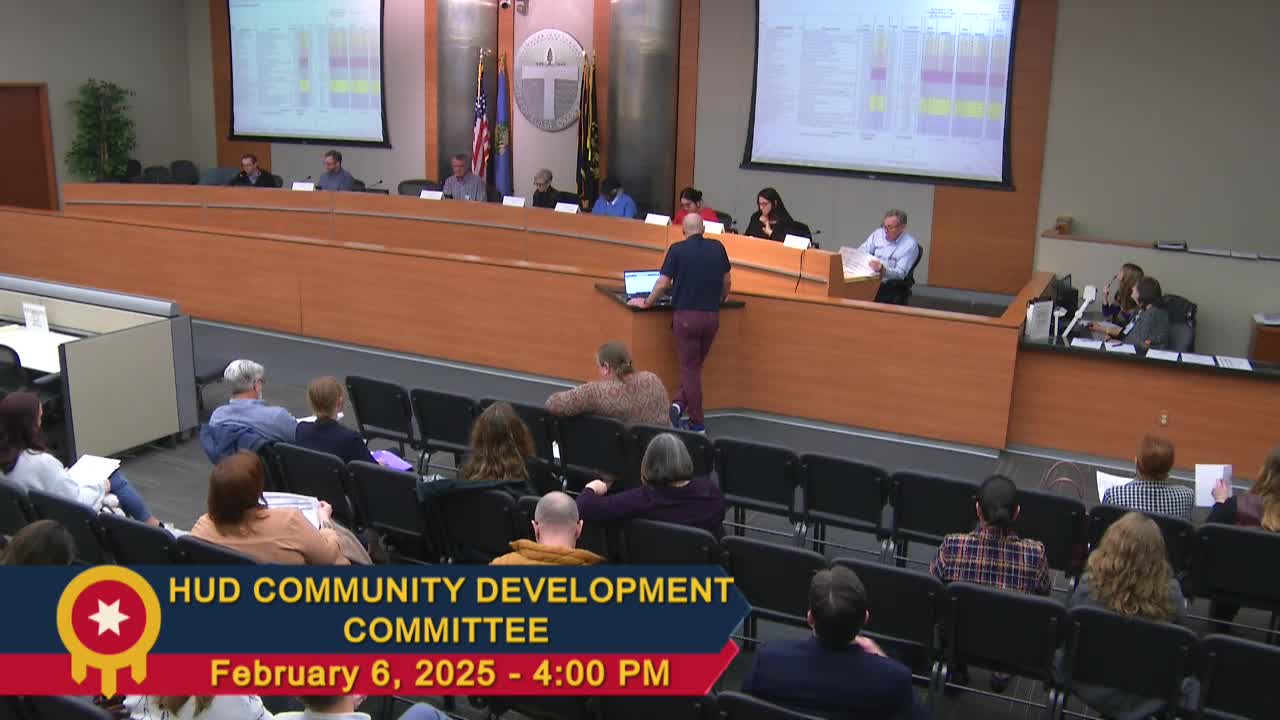
The Housing and Urban Development Community Development Committee reviewed CDBG, HOME, HOPWA and ESG funding scenarios, heard presentations from applicant organizations and recommended the staff’s funding plan (scenario 4) for the committee’s funding recommendations.
Grants administration presented six allocation scenarios for the CDBG public-service set-aside and described a historical practice of using a minimum award threshold to limit administrative burden. Staff noted the committee typically views awards under $20,000 as administratively inefficient and offered sliding-scale scenarios. Committee members discussed raising the minimum award to $25,000 for organizations scoring above 20 points.
Several applicant organizations made brief presentations. An Operation Aware representative summarized a virtual prevention-education program for Tulsa Public Schools that covers substance use, sexual-health topics, bullying and peer pressure for grades three through 11. Cynthia Qualls of Tulsa United Way described the 2-1-1 housing navigator program, saying the line receives roughly 4,000–5,000 calls per month and the navigator connects callers to rental-assistance and housing resources; the United Way asked for partial funding to cover a navigator position and said it would match part of the cost from its budget. A Youth at Heart representative said after-school and summer programming serves four Tulsa Public Schools sites and reaches 800–1,100 youth annually at no cost to families. Housing Solutions described a homeless-prevention program that uses CDBG funds to build staff capacity and match other homelessness funding to deliver rental assistance and related services.
Committee members debated a late request from the Mental Health Association concerning Bradstone Apartments. The association offered to complete exterior renovations for about $163,000 — less than half its original request — and asked whether funds could be shifted from a tenant-based rental-assistance (TBRA) allocation to cover exterior work. Grants administration advised against shifting funds from projects that would reduce other programs’ ability to operate; members noted removing substantial TBRA funds could make the rental-assistance program unsustainable.
A broader policy discussion followed over whether to prioritize down-payment assistance or TBRA in contingency planning. Grants administration recommended preserving rental-assistance funding ahead of down-payment assistance if allocations fall, citing historical program use and the immediate prevention needs for people at risk of homelessness. Committee members expressed divided views: some argued for homeownership pathways to build generational wealth, while others said rental-assistance better addresses immediate housing instability and homelessness prevention.
After discussion the committee moved to place staff’s recommendations on the record and advance them into public hearing. A committee member moved to approve the previously discussed recommendations across HOPWA, ESG, CDBG and HOME; another member seconded. The committee recorded a voice vote, and the chair announced the motion carried with all ayes and no opposition. The meeting then opened for public comment and later adjourned by voice vote.
The committee instructed staff to include the contingency plan that preserves rental assistance before reducing down-payment assistance if allocations decline, and to proceed to public hearing and final votes in the next step of the process.