Get Full Government Meeting Transcripts, Videos, & Alerts Forever!
Get email alerts on the Cdbg Immigrant Home Repair topic
No spam. Unsubscribe anytime.
Committee presses immigrant-focused repair program on capacity, monitoring and eligibility
Summary
Grants staff flagged capacity and compliance concerns for a proposed CDBG-funded home-repair program run by Tulsa Immigrants Community Development Corporation; the group's new executive director said a program coordinator hire and $55,000 match from GKFF would support the work and that immigration-status verification would be included in intake.
At a meeting of the Housing and Urban Development Community Development Committee, grants administration staff raised questions about a Community Development Block Grant (CDBG) application submitted on behalf of Tulsa Immigrants Community Development Corporation and urged clarification before any award is finalized.
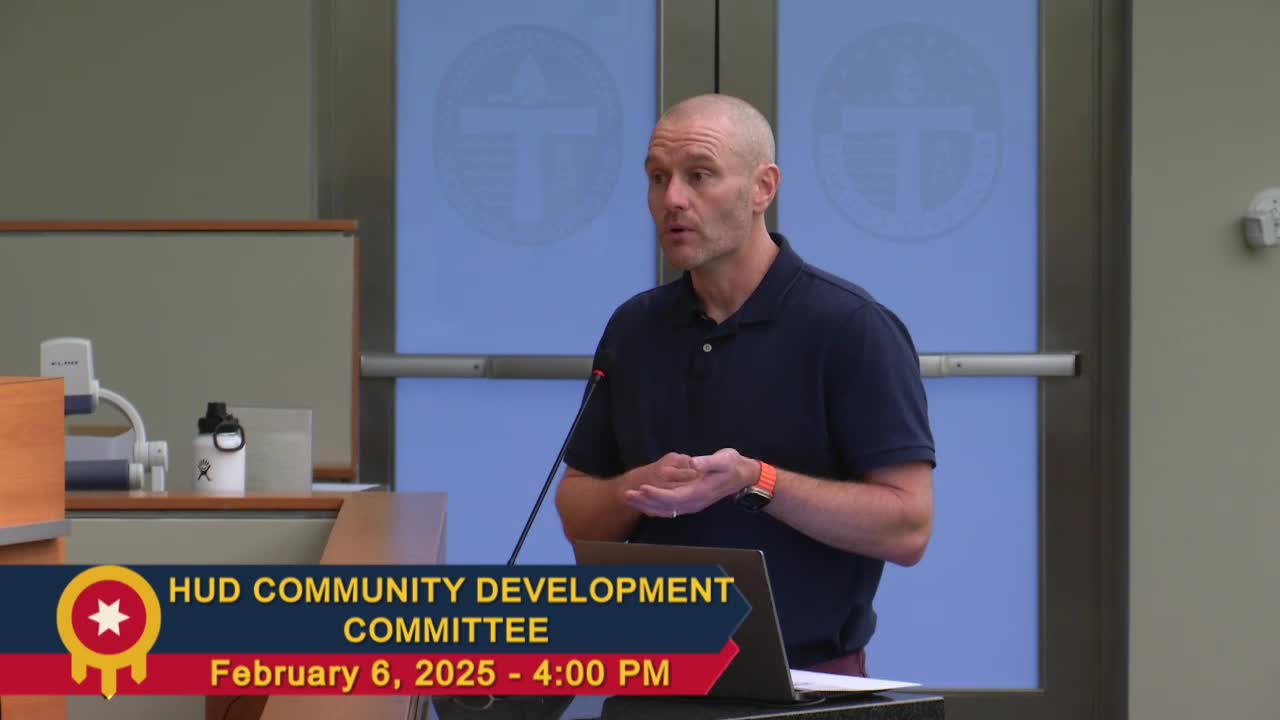
Rhys Williams, grants administration, told the committee the application must flow through the Tulsa Community Foundation because the applicant is not a 501(c)(3). Williams also said the proposed program raised several capacity and compliance concerns: the applicant listed two staff members, the program requires dedicated intake and inspection staff, environmental “tier” reviews must clear issues such as lead-based paint, hazardous waste and floodplain exposure, and federal funds require an open bidding process for contractors.
"There are staff concerns over capacity," Williams said, noting the city’s usual practice for similar programs includes a housing supervisor, multiple inspectors trained for lead-based-paint rules, and staff to handle income verification, contracts and reimbursements.
The organization’s new executive director, Louisa Croag, said Tulsa Immigrants Community Development Corporation currently has two employees but is recruiting a program coordinator who would manage intake and operations. Croag said the organization expects matching support from the George Kaiser Family Foundation (GKFF) totaling about $55,000 to help cover inspection and administrative costs.
"While we are definitely a small organization, having the support of TCF allows us to have accounting, HR and extensive back-office support," Croag said, referring to the Tulsa Community Foundation as the likely fiscal agent.
Committee members asked whether the CDBG-funded repairs would be limited to people who are legally present in the United States. Williams noted that CDBG rules do not require checking immigration status, but the city can include verification requirements in a subrecipient agreement. Croag said the organization planned to include verification in its intake process and that the program was written to serve homeowners who are legal permanent residents or citizens; she said the program’s intention is to serve roughly 20 homeowners.
Committee and staff discussion emphasized the practical requirements for a federally funded housing-rehab program: lead-based paint–trained inspectors, environmental clearances, procurement rules for contractors, and a clear staffing plan to perform intake, income verification and contract oversight. Grants administration said it needs those clarifications before the committee finalizes funding recommendations.
The committee did not take a separate, final vote on the Tulsa Immigrants Community Development Corporation application during the discussion; staff said the item will be incorporated in the committee’s broader funding recommendations that were later moved for approval.
The committee asked staff to return with documentation of the fiscal-agent arrangement with Tulsa Community Foundation, the program coordinator job posting or hiring timeline, the exact amount and terms of the GKFF match, and a description of how inspections and environmental reviews would be handled.