Get Full Government Meeting Transcripts, Videos, & Alerts Forever!
Get email alerts on the Active Transportation Funding Cycle 8 topic
No spam. Unsubscribe anytime.
CTC outlines Cycle 8 Active Transportation Program: $550 million expected, three funding components
Summary
At an Oct. 16 workshop, California Transportation Commission staff described Cycle 8 of the Active Transportation Program (ATP), including an anticipated $550 million across four years, eligible applicants, and how funds will be distributed among statewide, MPO, and small urban/rural components.
California Transportation Commission staff on Oct. 16 reviewed the structure and focus of Cycle 8 of the Active Transportation Program (ATP), saying the program is open to a broad set of applicants and that the commission expects approximately $550 million in ATP funds to be available across four fiscal years.
The ATP “funds projects that encouraged increased use of active modes of transportation, such as walking and biking,” Alika (Commission staff) said during the central workshop. She said the anticipated Cycle 8 total covers fiscal years 2027–28 through 2030–31.
Why it matters: the ATP supports infrastructure, non-infrastructure and planning projects that local agencies, transit operators, tribal governments and nonprofits use to increase walking and biking and improve access to schools and transit. Staff emphasized this cycle’s funding mix and how projects move through funding components.
Key facts presented - Expected Cycle 8 funding: about $550 million across four years (fiscal years 2027–28 through 2030–31). (Alika) - Distribution: 50% of funds to the statewide competitive component; 40% to metropolitan planning organization (MPO) components; 10% to small urban and rural component. (Alika) - Eligible applicants listed in the presentation include local, regional and state agencies, Caltrans, transit agencies, natural resources or public land agencies, school districts, tribal governments, private nonprofit tax-exempt organizations and “any other entity with transportation oversight.” (Alika) - Project types: capital infrastructure projects; non-infrastructure projects (education and encouragement); combined projects (capital plus non-infrastructure); and plans (community bicycle/pedestrian/active transportation plans that serve disadvantaged communities). (Alika)
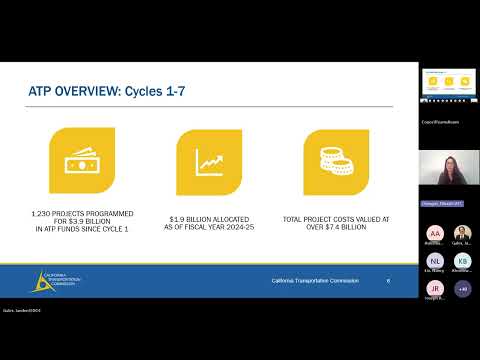
Program history: staff noted that over the first seven cycles the ATP programmed more than 1,200 projects with approximately $3.9 billion in ATP funds requested and about $1.9 billion allocated to date; total project costs across those projects were estimated at more than $7.4 billion. (Alika)
How projects move between components: staff reiterated that applicants submit to the statewide component first; projects not funded in statewide competition may be considered in the appropriate MPO component or, if outside a large MPO, the small urban and rural component.
Next steps and services for applicants: staff reminded attendees of branch workshops, site visits and application debriefs that are available to prospective applicants, and said the Cycle 8 application will be released with the final guidelines after commission adoption (scheduled for the March meeting). Staff also encouraged applicants to request site visits and use the application debriefs if an application is unsuccessful.
Ending note: staff said additional guidance and the Cycle 8 call for projects will be posted to the ATP website and reiterated upcoming central workshops on Nov. 19 (virtual) and Dec. 4 (hybrid, Riverside) where staff will cover topics including PSR equivalency.