Chesterfield officials outline sustainability plan for Access on Demand, update Cloverdale microtransit pilot
Loading...
Summary
County staff presented ridership and funding details for the Access on Demand program, recommended a fare increase to help sustain services, and described progress and a countywide study for the GRTC Cloverdale microtransit pilot.
Chesterfield County staff on Wednesday gave an update on the county’s Access on Demand paratransit program and on the GRTC Cloverdale microtransit pilot, saying the county faces sustainability questions as ridership rises and operating costs climb.
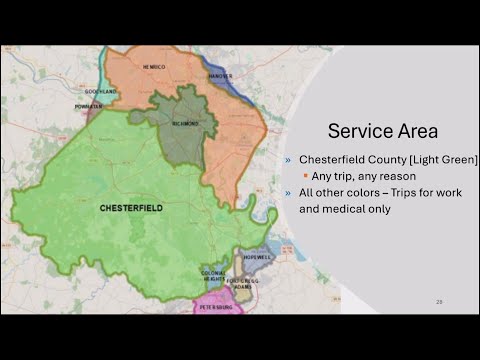
Kim Conley, a Community Engagement and Resources staff member, described Access on Demand as a schedule-and-pickup service that serves Chesterfield County residents who are age 60 or older, have a short- or long-term disability, or meet a low-income threshold. Conley said the service covers in-county trips for any purpose and allows out-of-county work and medical trips to Richmond, Henrico, Hanover and parts of Hopewell and Colonial Heights.
Why it matters: Access on Demand provides door-to-door, ADA-accessible trips primarily for seniors, residents with disabilities and low-income riders. Staff said the program is heavily used for employment trips and medical trips and that county leaders want to maintain the service while controlling costs.
Conley traced the program’s history: Access Chesterfield launched in 2004 as a curb-to-curb, voucher-based service; the county transitioned the program to Access on Demand in 2019 and has added online registration and reporting tools. Staff credited an internal Power BI tool developed in 2022 for making usage and cost data easier to track.
Conley reported that, according to the county’s Power BI dashboard, Access on Demand has had 2,636 active riders over the last three years and “over almost 400 paid trips.” She said the department’s figures show an average trip length of about 11.6 miles and an average cost per reported trip of about $31.32. Conley also said that in fiscal 2025 the program provided what she described as “150,000 paid trips,” and that passengers were “47 seniors, 41% disabled, and 12% low income.” The presentation contained several overlapping numerical statements that were not reconciled during the session.
To bolster operations, Conley said the county has three contracted vendors — Lodges, Ride Round Trip and You Serve — providing ambulatory and wheelchair-capable rides. She said drivers receive ADA sensitivity training and HIPAA-compliance training.
Conley outlined funding support from the Virginia Department of Rail and Public Transportation (VDRPT): a roughly $500,000 grant for wheelchair-capable vehicles and an $80,000 grant to fund a program coordinator position. She said those awards helped expand service and staffing.
Fare recommendation and timeline Conley said the department is recommending a change to passenger fares to improve sustainability: raising the in-county one-way fare from $6 to $10 and the out-of-county one-way fare to $15. She said staff recommend reviewing fees every two years for possible inflation adjustments and that the proposed changes, if adopted, would take effect Jan. 1, 2026. Conley described these as recommendations that county leaders and budget staff had discussed; she did not announce a final county decision or a formal vote.
Microtransit pilot and study Barb Smith, a Transportation Department staff member, described the GRTC Cloverdale Link microtransit pilot as an on-demand, curb-to-curb service that launched in March 2024 with demonstration funds from VDRPT. Riders request trips through the GRTC On the Go app or by phone; Smith said GRTC’s service goal is a 20-minute response time and that the pilot has generally met that standard.
Smith said the pilot operates in zone-based service areas and that the Cloverdale zone connects to fixed-route bus service at several points, which can expand rider options. She said microtransit can group rides during high demand, the vehicles are ADA accessible, and drivers do not require a commercial driver’s license — a workforce advantage.
Challenges, she said, include the zone-based nature of the service and questions about cost-effectiveness compared with fixed-route buses. Chesterfield has secured study funding from VDRPT to examine countywide microtransit options, zone design, integration with fixed routes and with Access on Demand, and the comparative costs of adding zones. Smith said the study will start this month and is expected to take about a year.
Community outreach and next steps Conley said staff plan community outreach and informational meetings to explain recommended changes and that they are coordinating with the county’s constituent services and the Citizen and Budget Advisory Council. She said the department will communicate changes via a constituent campaign and public meetings.
Direct quotes and attributions in the session included Conley’s statement that the program is ‘‘safe, it’s reliable, it’s door to door, and it’s an affordable transportation service’’ and Smith’s summary that GRTC’s on-demand microtransit ‘‘is an on-demand curb to curb service’’ with a 20-minute response goal.
No formal motions or votes were recorded on the recommendations during the presentation. Staff framed the fare adjustments and the countywide microtransit study as recommendations and next steps for the board and budgeting process, not as final decisions.
The county’s staff presentation noted that some numerical points in the slides and spoken remarks were overlapping and not reconciled on the record; staff said they would continue to supply detailed data to budget partners and meet with stakeholders before any final action.
Concluding remarks Conley closed by emphasizing residents’ support for the program and its role in maintaining mobility: she relayed that riders described the service as life-changing and said staff will continue outreach and coordination as the county studies microtransit expansion and considers fare adjustments.