
Lake Forest details response after late‑October water main breaks, lift boil order
Get AI-powered insights, summaries, and transcripts
Subscribe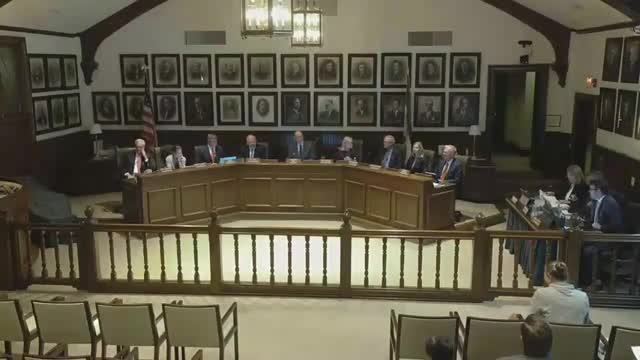
Summary
City staff described two cast‑iron transmission main breaks, a mandatory boil order, and next steps including condition assessments, electrical resiliency work with ComEd and possible vibroacoustic testing.
City of Lake Forest officials on Oct. 20 detailed response steps after two water‑main failures and a subsequent mandatory boil‑water order that affected parts of the city the prior week.
City Manager Jason Wietjoff said the city has launched an after‑action review to identify what went well and what the city will change to reduce the risk of recurrence. “We are going through a fairly extensive after action review to really ask the questions of what went right, what could have gone better, what lessons, can we learn from this experience,” Wietjoff said.
Public Works Director Michael Thomas described the sequence: crews had taken the water tower offline for scheduled work and were relying on interconnections with neighboring Lake Bluff when a cast‑iron transmission main fractured early on Friday, causing pressure drops below the 20 psi regulatory threshold that triggered Illinois EPA guidance requiring a boil order and 20 bacteriological samples. “Anytime we drop below 20 psi in our water main, we need to contact IEPA,” Thomas said. Technicians collected 20 samples and sent them to a certified lab in Highland Park; the initial set returned no bacteria at 11 p.m. Saturday, allowing the city to lift the boil order the following morning at 6 a.m.
Thomas told the council crews isolated and repaired a 14‑inch break the night it occurred and then located a more difficult 12‑inch break near Route 60 on Saturday night, which required additional work the following Monday and Tuesday. He said the two transmission mains involved date from 1948 and 1949 and are cast iron, and that repeated pump surges and intermittent utility power dips likely contributed to “water hammer” pressure spikes that caused the failures.
The city described several near‑term recommendations staff will pursue and present to council: procure a vibroacoustic inspection proposal to assess the condition of transmission mains and prioritize replacements; convene the plant engineer and electrical consultants with ComEd to evaluate measures that would protect the water plant from power surges and drops; and evaluate the Wesley Road booster station and the 14‑inch main between Ridge and Waukegan Road for potential targeted capital work. Thomas said the city will include prioritized transmission‑main work in the next fiscal year capital request.
Dana Olsen, director of communications, reviewed public notifications. The city posted frequent updates across channels; the initial web alert and posts generated high engagement, with the city website receiving “over 13,000 views” in the first 36 hours and the first Facebook post reaching roughly 36,000 views, she said. Olsen said the city’s emergency notification system, Smart911, initially reached roughly 1,000 subscribers but subsequent messages were sent to about 4,400 subscribers; the city is promoting signups and considering mailers and partnerships with senior‑serving organizations to reach residents who are not online.
Council members asked about staffing and resources used in the response, the role of pressure sensors, and whether lining or other rehabilitation technologies might be applied to older transmission mains. Thomas said the city has several pressure sensors around town and that one sensor would likely have pinpointed Saturday night’s break within minutes, but the plant had experienced a recent fiber outage that interrupted some sensor telemetry. He said the city will consider adding more sensors and additional redundancies for telemetry as part of the follow‑up work.
The city framed the episode as an operational failure with several contributing causes rather than a single procedural error, and staff said they will return with more detailed after‑action recommendations and cost estimates for capital and resilience work.
Ending: Staff said findings from the after‑action review and any capital recommendations will be shared with council in the coming weeks as the city evaluates timelines and budget implications.