Get Full Government Meeting Transcripts, Videos, & Alerts Forever!
Get email alerts on the Economic Development Route 1 topic
No spam. Unsubscribe anytime.
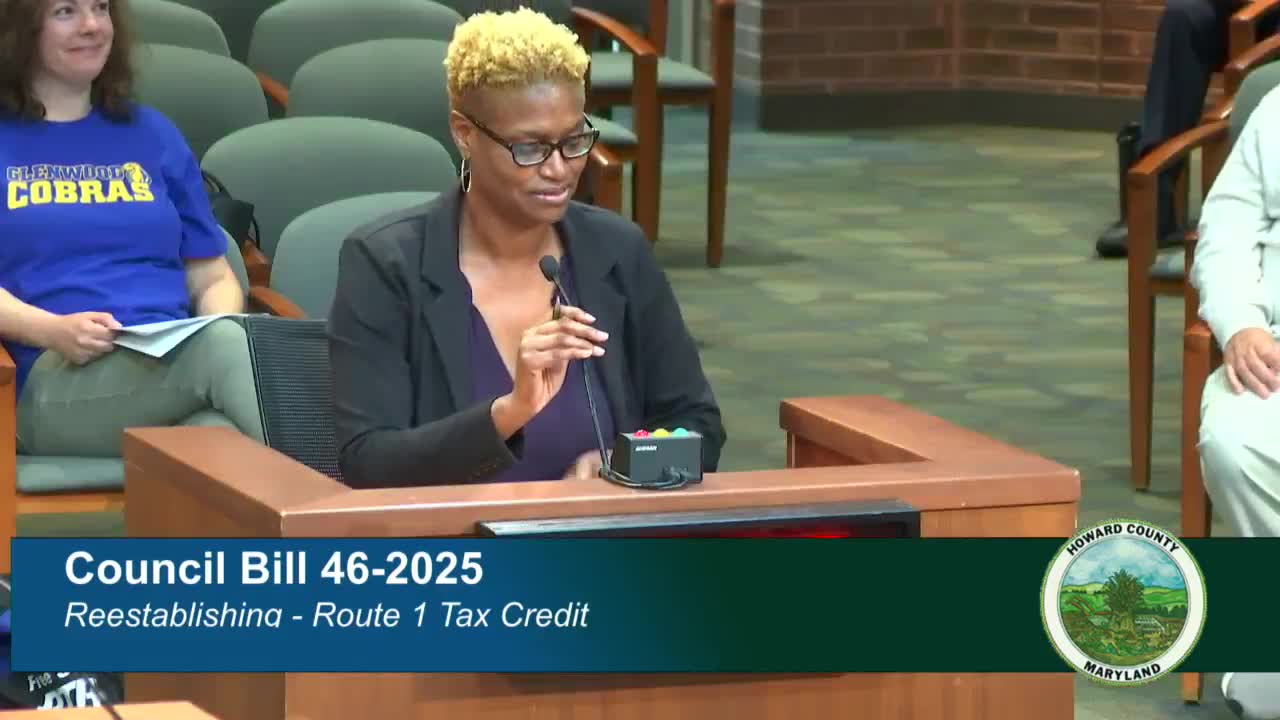
Howard County officials pitch changes to Route 1 tax credit to spur larger visual improvements
Summary
Economic Development Authority and Department of Planning and Zoning urged the council to expand and extend the Route 1 tax credit program, removing acreage and per-project caps and preserving a $250,000 annual program limit.
The Economic Development Authority and the Department of Planning and Zoning asked the Howard County Council during a June legislative public hearing to reauthorize and revise the Route 1 tax credit program to encourage larger facade and landscaping projects along the Route 1 corridor.
Jennifer Jones, head of the Economic Development Authority, told the council the bill (Council Bill 46-2025) would remove the program's 15-acre size limit, allow mixed-use properties to apply (with credits tied to commercial/retail/industrial portions), remove a per-project $100,000 cap while keeping landscaping enhancements capped at $100,000, allow interagency prioritization if demand rises, and extend the program five years to sunset at the end of FY2031.
Why it matters: proponents said these changes would allow more visually transformative projects on larger sites and better align incentives with the county's Route 1 corridor plan. Kristen O'Connor of DPZ, who administers the program, said the program has granted about $1.3 million in property tax credits over roughly a decade to 21 properties and that expanding eligibility could make roughly eight additional properties eligible, with about 280 commercial properties along the corridor generally eligible under current rules.
During questioning, Councilmember Young asked whether removing the $100,000 per-project cap could let a single applicant consume the program budget. O'Connor said the program is already capped at $250,000 in tax credits allocated per year; a single large project could apply for the annual cap, and property owners would need to return in future years if they sought additional credits. Rafael Healy, director of finance, confirmed DPZ's description and said finance would work with applicants to estimate tax burdens and adjust awards because the tax credit is limited to the property's tax liability over the credit term.
Clarifying details provided at the hearing: DPZ said there are about nine properties larger than 15 acres with substantial Route 1 frontage; expanding eligibility to mixed-use properties would allow credit only for work on commercial/retail/industrial parts of a building; and the program's annual payout limit is $250,000. DPZ and EDA emphasized the credit is a property tax credit (not a grant) and that the credit only offsets taxes the property would otherwise owe, subject to the recipient's tax burden over the credit term.
Board next steps: The bill was presented as part of the hearing; no council vote was recorded that evening.