Get Full Government Meeting Transcripts, Videos, & Alerts Forever!
Get email alerts on the Bottle Deposit topic
No spam. Unsubscribe anytime.
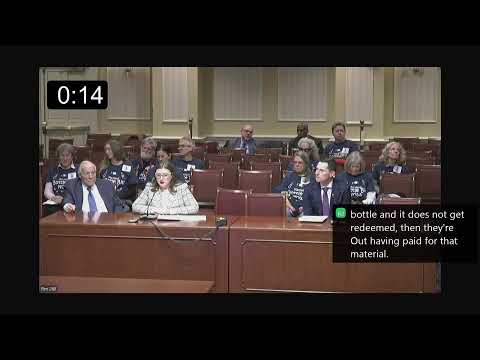
Senate committee hears bill to add 10¢ deposit to beverage containers to cut litter and boost recycling
Summary
Annapolis — The Education, Energy and the Environment Committee on Thursday heard hours of testimony on Senate Bill 3-46, a proposal from Sen. Sarah Brooks to add a 10-to-15-cent refundable deposit to beverage containers sold in Maryland.
Annapolis — The Education, Energy and the Environment Committee on Thursday heard hours of testimony on Senate Bill 3-46, a proposal from Sen. Sarah Brooks to add a 10-to-15-cent refundable deposit to beverage containers sold in Maryland.
Sen. Brooks, the bill’s sponsor, told the committee the deposit-return program is designed to reduce litter, increase recycling and shift costs off local governments. “The purpose of this bill is to create a beverage container deposit program in Maryland to reduce beverage container litter, improve environmental quality, and reduce the costs for local government,” she said during her opening remarks.
Why it matters: Supporters argued the measure would get large numbers of containers out of waterways, parks and streets that are currently not captured by curbside recycling — and would boost the state’s poor beverage-container recycling rate. Opponents, including representatives of farm, retail and waste-industry groups, warned the policy could disrupt existing municipal recycling processing, raise costs for some businesses and require careful design to avoid unintended consequences.
What the bill would do: SB 3-46 would add a small refundable deposit to the purchase price of most beverage containers. Consumers would reclaim the deposit by returning empty containers to participating retailers, reverse-vending machines or dedicated redemption centers. Unclaimed deposits would be used to fund program administration and grants for recycling and litter reduction.
Supporters’ case
- Environmental groups and watershed organizations told the committee Maryland has an acute litter problem — particularly in the Anacostia and Baltimore Harbor watersheds — and a deposit system is a targeted, proven solution. “If SB 3-46 is enacted and successfully implemented, our studies show that it could reduce the level of trash in the Anacostia River by half at a stroke,” said Christopher Williams, president and CEO of the Anacostia Watershed Society.
- Martha Ainsworth of the Sierra Club said a deposit system would sharply increase recycling rates for bottles and cans and reduce litter where curbside recycling does not capture containers consumed away from home. “Don’t waste another 4,000,000,000 beverage containers this year,” she told the committee.
- Industry and policy analysts pointed to other jurisdictions where deposit return systems achieve very high recovery rates. Witnesses cited Michigan and Oregon as examples where a 10-cent deposit is associated with recycling rates above 80–90 percent.
Opponents’ concerns
- Waste and recycling industry representatives warned a deposit law would pull high-value materials — particularly metal and certain grades of glass — out of the current municipal recycling stream, potentially undermining facilities that rely on commodity revenue to operate. “A bottle bill would pull these valuable materials out of the recycling stream, making these facilities more expensive to run,” said Drew Vetter of the National Waste & Recycling Association.
- Retailers and small-business advocates raised practical concerns about in-store return logistics, the cost of installing or servicing reverse-vending machines, and the administrative burden of handling deposits. Sarah Price of the Maryland Retailers Alliance said small stores and food-service businesses could face complex operational demands under some redemption models.
- Agricultural and pesticide-industry witnesses opposed other related measures heard earlier in the same session and noted broader questions about how deposit programs interact with extended-producer-responsibility proposals under consideration.
Design and implementation issues discussed
Committee members and witnesses spent substantial time on program details: the deposit amount and whether it should rise if targets are not met; how retailers, redemption centers and a potential stewardship organization would be compensated; handling of on-premises consumption (stadiums, restaurants) and unclaimed deposits; and how the program would interact with local material recovery facilities and an ongoing statewide recycling needs assessment.
A number of witnesses recommended safeguards in statute: clear performance targets, an independent oversight mechanism, and provisions to reimburse counties or private processors if their net revenue were demonstrably harmed during program transition.
What happens next
Supporters urged moving forward now rather than delaying while other recycling bills (extended producer responsibility proposals) are studied. Opponents asked for additional study and for the results of the state’s recycling needs assessment, which stakeholders said has been delayed.
Ending
Legislators in the committee did not vote on the measure at the hearing. Committee members asked staff and stakeholders to provide more detail on program design — including estimates of material flows, retailer impacts, and how unclaimed deposits and program administrative fees would be allocated — before a formal committee decision.
Key quotes
- “The purpose of this bill is to create a beverage container deposit program in Maryland to reduce beverage container litter, improve environmental quality, and reduce the costs for local government.” — Sen. Sarah Brooks, sponsor
- “If SB 3-46 is enacted and successfully implemented, our studies show that it could reduce the level of trash in the Anacostia River by half at a stroke.” — Christopher Williams, Anacostia Watershed Society
- “Don’t waste another 4,000,000,000 beverage containers this year.” — Martha Ainsworth, Sierra Club