Get Full Government Meeting Transcripts, Videos, & Alerts Forever!
Get email alerts on the Courthouse Johnson Street Closure topic
No spam. Unsubscribe anytime.
Louisburg council votes to close Johnson Street to allow county judicial complex; county offers to pay utility relocation costs
Summary
After more than an hour of public comment, the Louisburg Town Council adopted an order to close Johnson Street to accommodate a proposed Franklin County judicial complex. County representatives said the county would pay to relocate underground utilities; council also approved short-term finance and budget measures during the meeting.
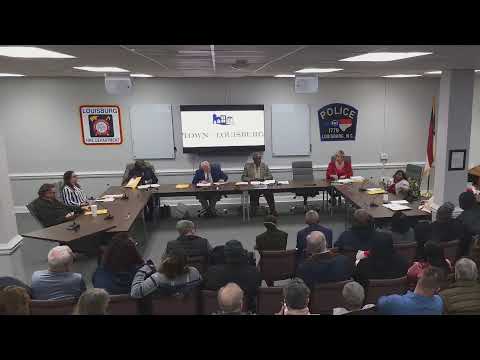
The Louisburg Town Council voted to close Johnson Street on a voice/hand vote after an extended public comment period and council discussion that included an offer from the Franklin County commissioners to pay to relocate utilities needed for the proposed judicial complex.
The council’s action follows public testimony both for and against closing the street and keeping the county courthouse in downtown Louisburg. David Bunn, chairman of the Franklin County Board of Commissioners, told the council that the county "agrees to pay 100% of the cost of relocation of all the utilities, power, water, and sewer" if the town approves the closure and the county and town finalize a formal agreement.
Why it matters: Residents and downtown business owners said keeping the courthouse downtown preserves foot traffic that supports restaurants, retail and professional offices. Opponents warned that closing Johnson Street could limit access and reduce downtown economic activity. The council’s decision begins a multi-step process that will require a later county vote on a formal agreement and additional design and permitting work.
Discussion and public comments
Dozens of residents and downtown proprietors spoke during the public-comment period. Charlotte Murphy, speaking on behalf of Lawrence Edward Tickle, said the county is "not bluffing" and warned that the courthouse could be relocated near the Walmart shopping center if the street closure is not approved. Several business owners and longtime residents — including commercial property owners who said they have invested in downtown — urged the council to keep the courthouse in the town center.
Shelley Dickerson, Franklin County clerk of court, said the courthouse’s location and facilities were developed with input from judicial partners and that she would not ask the town to close Johnson Street "if I had not spent hours of my time knowing what our needs are." Other speakers recounted the economic role court days have for lunch and retail businesses downtown.
County offer on utilities and next steps
At the meeting, commissioners’ representative David Bunn read a prepared statement saying the county would pay the costs required to relocate underground utilities that must be moved to accommodate the project. The statement as read in the meeting said the county would pay "100% of the cost necessary to move the underground utilities, that span from Nash Street to West Johnson Street, that is needed to be moved." Bunn also said the county commissioners would consider a formal agreement at their Feb. 17, 2025 meeting.
Council debate and vote
Council members acknowledged the decision was difficult. Multiple council members said they worried about impacts to downtown businesses but believed the county assurances and the potential long-term benefits made the compromise appropriate. After discussion, a motion to adopt an order to close Johnson Street was moved, seconded and approved by a hand/voice vote. The council did not record individual named vote tallies in the meeting transcript.
Other formal actions at the meeting
The council also approved three finance-related measures during the same meeting: appointing an interim finance officer, authorizing the town administrator to serve as budget officer, and adopting an amended budget ordinance to bring the town into compliance with state requirements. Those measures were presented as required by North Carolina law and adopted by motion and voice vote.
What the council approved (summary)
- Order to close Johnson Street: Approved. Motion moved and seconded; vote by hand/voice. The town transcript records that the motion passed; no individual roll-call tallies appear in the transcript. - Interim finance officer appointment (interim appointee named in the meeting transcript as Sean Medlin): Approved by motion and second. - Ordinance designating town administrator as budget officer: Approved by motion and second. - Amended budget ordinance (to align budget records and comply with state rules): Approved by motion and second.
Unresolved details and dependencies
The county’s written agreement language and the scope of infrastructure the county will pay to relocate were discussed but not finalized at the council meeting. Council members asked for clarity whether the county’s commitment covers only relocation of existing underground utilities or also the new infrastructure (lines and hookups) that the complex would require; the county representative described the language as covering the utilities "needed to be relocated in order to accommodate the judicial complex," and said the county will consider the final agreement on Feb. 17, 2025.
The town administrator and council also noted parallel administrative work: the town is working with the Local Government Commission and outside auditors to bring financial audits and records up to date before a newly hired finance officer begins work. That process may affect implementation timing for any infrastructure payments and contract approvals.
Ending
Council members urged the public to keep engaging as negotiations with the county proceed and as design, permitting and financial steps move forward. The order to close Johnson Street takes effect as the town and county finalize written agreements and next steps, including the county’s Feb. 17 consideration of a formal agreement.