Get Full Government Meeting Transcripts, Videos, & Alerts Forever!
Get email alerts on the Sheriff Oversight topic
No spam. Unsubscribe anytime.
Board renames Community Review Commission, approves membership changes after report and questions about sheriff's mental‑health policy
Summary
On Feb. 4 the Sacramento County Board of Supervisors unanimously approved a resolution renaming the Community Review Commission to the Sheriff Community Review Commission and updating member terms. Commissioners and supervisors pressed for more information after the sheriff implemented a change to how deputies respond to some mental‑health calls.
The Sacramento County Board of Supervisors on Feb. 4 unanimously approved a resolution that changes the Community Review Commission’s name to the Sheriff Community Review Commission and revises membership terms, including a move to stagger appointment years and clarify midterm appointment length.
The commission, created after state action enabling civilian oversight, delivered its annual report to the board and urged clearer public communication and additional study of a recent Sacramento County Sheriff’s Office policy change on field response to behavioral‑health calls.
The commission’s chair, Paul Curtis, summarized the board packet and the panel’s three years of work. He told supervisors the commission was created after Assembly Bill 1185 permitted county sheriff oversight boards with subpoena power and that Sacramento had been an early adopter of civilian review work in the state. Curtis said the panel’s ad hoc committees have examined vehicle stops, jail mental‑health care and other sheriff operations and have issued recommendations to the county’s Office of the Inspector General.
Curtis told the board the commission supports changing its name to clarify its role with respect to the sheriff and to distinguish it from city oversight bodies. The commission also recommended aligning member terms with the fiscal year, staggering appointee start years so supervisors do not replace multiple members at once, clarifying midterm appointment lengths and removing the existing term‑limit language so experienced volunteers are not lost in a field that Curtis described as difficult to recruit for.
Supervisors praised the commission’s work but divided on term limits. Supervisor Don N. Hume said staggered terms were sensible and later moved to uphold the planning commission’s denial in a separate agenda item (see separate article). Supervisor Patrick Kennedy, who helped develop the commission’s original structure, supported the proposed name change while explaining earlier choices to avoid the word “oversight” so as not to overpromise authority to the public. Supervisor Desmond and Supervisor Rodriguez offered similar thanks for the commission’s work.
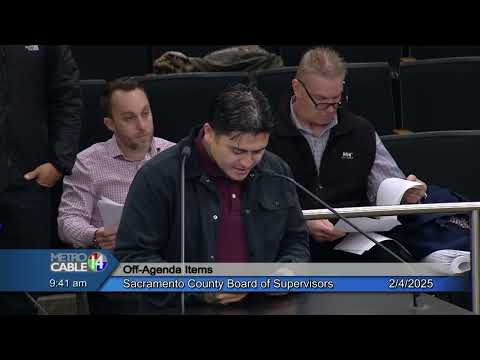
Several members of the public and community organizations addressed the board during the CRC item. Patricia Wenzel, a member of the County Mental Health Board and the Community Wellness Response Team advisory committee, urged stronger county promotion of 988 and said she and others want data on how many 911 calls are being diverted to 988. The League of Women Voters’ Paula Lee and the Sacramento chapter of the ACLU asked the board to protect a robust civilian oversight role; the ACLU speaker said advocates had pushed for a body with “oversight” in its name when the commission was created. Other commenters asked that commission duties include review of sheriff compliance with state laws on use of force and jail operations.
The commission also raised alarm about a recently announced sheriff’s policy change limiting deputy responses to some mental‑health calls. Curtis told the board the commission had asked the sheriff’s office to present the new policy at the commission’s Jan. 21 meeting and that the body is “extremely concerned” the policy was implemented without broad consultation with other first responders and civilian crisis clinicians. Commissioners said they will gather more information, collect public comment and direct an ad hoc committee to analyze how the change will affect residents and other responders; the CRC planned to revisit the issue at its Feb. 18 meeting.
County staff confirmed they worked with county counsel to prepare the resolution and that, if the board approved the document in the packet, the changes would take effect immediately. After discussion and public comment, the board voted unanimously to approve the resolution updating the commission’s name and membership terms and authorized the clerk to adjust current members’ term dates to align with the staggered schedule.
The board and commission members repeatedly noted limits on the board’s direct authority over an elected sheriff’s operational policy while emphasizing the commission’s role as a conduit for public concerns to the Office of the Inspector General and as a forum for recommendations to the sheriff’s office.
The commission’s full annual report and proposed redline of the resolution are on the commission website; the CRC said it will continue its review of the sheriff’s mental‑health response policy at its next meeting and encouraged public attendance.