
Ojai Planning Commission delays decision on Ojai Valley Inn winery expansion after public concerns
Get AI-powered insights, summaries, and transcripts
Sign Up Free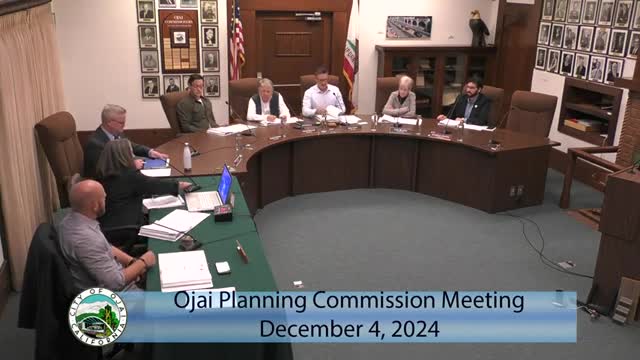
Summary
The Ojai Planning Commission on Dec. 4 postponed action on the Ojai Valley Inn’s proposed renovation and expansion of the Ojai Mountain Winery at 821 West Ojai Avenue, agreeing to continue the matter to a date certain, Jan. 15, 2025, so staff can provide more analysis and the city and applicant can respond to concerns raised by neighbors and the commission.
The Ojai Planning Commission on Dec. 4 postponed action on the Ojai Valley Inn’s proposed renovation and expansion of the Ojai Mountain Winery at 821 West Ojai Avenue, agreeing to continue the matter to a date certain, Jan. 15, 2025, so staff can provide more analysis and the city and applicant can respond to concerns raised by neighbors and the commission.
The commission’s delay comes after about two hours of staff presentation, an applicant PowerPoint and nearly two hours of public comment. Principal Planner Maura Macaluso told the commission the project includes a design review permit for exterior renovations, an amendment to an existing conditional use permit for outdoor seating and a tree permit that would authorize the removal of eight protected coast live oaks. The proposal would add roughly 5,000 square feet — mostly a commercial kitchen and restrooms — reduce interior seating from 72 to 48, keep existing approved special-event hours (noon–11 p.m.) and provide 61 on‑site parking spaces with additional campus parking accessed across the Ventura County bike path.
Why it matters: Commissioners and residents said the proposal would affect the city’s entrance, the safe use of the Ventura County/Ojai Valley bike trail, and nearby residential neighborhoods. Speakers asked the commission to set clearer limits on events, require enforceable noise monitoring and clarify how tree removals and replanting would be handled.
Project details and applicant response
Maura Macaluso, the city’s principal planner, summarized the application and said the path crossing across the Ventura County bike path will be subject to a maintenance agreement between the City of Ojai and Ventura County and that tree work will require arborist supervision and specific protections. Maura said, “There are a total of 46 qualifying protected oak trees on the project site. The requested tree permit is due to the proposed removal of 8 of those protected trees.”
Chris Kanzor, senior vice president at the Ojai Valley Inn, described the Inn’s reasons for buying the winery in 2022 and for adding a commercial kitchen to support both guest dining and event catering. Kanzor said the added kitchen and associated square footage “triggered us to have to put 20 more parking spots just to have a kitchen,” and stressed the Inn’s intention to keep the venue accessible to locals: “We do want it to be approachable.” He told the commission the Inn plans to tight‑enforce hours and to work with neighbors on noise mitigation, including berming, screening and possible acoustical treatments.
Applicant and design team members explained the program: the existing winery footprint would be expanded primarily for a kitchen and restrooms, outdoor seating is proposed on the south and east sides of the structure, and the design shifts from the current Mission/Spanish elements toward a farmhouse architectural palette to tie into the Inn’s farmhouse venue. The project document set indoor seating at 48 and noted the site would have 61 on‑site parking spaces with additional campus parking available to the winery.
Community concerns and public comment
Dozens of residents, several public‑interest groups and neighbors spoke during public comment. Common concerns included noise from events, the safety and design of the proposed bike‑path crossing, the extent of tree removals, the scale and visibility of new parking along West Ojai Avenue and whether the venue would be used for private “buyout” events that limit public access.
Ruth Miller, representing the NHAS task force, urged care in interpreting public‑safety statistics and praised on‑site services for the nearby tent encampment; she concluded that data showed “a positive impact made by the city's prudent investment in services.” Resident Diane, who identified herself as visually impaired, told commissioners: “I am totally blind and I walk through that part of the bike trail a minimum of once a day,” and asked the commission to consider safety impacts of construction and the design of the crossing. Several speakers asked the commission to delay action until after the holidays so more neighbors could review project materials.
Staff clarifications and outstanding technical items
Staff and the project’s traffic consultant, Scott Schell of Associated Transportation Engineers, said they studied levels of service and screening thresholds for vehicle‑miles‑traveled. Schell said the team used Inn point‑of‑sale records to estimate how many winery patrons would be Inn guests versus public visitors; the Inn’s restaurants showed a high internal capture rate, and the traffic study assumed a conservative 50% internal capture for the winery. Schell said the study concluded the project would not materially change intersection level‑of‑service metrics and met state screening criteria for VMT analysis.
On trees, the project’s arborist valued the eight protected oak trees slated for removal at $21,200; staff said the permit requires replacement plantings or a mitigation package to meet that replacement value (for example, a combination of 24‑, 36‑ and 48‑inch box trees). Maura also noted the arborist recommended pre‑construction nesting‑bird checks and additional protections if nesting birds are present.
Commission action and next steps
After public comment and a lengthy commission discussion, a motion passed to continue the item to Jan. 15, 2025, so staff can return with additional analysis and recommended conditions. Commissioners specifically asked staff and the applicant to provide:
- A summary of event‑related conditions the city has imposed on similar venues and proposed language the commission could use (for example, limits on number or size of events and public‑access guarantees). - A clear enforcement plan for noise limits (the applicant has proposed 55 dB for special events in some materials; the city code baseline is 65 dB) including who will monitor and how monitoring will be triggered. - Additional details and possible design revisions that address community character, visibility from West Ojai Avenue and screening of parked vehicles. - A clearer plan for the proposed bike‑path crossing, including safety measures for pedestrians, cyclists and people with disabilities and the legal/maintenance agreement with Ventura County.
Formal action recorded: the commission voted unanimously to continue the matter to a date certain, Jan. 15, 2025. The motion was seconded and passed in a roll‑call vote with all five commissioners voting yes.
What remains unresolved
The commission did not approve or deny any permits on Dec. 4. The key unresolved items are noise enforcement language and monitoring, a firm limit or structure for how many private events (or buyouts) will be allowed if any, the exact dimensions and mitigation for tree removal and the final crossing agreement with Ventura County for the bike path. The applicant said the earliest possible construction start would likely be in late summer 2025 if approvals move forward.
Ending
Staff said it will return with the requested analyses and draft conditions. The commission set Jan. 15, 2025, as the next hearing date for the item and asked that the applicant and staff use the interval to refine noise controls, event management plans and the design of landscaping and screening along West Ojai Avenue.