Get Full Government Meeting Transcripts, Videos, & Alerts Forever!
Spring ISD trustees hear detailed special education and staffing update; district reports rising identifications, staffing gaps
Summary
Spring Independent School District trustees heard a two-part presentation on Oct. 14 reporting 4,196 students (12.9% of enrollment) receive special education services and detailing persistent vacancies in critical special education roles, a new pod rotation model for providers, and steps to address discipline disproportionality and staffing.
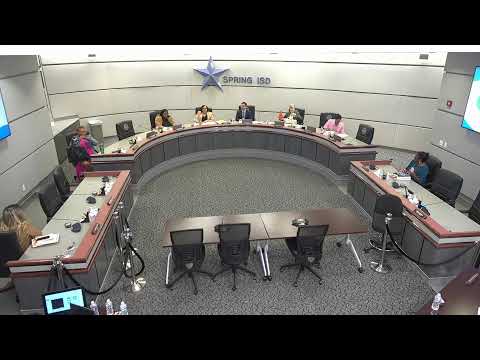
Spring Independent School District trustees heard a two-part presentation on special education services and staffing Tuesday evening that outlined program enrollment, academic trends, discipline disparities and staffing shortages.
The district reported that, as of Sept. 30, 2025, Spring ISD was serving 4,196 students through special education — about 12.9% of the district’s student population — with autism, specific learning disability and speech or language impairment the top three primary disability categories. "Our special education services are thoughtfully designed to meet the diverse needs of every learner," presenter Dr. Regina Miller said, summarizing the department's mission and service continuum.
The update placed staffing shortages at the center of operational challenges. The human resources profile cited 376 campus-level special education positions, 256 of which are certified teachers; the district reported 120 vacancies in special education roles, 96 of which were currently filled by interim staff. District leaders described four contracted speech-language pathologists recently added to supplement in-house staff.
Trustees and staff discussed multiple efforts the district is using to maintain service delivery. Dr. Miller and Dr. Tran Russell described a new "POD" model (approximation and optimizing supports by data) that groups campuses by need and assigns itinerant providers on an approximately eight-week rotation so each campus in a pod receives services on a scheduled cycle. "All of our providers are itinerant staff at this time," Dr. Miller said. Parents were notified of rotation schedules, the presenters said.
The presenta…
Already have an account? Log in
Subscribe to keep reading
Unlock the rest of this article — and every article on Citizen Portal.
- Unlimited articles
- AI-powered breakdowns of topics, speakers, decisions, and budgets
- Instant alerts when your location has a new meeting
- Follow topics and more locations
- 1,000 AI Insights / month, plus AI Chat