Get Full Government Meeting Transcripts, Videos, & Alerts Forever!
Get email alerts on the Special Education topic
No spam. Unsubscribe anytime.
Spring ISD trustees hear detailed special education and staffing update; district reports rising identifications, staffing gaps
Summary
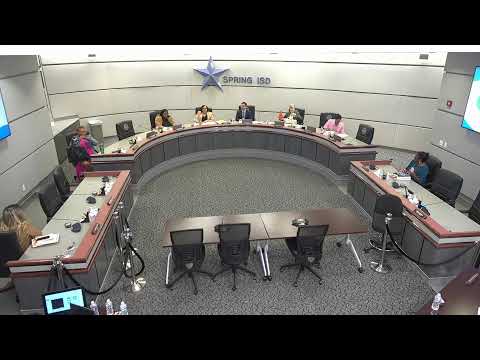
Spring Independent School District trustees heard a two-part presentation on Oct. 14 reporting 4,196 students (12.9% of enrollment) receive special education services and detailing persistent vacancies in critical special education roles, a new pod rotation model for providers, and steps to address discipline disproportionality and staffing.
Spring Independent School District trustees heard a two-part presentation on special education services and staffing Tuesday evening that outlined program enrollment, academic trends, discipline disparities and staffing shortages.
The district reported that, as of Sept. 30, 2025, Spring ISD was serving 4,196 students through special education — about 12.9% of the district’s student population — with autism, specific learning disability and speech or language impairment the top three primary disability categories. "Our special education services are thoughtfully designed to meet the diverse needs of every learner," presenter Dr. Regina Miller said, summarizing the department's mission and service continuum.
The update placed staffing shortages at the center of operational challenges. The human resources profile cited 376 campus-level special education positions, 256 of which are certified teachers; the district reported 120 vacancies in special education roles, 96 of which were currently filled by interim staff. District leaders described four contracted speech-language pathologists recently added to supplement in-house staff.
Trustees and staff discussed multiple efforts the district is using to maintain service delivery. Dr. Miller and Dr. Tran Russell described a new "POD" model (approximation and optimizing supports by data) that groups campuses by need and assigns itinerant providers on an approximately eight-week rotation so each campus in a pod receives services on a scheduled cycle. "All of our providers are itinerant staff at this time," Dr. Miller said. Parents were notified of rotation schedules, the presenters said.
The presentation also covered academic measures for special education students. Dr. Tran Russell noted beginning-of-year NWEA MAP results showing improvement from 27% on or above grade level at the start of last year to 41% at the end of last year; early-grade MCLASS comparisons were described as having more time for improvement this year. The presenters emphasized targeted Tier 1 instruction, intervention and interim-teacher development as strategies to raise proficiency.
Attendance and discipline figures were raised as both problems and targets. The district reported an uptick in average daily attendance for August–September (2.2 percentage points higher than the same period last year) and more evaluations completed, which staff said has contributed to higher special-education identification. On discipline, trustees were shown a three-year comparison indicating the 2023–24 school year had the highest number of removals; so far this year there were 28 more removals than at the same point last year. Staff told trustees that 69% of students removed for in-school or out-of-school suspension who receive special education services are African American. "We are aware of the trend for disproportionality," Dr. Miller said, and noted interdepartmental efforts with campus behavior coordinators and TEA Learn training to address the issue.
Staff training and program details included: - Dyslexia supports: Reading by Design is the state‑approved program used for identified students; the district provides week‑long training for campus staff and a dyslexia supplement for special education teachers. - Behavior supports: the district requires TEA Learn behavior-is-communication training, manifestation determination review training for administrators, crisis management and Texas Behavior Support Institute training. - Interim-teacher supports: targeted beginning-of-year training, October learning fair sessions, and ongoing coaching were described as measures to improve support for interim and guest teachers.
Human resources and staffing presentation
The trustees also received a staffing update that detailed results of a multiyear HR transformation supported by a $500,000 Houston Endowment grant. The grant funded five work streams: HR restructuring, HR business-partner training, leadership development, data readiness and process redesign. The HR presentation noted new dashboards, a redesigned hiring and onboarding process and leadership pathways (including an aspiring-counselor academy and district leadership academy).
Dr. King (presenter) said the district has reduced the number of uncovered vacancies since last year and increased the number of certified special education and bilingual teachers; he cited recent summer hiring turnaround improvements and a substitute (guest teacher) fill rate at about 70% for the last two weeks of September. The district also described an international teacher recruitment program that has brought teachers from the Philippines in recent years to fill certificated positions.
Trustees asked for monitoring and follow-up measures. Trustee Kelly P. Hodges asked how the district monitors whether IEP accommodations are implemented; Dr. Miller described a district spreadsheet review identifying whether IEP accommodations and progress reports had been distributed and requiring principals to respond where gaps were found. Trustees asked for continued reporting on co‑teaching fidelity, the POD rotation schedule, discipline disproportionality analyses and the effect of increased staffing on instruction and student outcomes. Trustee Rhonda Newhouse asked whether the district is taking additional steps beyond stipends and recruitment to address the national shortage in special education personnel; staff replied that pay grade adjustments for evaluation staff, contract hires, strategic recruitment and international hiring are part of an integrated approach.
Why this matters
Trustees framed the staffing shortages and disproportionality as operational and equity priorities. Multiple trustees urged regular, data‑driven follow up. "If we can really have an impact on instruction and what's taking place in the classroom, minimizing the number of kids that actually go to the office is definitely gonna reduce the number of students who actually are suspended," Dr. Tran Russell said.
What comes next
District staff said they will continue accountability classroom and campus walks, monitor IEP distribution and progress reporting, expand contracted provider coverage where needed and report midyear staffing and academic comparisons back to the board. Trustees asked for added context comparing local attendance and absenteeism rates with regional and state averages and for future updates on implementation fidelity for the co‑teaching and POD models.
Ending: The presentation closed with board recognition of the operational and equity challenges and a pledge from staff to return with targeted metrics and follow-up actions at future meetings.