Get Full Government Meeting Transcripts, Videos, & Alerts Forever!
Get email alerts on the Housing Affordability topic
No spam. Unsubscribe anytime.
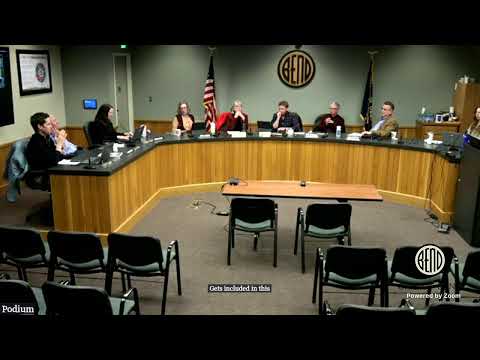
Bend planning commission recommends loosening 30%‑AMI requirement for Southwest UGB affordable units
Summary
The Bend Planning Commission on Jan. 13 voted to recommend that City Council amend Bend Comprehensive Plan Policy 11‑116 so that only 10% of the required deed‑restricted affordable units in the Southwest UGB expansion area must be affordable to households at or below 30% of area median income (AMI), with the remainder allowed to be affordable up to 60% AMI.
The Bend Planning Commission on Jan. 13 voted to recommend that City Council amend Bend Comprehensive Plan Policy 11‑116 so that only 10% of the required deed‑restricted affordable units in the Southwest urban growth boundary (UGB) expansion area must be affordable to households at or below 30% of area median income (AMI), with the remainder allowed to be affordable up to 60% AMI.
The change, requested by the Ponderosa master‑plan applicant, would leave the total number of required deed‑restricted affordable units unchanged while changing the income bands those units must serve. Staff and the applicant told commissioners the adjustment was necessary to make a financially viable affordable‑housing project pencil in the current market.
Staff framed the request as a narrow text amendment to a single policy that applies to the Southwest UGB expansion area added in 2016. Colin Stevens, the city’s community and economic development director, reminded the commission that the 2016 UGB expansion and associated policies followed a lengthy planning process and that the 2016 policy set a high target for very low‑income housing in that area. Aaron Henson, senior planner, outlined the amendment and the approval criteria that apply to comprehensive‑plan text changes, including compliance with statewide planning goals and coordination with affected agencies.
Why it matters: the amendment retains the same overall number of deed‑restricted units but changes who those units are designed to serve. City staff said the policy as written — which the commission noted was the product of the 2016 UGB adoption — requires development that, in the city’s and the applicant’s view, is increasingly difficult to finance in the current market and in that location.
What staff and the applicant told commissioners
• Aaron Henson (senior planner) told the commission the policy currently requires a minimum number of affordable units (125 units or 25% of the master‑plan housing, whichever is greater) and that the applicant proposes to keep that quantity while changing the income targeting of those units. Henson listed the applicable approval criteria, including Goal 10 (Housing) and Goal 2 (Land Use Planning).
• Colin Stevens (Community and Economic Development director) put the Southwest expansion in historical context: the land was added to the UGB in 2016 after a long public process and the policy framework for the area was established at that time. Stevens said the city and applicant have met procedural requirements and that the proposed text change affects only how the existing affordability obligation would be targeted, not the total required number of affordable units.
• Rachel Baker (housing staff) answered commissioners’ questions about whether units targeted at 60% AMI could in practice house lower‑income households: she said households with lower incomes can occupy those units if they receive rental assistance or vouchers, but vouchers are not guaranteed and the property must be financially viable without assuming voucher availability.
• Ben Prey, CEO of Home First Development (the applicant’s affordable‑housing partner), told the commission the applicant underwrote its project on the basis of a reduced 30% requirement (10% at 30% AMI) and that “economically, an entire property with the rent set at 30% is... not viable right now.” Prey said site characteristics — relative distance from grocery, medical and other walkable services — and the absence of guaranteed site‑based subsidies (vouchers) made the deeper 0–30% model infeasible for that location.
Public comment and concerns
Residents who spoke during the public hearing raised infrastructure and access concerns for the broader Southwest area (transportation, sidewalks, emergency access) and noted recent affordable projects nearby. Commenters also said the Southwest area already contains several affordable projects and urged the commission and council to spread affordability across the city. Several speakers said the proposed affordability mix would still provide significant affordable housing in the neighborhood.
Commission deliberation and vote
Commissioners questioned the tradeoff between deeper affordability (30% AMI) and project feasibility. Several commissioners expressed concern about the loss of 30% units but also acknowledged the high overall number of deed‑restricted units the master plan proposes. After deliberation, the commission voted to recommend City Council approve the text amendment as drafted by staff, with staff findings supporting consistency with statewide goals and the city comprehensive plan. The recommendation will go to City Council for a final decision.
Next steps
The commission’s recommendation and the staff record will be forwarded to City Council for public hearings and final action. Commission members noted City Council will have the final decision; a commission representative will appear to present the recommendation at the council hearing. The City of Bend and the applicant will continue coordinating with the housing division on implementation and restrictive‑covenant requirements for the deed restrictions.
Ending
The commission’s recommendation preserves the required quantity of deed‑restricted units while changing the income bands they must serve; commissioners said the change seeks to balance the city’s housing goals with the economics of delivering affordable housing at this location.