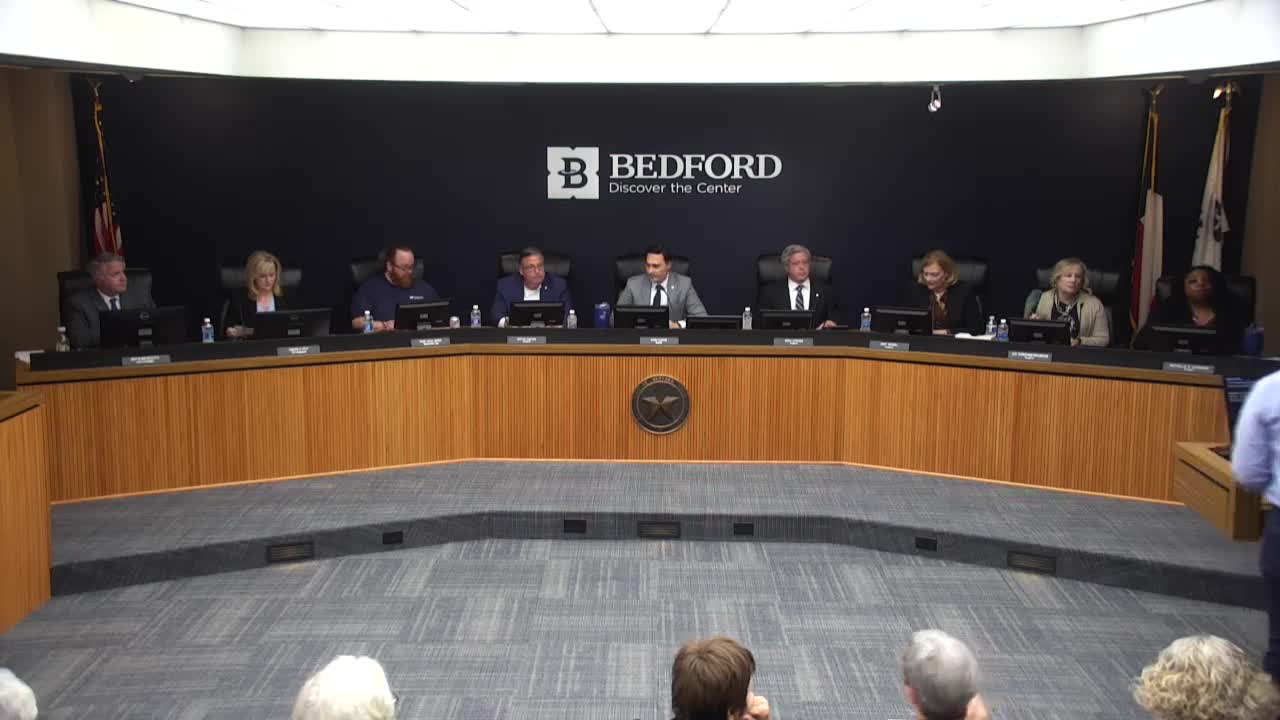
Bedford council, staff say state court rulings limit citywide ban on short-term rentals; enforcement, registration remain tools
Loading...
Summary
A Bedford resident urged tighter controls on short-term rentals citing safety, noise and parking concerns. City attorneys and staff told the City Council legal precedent constrains a citywide ban and described current local tools: an annual registration and inspection program, code enforcement and permit revocation for violations.
A Bedford resident urged the City Council on Feb. 25 to take stronger action on short-term rentals, saying neighbors face increased noise, parking congestion and security worries when homes are used year-round as short-term rental properties.
Spencer Jacobson, who identified himself as a Bedford resident, told the council that a nearby home was purchased with the intent to operate as a year-round short-term rental and said "Airbnb does not require clients ... to submit photo IDs," arguing that the platforms' screening practices leave nearby families exposed to risk.
City officials described the limits of local authority. The city attorney summarized recent Texas case law, saying the Texas Supreme Court and several courts of appeals have generally treated short-term renting as an inherently residential use and have been "rather unfriendly" to citywide bans. The attorney cited decisions from the Texas Supreme Court, the Fort Worth Court of Appeals and other appellate courts that have constrained municipalities' ability to prohibit rentals outright.
Given the legal environment, city staff and council members said Bedford has focused on regulation and enforcement rather than a citywide ban. Andrea Roy, city manager, told the council that "anyone that does have a short term rental is required to register with us annually. There is a fee. There is an inspection conducted to make sure that the home is equipped properly and that it does have the required number of parking spaces." She added the registration lets the city collect hotel-occupancy tax generated by rentals and provides a record for enforcement.
The city attorney described a strategy the council has pursued in other communities: impose strict operating permits and municipal code requirements, then rely on code enforcement and municipal court adjudication to pursue violations that can lead to permit suspension or revocation. The attorney noted one judicial pathway that gave a limited win when a court allowed an entertainment district carve-out, but said that approach can be difficult in largely residential cities like Bedford.
Council members and staff urged residents to report suspected illegal operations and code violations, saying documented complaints strengthen the city's position when pursuing permit actions or municipal-court enforcement. The city manager reiterated that staff are monitoring and administering the registration and inspection program and asked neighbors to contact code enforcement with specific complaints so the city can document violations.
Council members said they do not want the negative impacts Jacobson described but emphasized the need to proceed within legal constraints, follow ongoing court decisions, and use licensing, inspections and code enforcement to limit nuisances.
Looking ahead, the council signaled it will continue to monitor higher-court rulings on short-term rental regulation and adjust local rules and enforcement practices as legal developments allow.