Get Full Government Meeting Transcripts, Videos, & Alerts Forever!
Get email alerts on the Economic Development Workforce topic
No spam. Unsubscribe anytime.
Chamber lays out economic-development strategy with focus on talent, childcare and minority business support
Summary
The Knoxville Chamber presented its five-year priorities — business expansion, talent pipeline, childcare and digital literacy — and described programs addressing minority-owned business access to capital and technical assistance.
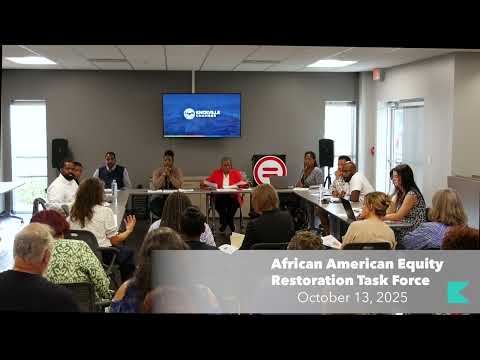
Representatives from the Knoxville Chamber told the African American Equity Restoration Task Force that the chamber’s five-year strategy centers on raising average annual pay, expanding the region’s talent pipeline and supporting business growth, with specific programming aimed at minority-owned firms.
Amy Nolan, vice president of mutual enhancement for the Knoxville Chamber, described the chamber’s strategic shift toward economic prosperity work: "Our reason for being is to help businesses that are here grow, expand, be prosperous," Nolan said. Lauren Longmire, vice president of economic development, highlighted the chamber’s business pipeline and recent wins she said would yield thousands of jobs and significant capital investment.
Panelists emphasized workforce and childcare as barriers to employment and economic mobility. Chamber staff said average annual pay for child care workers is roughly $23,000–$24,000 while childcare costs run about $10,000–$11,000, a gap that contributes to parents leaving or limiting participation in the workforce. The chamber described advocacy and local regulatory changes intended to ease childcare development, including aligning local zoning and regulations with state standards and advocating for higher wages and employer access to grant funding.
The chamber also described a digital literacy program that offers a 15-week curriculum, devices, and state broadband-funded Chromebooks for eligible Knox County residents; the chamber said it had about $200,000 to deploy through 2026 to expand site partners and training.
On minority business support, Chamber staff reviewed access-to-capital barriers and cited efforts including an announced Opportunity Fund (described as a multi-million-dollar loan fund launched in January 2023) that provides loans from about $5,000 to $50,000 targeting women- and minority-owned businesses. The chamber said smaller firms often abandon loan applications when asked for business and personal tax records and that financial education and business coaching are needed to improve application completion.
Chamber presenters invited task force collaboration on equitable career-awareness programs, internships and pathways linking employers and training providers. They also requested help identifying trusted community partners to host digital-literacy courses and to support outreach to minority-owned businesses.
Task force members asked for details about forecasting and timelines for procurement and capital projects so small businesses could prepare; chamber staff said large project forecasts are shared annually after the budget is adopted and that departments can break larger projects into smaller chunks to improve accessibility for small firms.