Get Full Government Meeting Transcripts, Videos, & Alerts Forever!
Get email alerts on the Utility Rates Energy topic
No spam. Unsubscribe anytime.
Resident warns council about CenterPoint rate increase, urges weatherization and solar funding
Summary
Christopher Nori told the Evansville Common Council on Feb. 10 that CenterPoint has received about $80 million in approved rate increases and urged the city to use ARPA and other funds for weatherization and to pursue federal solar funding to ease impacts on residents.
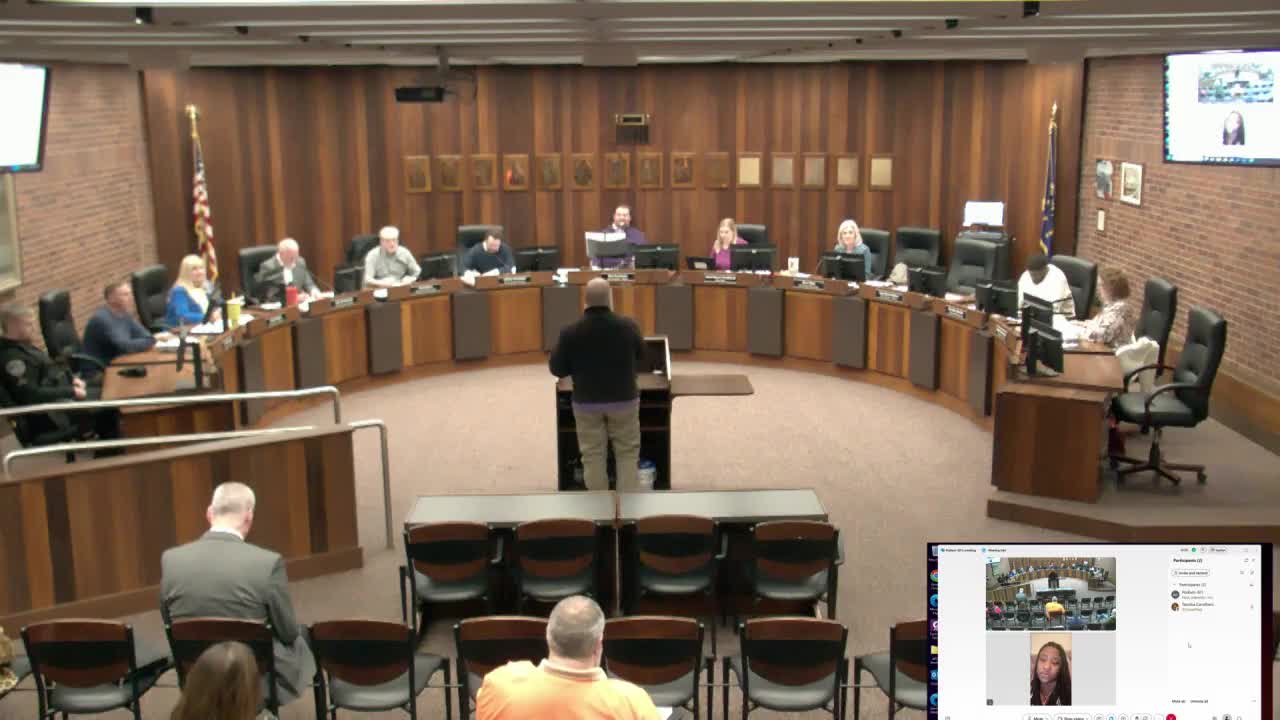
Christopher Nori, a local energy advocate, addressed the Evansville Common Council during miscellaneous business on Feb. 10 to warn about recent utility rate activity and to urge city action.
"CenterPoint did receive their rate increase, dollars 80,000,000 in total," Nori said, adding that the utility has said some customers are on an older electric-heating rate that could see increases of approximately $50 on monthly bills. He said about 22% of Evansville residents remain on that older heating rate and urged city officials to consider funding weatherization efforts to blunt the impact.
Nori suggested reallocating $175,000 of ARPA funds that have been tracked for weatherization-like projects and called on the council to coordinate with local organizations that do weatherization work, including JD Sheth and CAPE. "The only thing I've come up so far because, like I said, it's happening — it's gonna get here real quick," Nori said, urging council support for mitigation through weatherization.
He also referenced federal funding opportunities tied to the Inflation Reduction Act, noting the state was approved for Solar for All funds and that Evansville is slated for Phase 2 allocations. Nori said the state program had experienced administrative disruptions and that city advocates should watch for availability of roughly $171 million the state had been allocated for low-income solar programs and community solar that could benefit renters and low-income residents.
Council members asked Nori several technical questions about net metering, community solar and the structure of utility rate riders. In response he described past changes to net metering that reduced compensation for customer-generated solar and discussed the transmission-distribution system improvement charge (TDSIC) riders, which he said had allowed utilities to collect large sums up front for infrastructure improvements (two riders of about $446 million and $454 million, respectively, were cited in his remarks).
Nori recommended that the city consider targeting local funds to weatherization, supporting community solar initiatives, and working to preserve or restore favorable net-metering policies at the state level. No formal council action was taken on the subject at the meeting, but council members engaged with Nori’s questions.
The council's next meeting was announced for Feb. 24; Nori offered to follow up with staff on mitigation ideas.