Get Full Government Meeting Transcripts, Videos, & Alerts Forever!
Get email alerts on the Historic Cemeteries topic
No spam. Unsubscribe anytime.
Residents ask Clay County preservation board to form cemetery subcommittee
Summary
Genealogists and volunteers urged the Clay County Preservation Board to create a cemetery-focused subcommittee, citing undocumented burial sites, volunteer coordination problems and requests for staff review of the board's jurisdiction and the Florida master site file.
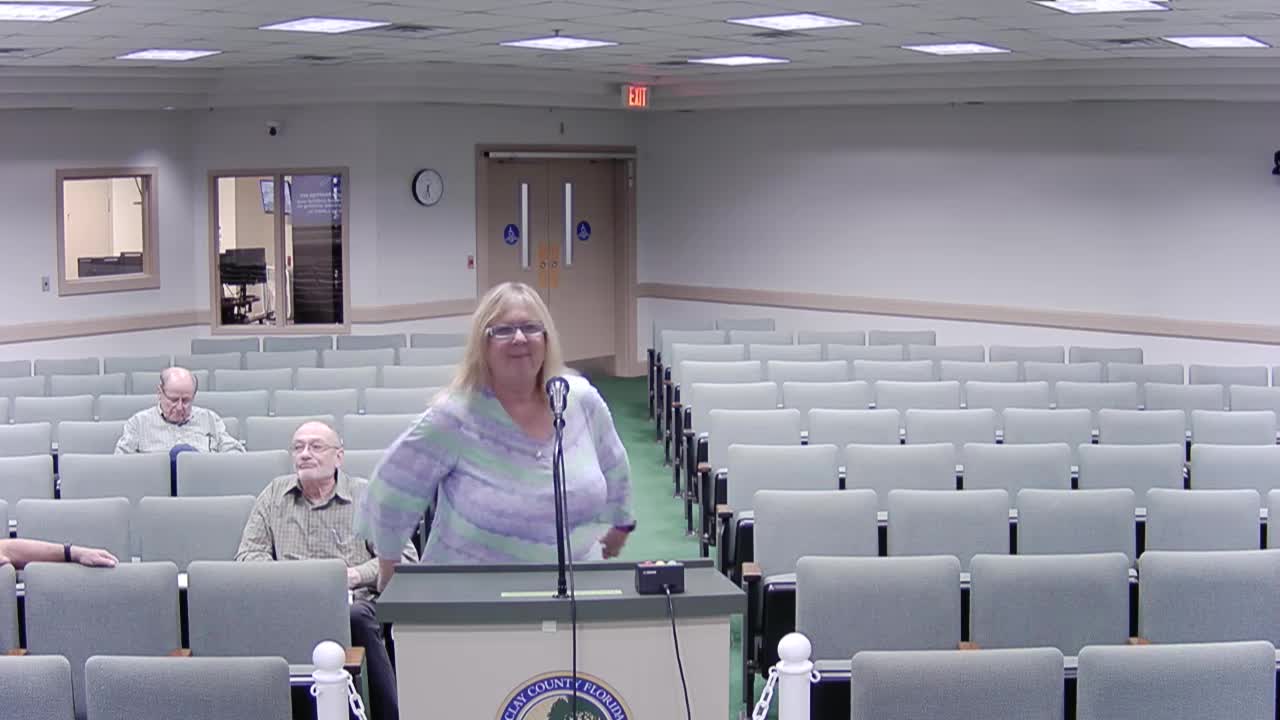
Kathy Gess, a Clay County resident and genealogist, told the Clay County Preservation Board during public comment that volunteers who document and restore historic cemeteries are ‘‘kind of disjointed’’ and asked the board to re-establish a cemetery subcommittee within the county preservation structure.
Gess said she and volunteers have been working on several sites, including one in Orange Park, and that others such as Pleasant Point and Foreman's Cemetery have active volunteers but lack a central organizing body. “We need the preservation board to be kind of our foothold and have a committee of people that can come together and manage that information,” Gess said.
The request prompted a staff-direction response from a board member: staff were asked to review the board’s charter and determine what jurisdiction the preservation board has over historic (nonactive) cemeteries on private property and what steps the board could take to support volunteers. The board member said staff could look at the charter and report back to the board.
Volunteers and local preservation advocates present said the work involves research, documentation and sometimes fieldwork; they noted gaps in the Florida master site file (the state inventory) for some cemeteries. A volunteer who identified himself as working on Pleasant Point said research increased the known burials at that site from six to 33. Speakers also described a recent case they learned about where a house was built on property believed to contain burials.
Speakers asked the board to consider nonmonetary support (coordination, a named liaison) and to explore funding options for technical work such as ground-penetrating radar. One volunteer said state archaeologists at the University of Florida had offered to assist ‘‘if we can get the ground accessible for them.’’ Board members suggested coordinating with the Florida Public Archaeology Network (FPAN) and confirmed staff contacts would examine what the board can and cannot do under its charter.
Board members and volunteers also discussed the Florida master site file: volunteers described ongoing work to add sites that are newly documented to the state file and noted that some historic cemeteries are on private property, which complicates access and designation. The public and volunteers emphasized training and legal compliance, saying cemetery law can be “very stringent” and that volunteers need a consistent point of contact.
The public comment concluded with volunteers asking the board to formalize a mechanism to gather and inventory historic cemetery records, coordinate with FPAN and the Florida master site file, and identify potential funding or county assistance for archaeological survey work.
Board follow-up: staff were directed to check the board charter and report back on the board’s jurisdiction and potential next steps for supporting volunteer cemetery documentation and inventory work. No formal motion or funding decision was made during the meeting.