Get Full Government Meeting Transcripts, Videos, & Alerts Forever!
Get email alerts on the Pension Transfer Laterals topic
No spam. Unsubscribe anytime.
Former officers and chiefs push House Bill 424 to ease pension transfer barriers after 2015 change
Summary
At a second hearing on House Bill 424, a longtime deputy and other witnesses described how a 2015 statutory change limited lateral-transfer options and can force officers to work many additional years to consolidate retirement credit; proponents argued HB 424 would restore flexibility and ease hiring across agencies.
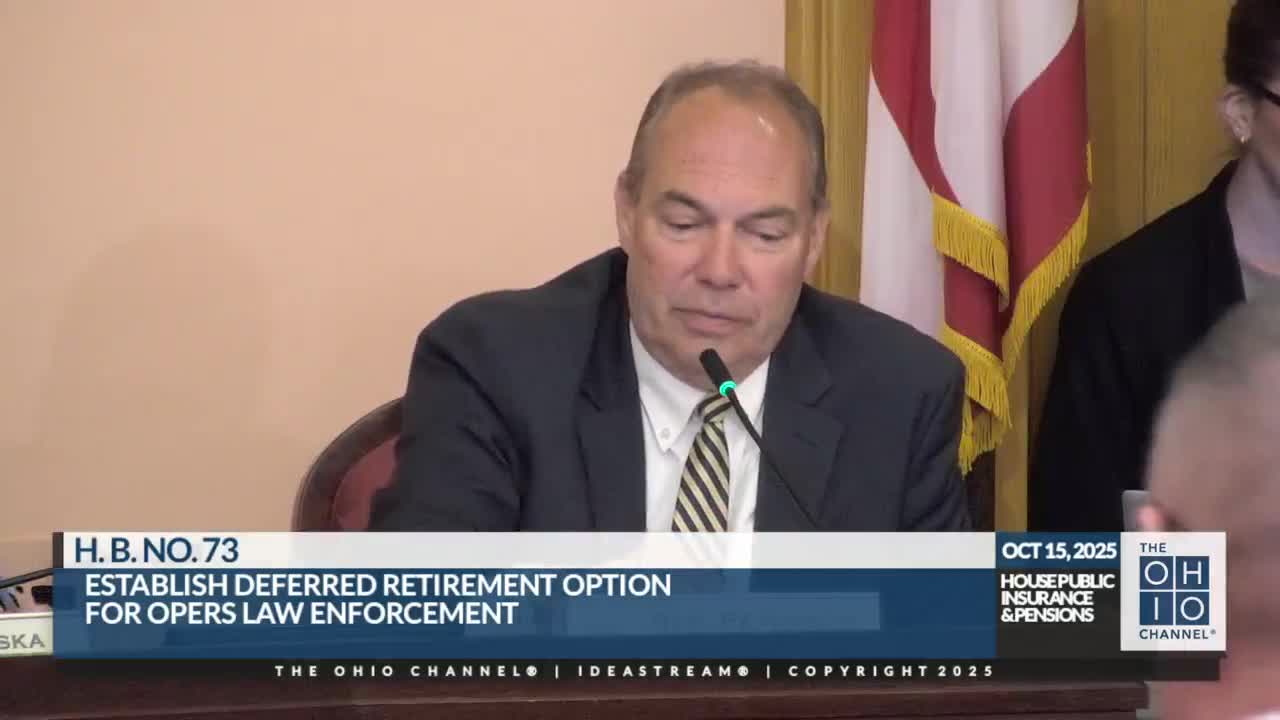
The House Public Insurance and Pensions Committee heard proponent testimony on House Bill 424, a measure aimed at addressing pension credit and transfer rules that currently complicate lateral moves between different Ohio public-safety retirement systems.
Why it matters: Witnesses told the committee the 2015 legislative change (Senate Bill 42) eliminated or curtailed previous joint-pension credit arrangements, forcing some officers who switch systems to work many additional years to carry service credit forward. Proponents argued that the change reduces lateral hiring and makes it harder for smaller jurisdictions to recruit experienced candidates.
Jim Gilbert, chief deputy with the Franklin County Sheriff’s Office, described his own career and the change’s effect on his service credit. Gilbert said he was told in 2013 by OPERS staff that his prior Ohio Police and Fire (OP&F) time would carry forward; but after Senate Bill 42 went into effect on March 25, 2015, that option was removed. “We had no idea,” Gilbert said, describing a case in which an officer who left Findlay Police Department with 19 years of service had to work into his late 60s to achieve equivalent retirement credit after switching.
Gilbert and other witnesses said the loss of a predictable joint retirement option has discouraged lateral transfers, reduced mobility and complicated recruiting. They asked the committee to restore a mechanism that would allow service credit earned under multiple systems to be treated more equitably so that experienced officers can move between municipal, county and state agencies without a severe, unanticipated extension of their careers.
During questioning, representatives asked about the scale of the problem and whether any window to address transfers had been available after the 2015 change. Gilbert said there was no effective grandfathering and that many employees were not notified of the impact at the time. He cited an internal FOP survey estimate of roughly 800 to 1,000 affected members, but acknowledged he did not have firm statewide counts; committee members requested more data and for staff to distribute written testimony received.
Ending: Proponents framed HB 424 as a targeted fix to restore lateral hiring flexibility and reduce a statutory barrier introduced in 2015; the committee received testimony and written submissions and did not vote at the hearing.