Committee Hears Testimony on Bill to End 'Pension Pickup' and Boost Pay Transparency
Loading...
Summary
The Public Insurance and Pensions Committee heard proponent testimony for House Bill 473, which would prohibit government agencies from paying the employee share of public pension contributions and require total compensation to be disclosed plainly.
The Public Insurance and Pensions Committee heard proponent testimony on House Bill 473, which would bar government agencies from picking up the employee portion of public pension contributions and require total compensation to be shown plainly to the public.
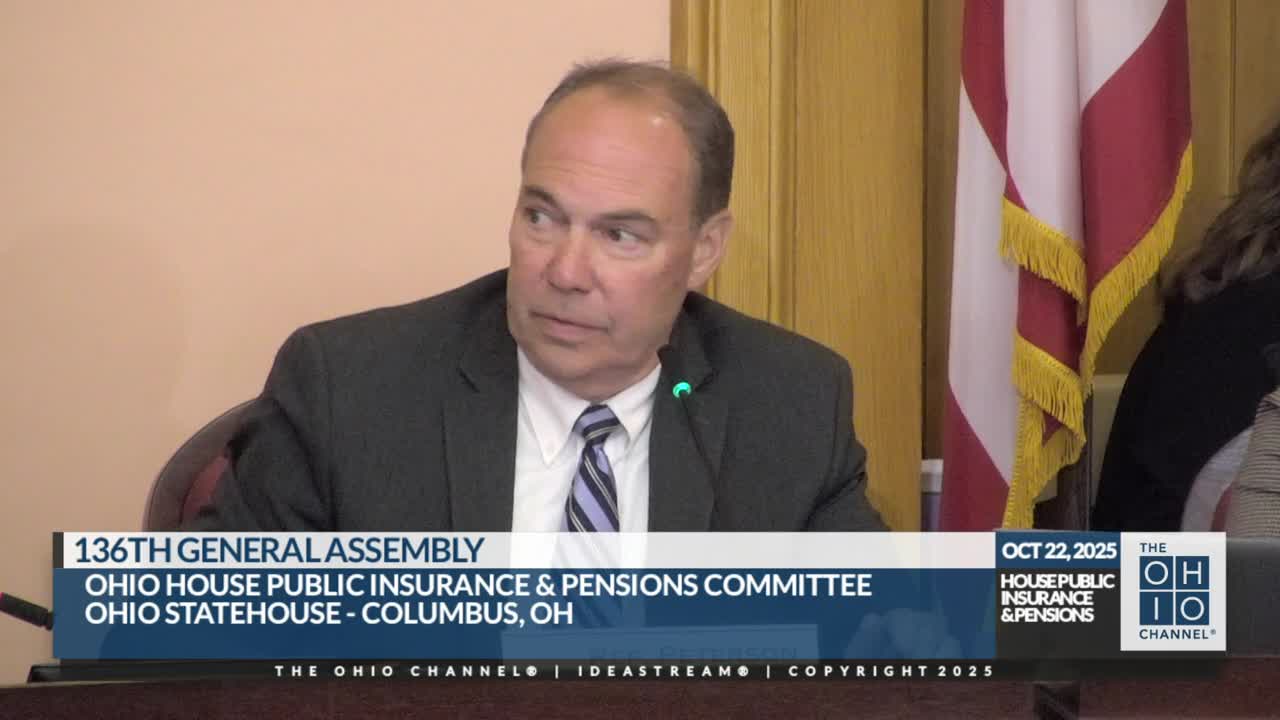
The bill’s sponsor was not present; Christopher Galloway, Lake County auditor and second vice president of the County Auditors Association of Ohio, testified in support and said the change would improve transparency and reduce hidden compensation practices that shift costs to taxpayers.
Galloway told committee members the practice of an employer “picking up” the employee pension share is often hidden from residents who try to compare actual compensation. “This practice is hidden from the public when they try to educate themselves on how much a director of an agency or an executive of a school district is making in salary,” Galloway said. He added, “As a taxpayer, it angers me that there are public employees not paying their share of the pension cost.”
Committee members asked how removing the employer pickup would affect total compensation and taxpayer costs. Representative Bridal asked whether entities would need to increase base salary to offset the change and whether that could raise employer payroll costs. Galloway responded that negotiations typically determine pay and benefits and that there is no automatic requirement to offset a pickup removal with a salary increase. “We do it all the time in negotiations when it comes to health care costs,” he said.
Representative Miller and others raised tax and parity questions. Galloway noted that some employees currently avoid immediate income taxation on the portion the employer pays and said requiring employees to pay their share would make compensation and tax liabilities clearer. He also stressed that the County Auditors Association of Ohio had not yet taken a formal position on HB 473; its membership would meet at an upcoming conference before deciding.
Members also pressed Galloway on examples of other hidden benefits. Galloway said he discovered in his office a fleet of about six vehicles used as daily commuters and reduced it to two, describing that as an example of compensation or benefits that can be legal yet excessive. “There is a lot of largesse that occurs in many public offices in terms of extra benefits that folks gain,” he said, adding that auditors routinely request documentation and public-purpose explanations from county departments.
Galloway described efforts he has taken in Lake County to increase transparency, including placing county financials on Ohio Checkbook and frequent records reviews. He said the aim of HB 473 is to make total compensation “plainly in their pay rate and obvious to a member of the public seeking to know that compensation.”
No vote was taken on HB 473 during the hearing. The County Auditors Association of Ohio’s formal position on the bill was described as “not specified” pending the organization’s November meeting. The committee did not announce further action at the end of the session.