Get Full Government Meeting Transcripts, Videos, & Alerts Forever!
Get email alerts on the Drop Opers Law Enforcement topic
No spam. Unsubscribe anytime.
Committee hears testimony for House Bill 73 to create DROP option in OPERS for law enforcement
Summary
Proponents told the House Public Insurance and Pensions Committee HB 73 would create a Deferred Retirement Option Plan (DROP) for OPERS law enforcement members, modeled on programs in OP&F and the Highway Patrol system; witnesses said the change would aid retention and succession planning.
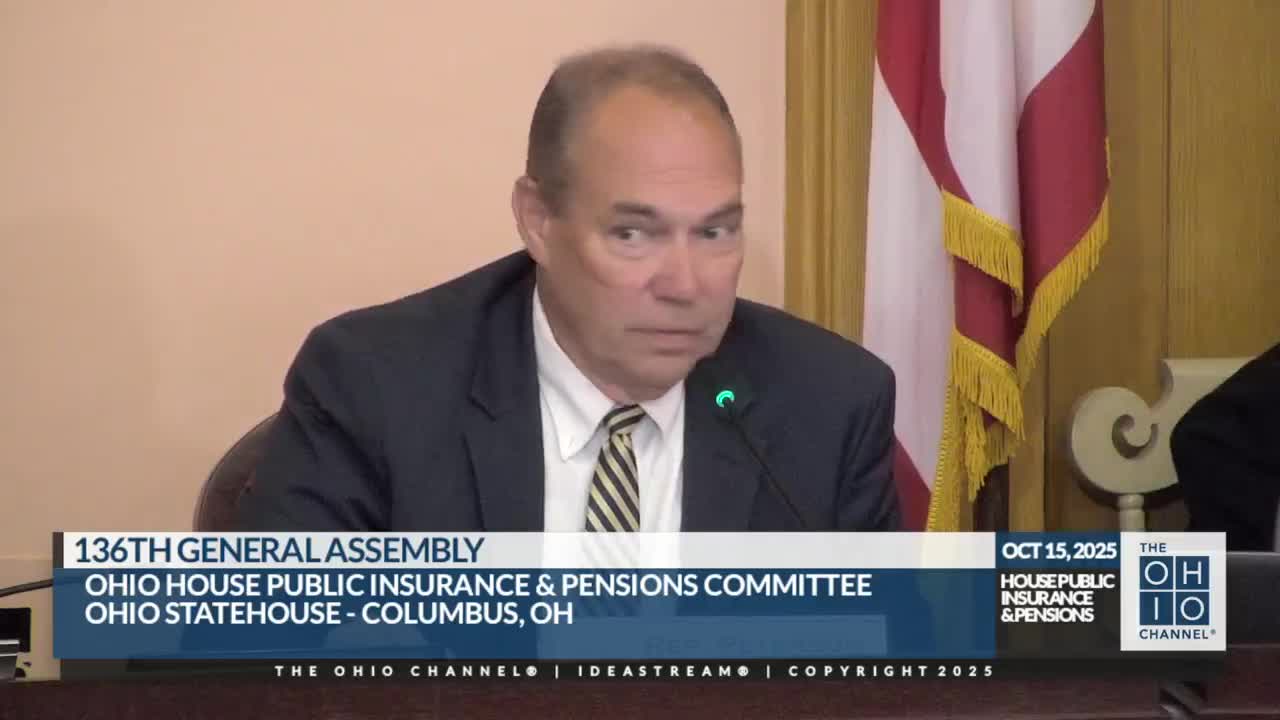
The House Public Insurance and Pensions Committee held a second hearing on House Bill 73, a proposal to create a Deferred Retirement Option Plan (DROP) for law-enforcement members of the Ohio Public Employees Retirement System (OPERS).
Why it matters: Supporters said a DROP program would let experienced officers draw pension payments while remaining employed and deposit those payments into an approved annuity—often for a fixed term—giving agencies more predictable retirement timing and encouraging veteran officers to remain on the job longer.
“House Bill 73 proposes to create a deferred retirement option plan known as DROP for law enforcement officers within the Public Employee Retirement System,” said Chief Robert Butler, president of the Ohio Association of Chiefs of Police. Butler told the committee that making a DROP universally available across systems would put municipal police, county sheriffs and university police “on a similar competitive field” and would help preserve institutional knowledge.
“TJ Asen, sergeant with the Mahoning County Sheriff’s Office and state vice president of the Fraternal Order of Police of Ohio, told the committee DROP would allow members to start drawing monthly pension payments while maintaining active employment and deferring those payments into an approved annuity for up to eight years,” Asen said. "There is no negative impact to the OPERS Healthcare Trust, as the members who are enrolled in DROP would continue to be actively covered under their employer's healthcare plan," he added.
Witnesses characterized DROP as modeled on existing programs in the Ohio Police & Fire Pension Fund and the Highway Patrol Retirement System. Proponents said the measure would be a recruiting and retention tool amid “historically and critically low” staffing levels and could provide departments with advance notice of actual retirement dates when DROP terms specify a final separation date.
Committee members asked clarifying questions about how DROP benefits would compare to existing partial lump-sum options (PLOP) and whether DROP would change healthcare coverage or fiscal exposure for OPERS; witnesses said DROP differs from PLOP by allowing continued employment without loss of rank or seniority and by being structured as a deferred annuity mechanism. Proponents described the bill as cost-neutral to OPERS in that the fund would receive a share of the investment interest generated by deferred monthly payments.
The hearing ended after questions; the committee did not vote at this session. Proponent testimony concluded and committee staff accepted written submissions on the bill.
Ending: Proponents urged the committee to give HB 73 favorable consideration, describing DROP as a retention tool that reduces churn, helps succession planning, and aligns OPERS law-enforcement benefits with existing DROP programs for other first-responder systems.