Get Full Government Meeting Transcripts, Videos, & Alerts Forever!
Get email alerts on the Pension Portability topic
No spam. Unsubscribe anytime.
Committee hears bill to ease pension transfer barriers for police and fire
Summary
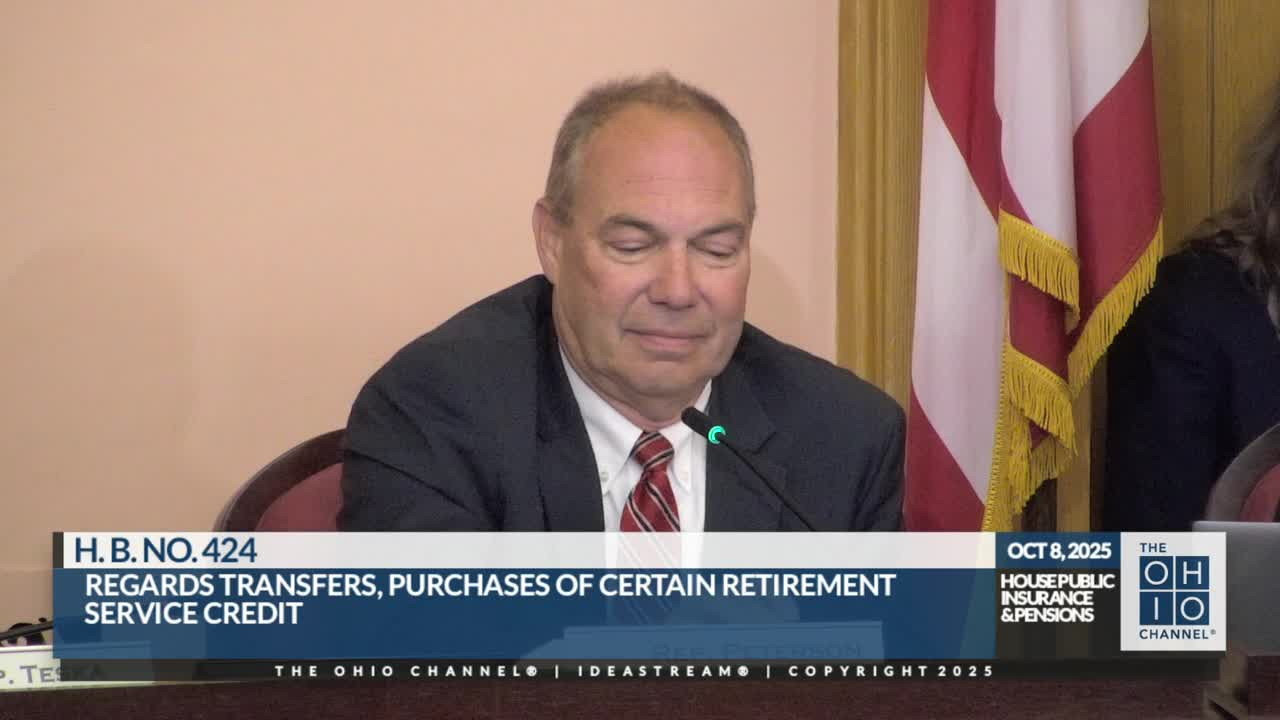
Representative Willis and joint sponsor Representative Craig presented sponsor testimony on House Bill 424, which they described as an effort to restore portability of service credit between the Ohio Police & Fire Fund and OPERS' law‑enforcement section.
Representative Willis and joint sponsor Representative Craig presented sponsor testimony on House Bill 424, which they described as an effort to restore portability of service credit between the Ohio Police & Fire Fund (OPNF) and the law‑enforcement section of the Ohio Public Employees Retirement System (OPERS LE).
"What I'm asking is we try to make that make sense," Representative Willis said, describing a statutory barrier that he said was added in the 130th General Assembly and later closed off except for a brief grace period. He said the change has left some officers unable to make lateral career moves without losing previously earned retirement credit.
Representative Craig told the committee the bill seeks a practical solution: require the two funds to calculate and disclose the value of service credits so officers can make informed choices about transferring. "Give us a number and then calculate what that number equates to over here," Willis said during questioning, urging a mechanical actuarial conversion rather than a blanket requirement that an officer accumulate an equivalent number of active years in the receiving fund.
Committee members raised several technical concerns. Representatives asked whether the number of affected employees is known; sponsors answered that OPERS has some data but that no specific count was available at the hearing. Multiple members pressed the sponsors on actuarial implications, unfunded liabilities, and differences among benefit formulas and contribution rates, and urged the sponsors to consult actuaries and the retirement systems for detailed cost estimates. Representative Miller and others said the calculations are feasible but acknowledged the work is complex. Representative Glassburn asked whether transfers would incorporate individualized actuarial factors or rely on a standardized conversion; sponsors said the bill's intent is to translate years of service into an equivalent credit or value, not to require medical or individualized underwriting.
Speakers referenced a brief grace period that followed the statutory change and said many workers never learned of that window. Representative Craig characterized the change in 2014–15 as a late insertion in a larger bill that unintentionally removed portability. Representatives said they expected more testimony from affected officers and from retirement systems in subsequent hearings.
No formal committee action was taken. The bill received initial testimony and questions; sponsors said they will work with system administrators and actuaries to refine language and analyze fiscal impact before further consideration.