Get Full Government Meeting Transcripts, Videos, & Alerts Forever!
Get email alerts on the Unemployment Insurance Duration topic
No spam. Unsubscribe anytime.
Committee hears bill to cut Ohio unemployment benefit cap to 20 weeks
Summary
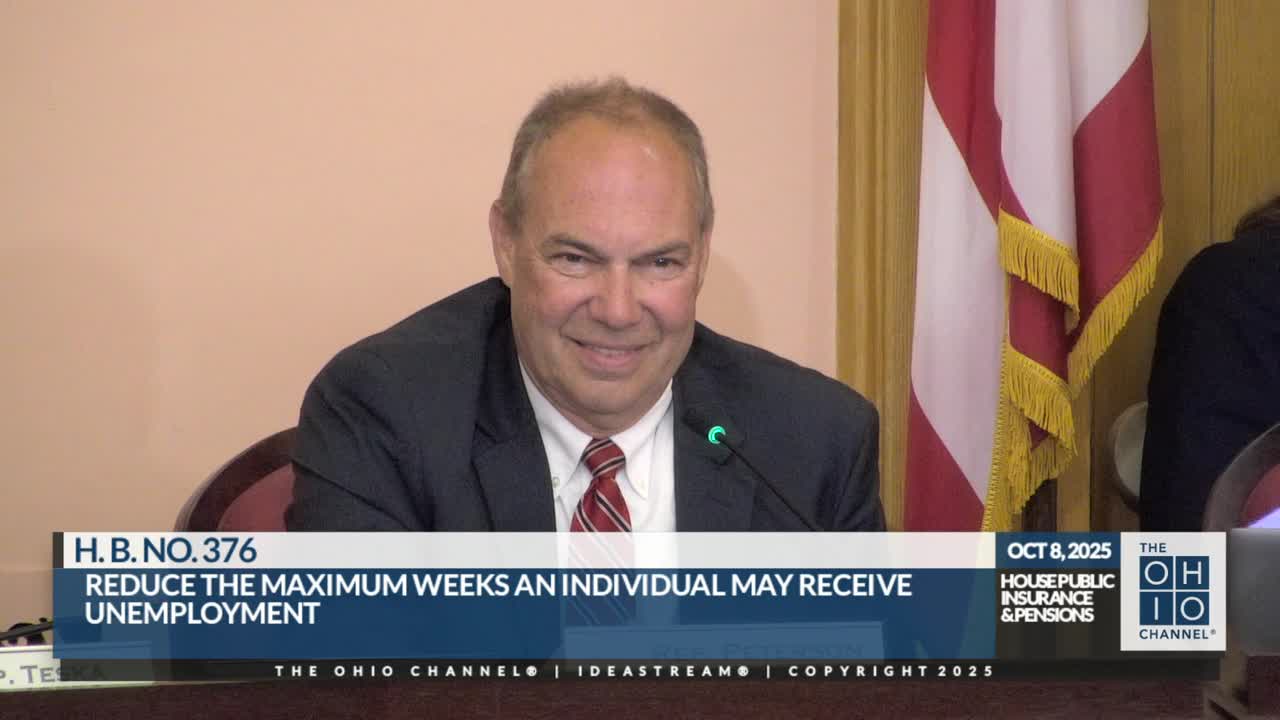
Representative Teska, the bill sponsor, told the House Public Insurance and Pensions Committee during sponsor testimony that House Bill 376 would reduce the maximum number of weeks an individual may receive state unemployment benefits from 26 weeks to 20 weeks.
Representative Teska, the bill sponsor, told the House Public Insurance and Pensions Committee during sponsor testimony that House Bill 376 would reduce the maximum number of weeks an individual may receive state unemployment benefits from 26 weeks to 20 weeks.
"This proposal is a prudent balanced reform that aims to protect the solvency of Ohio's unemployment insurance trust fund, encourage faster reemployment, and better align our benefit system with current labor market conditions," Representative Teska said in opening testimony. Teska told the committee the Ohio Department of Job and Family Services projects the change "would save over $154,800,000 in charges to Ohio's trust fund annually."
The bill's sponsor described three central goals: strengthen the trust fund, encourage quicker returns to work, and align benefit duration with labor market conditions. Teska cited federal and international research — and state figures — to make the case that most claimants do not exhaust the current 26‑week maximum. In testimony the sponsor said Ohio's average claimant spends 13.7 weeks on benefits and that about 23% of claimants exhaust 26 weeks.
Sponsor testimony also referenced the U.S. Department of Labor and a state projection that, if Ohio were to enter a recession, the current trust fund balance could become insolvent within roughly six months. Teska told the committee that shortening the maximum duration by six weeks would "help stabilize the fund and limit the need for future tax increases on employers." The sponsor framed the change as preserving a meaningful safety net while freeing resources to expand reemployment services administered by the Ohio Department of Job and Family Services.
Committee members asked questions about alternatives. Chair Peterson asked whether a variable benefit length tied to the unemployment rate had been considered; Teska said he was "open to discussion" about sliding scales keyed to labor market conditions but described the bill as a straight reduction in its current form.
No formal action was taken; the committee held a first hearing and concluded discussion. The bill will return if scheduled for further hearings or markup.