Get Full Government Meeting Transcripts, Videos, & Alerts Forever!
Get email alerts on the Pension Reform Opnf topic
No spam. Unsubscribe anytime.
Committee hears broad proponent testimony for House Bill 280 to raise police employer contributions to OP&F
Summary
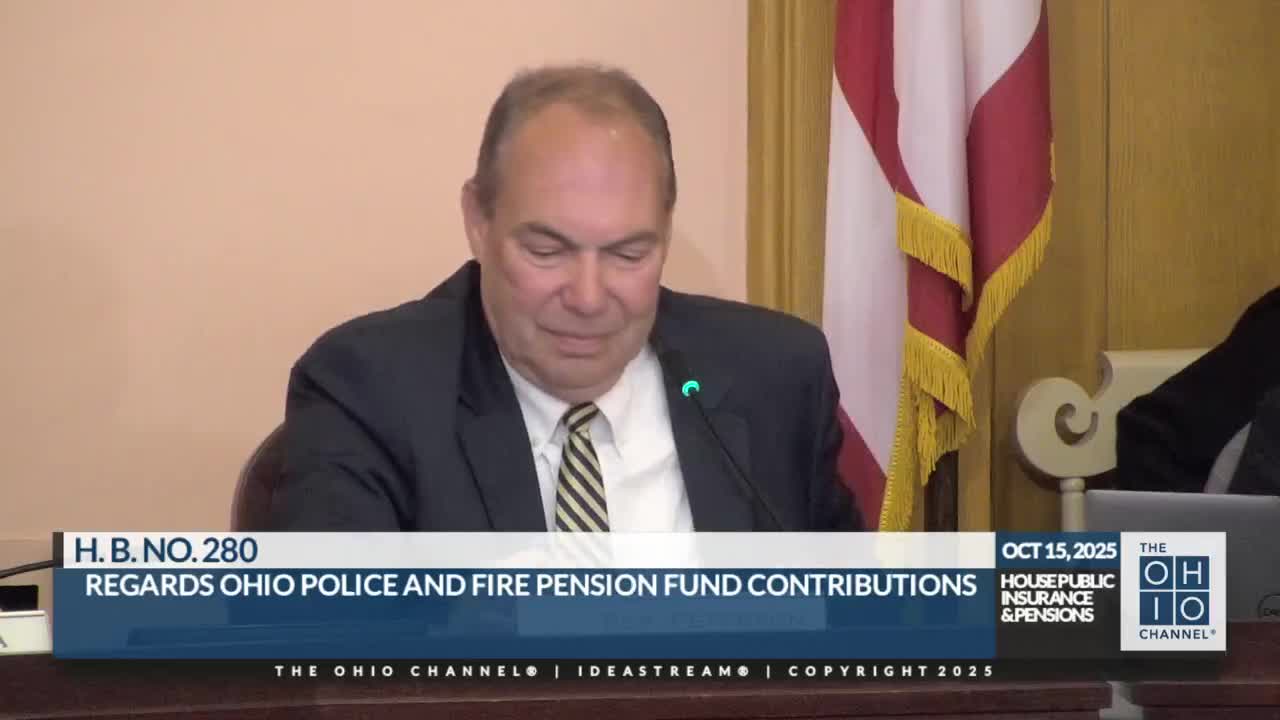
The House Public Insurance and Pensions Committee heard proponent testimony on House Bill 280, which would phase police employer contribution rates to 24% and add actuarial guardrails intended to keep OP&F’s amortization period within 30 years.
The House Public Insurance and Pensions Committee heard proponent testimony on House Bill 280 on Oct. 29, 2025. The bill would raise the employer contribution rate for municipal police from 19.5% to 24% over five years, require the Ohio Police & Fire Pension Fund (OP&F) to keep its amortization period within 30 years, and permit limited, actuarially triggered employer contribution adjustments capped at 0.5 percentage points in a single year and 1.5 points over three years.
Why it matters: Supporters said the measure restores long-standing parity between police and firefighters, protects retirement benefits that attract and retain first responders, and reduces the risk of larger, more costly fixes later. Several witnesses framed the proposal as incremental and actuarially grounded, and tied it to recruitment and public-safety consequences if the fund’s structural imbalance is not addressed.
“House Bill 280 is a fair and rational solution,” said Jay McDonald, chief of police in Marion and state president of the Fraternal Order of Police of Ohio. McDonald and other police leaders testified that the state’s police retirement funding is out of balance with firefighters and that past benefit cuts and contribution increases have fallen heavily on members instead of employers.
John Harvey, president of the Ohio Association of Professional Firefighters, said the bill phases in increases for police employer contributions while preserving actuarial guardrails and reporting requirements. “This legislation brings the Ohio Police and Fire Pension Fund into the modern era,” Harvey said, urging lawmakers to adopt the proposal to preserve retirement security for public-safety workers.
Marybeth Foley, executive director of the Ohio Police & Fire Pension Fund, summarized fund history and data during her appearance. Foley noted the fund’s membership and recent investment performance while restating that active and retired members have accepted substantial cuts and changes—she cited $3.2 billion in cumulative reductions and said average retirement age has risen by roughly six years (from about 48 to about 54). Foley told the committee the bill’s design aims to equalize rates and provide actuarial discipline through the Ohio Retirement Study Council (ORSC) audits and routine stress testing.
Other witnesses emphasized similar points from different perspectives. George Sokolakis of the Ohio Patrolmen’s Benevolent Association described the staffing crisis in law enforcement and said officers now face the highest employee contribution and among the lowest employer contributions compared with peer plans. Donovan O’Neil, state director of Americans for Prosperity Ohio, supported the measure’s move toward an actuarially driven funding mechanism, calling it a way to “avoid a fiscal cliff” and reduce long-term taxpayer risk.
Representatives of municipal employers and some local-government groups were mentioned in testimony as having offered limited alternative proposals; several union leaders said they had not been contacted for sustained, joint negotiations about employer-side solutions. Witnesses repeatedly described the bill as phased and measured to give local governments budget runway to adapt. Testifiers from firefighter and chiefs associations, including Steve Agenbroad of the Ohio Fire Chiefs Association and Steve Stein of Columbus Firefighters Local 67, said parity between police and fire employer rates is a logical and fair step that will protect recruitment and retention.
What the bill would do, in practice: - Increase the police employer contribution rate to 24% over five years (1 percentage point per year under the bill’s current language). - Require reporting and a 30-year cap on amortization for unfunded liabilities; if amortization exceeds 30 years, limited board authority would allow small annual rate adjustments (no more than 0.5 percentage points in a single year; capped at 1.5 points across three years). - Preserve ORSC oversight, independent actuarial audits and annual stress testing.
Supporters said the bill is not intended to be a sudden budget shock to municipalities; several witnesses described it as an incremental fix that avoids deeper benefit cuts or steeper employer burdens later. Opponents were not heard during this hearing; the committee received multiple written statements and proponent witnesses representing active members, retirees and public-policy groups.
The committee did not take a vote during the hearing; testimony was received and the panel adjourned the HB 280 hearing after questions and answers.
Ending: Supporters framed HB 280 as a fiscally disciplined, phase-in approach aimed at long-term solvency and recruiting stability. Committee members asked for actuarial and stress-testing detail; the OP&F director offered to provide additional datasets and modeling to the committee for further review.