Get Full Government Meeting Transcripts, Videos, & Alerts Forever!
Get email alerts on the Rulemaking Updates topic
No spam. Unsubscribe anytime.
Tennessee board adopts broad rule update, adds interior-design definitions and other clarifications
Summary
The Tennessee Board of Architecture and Engineering Examiners on Aug. 7 adopted a comprehensive set of rule amendments that clarify licensure pathways, continuing education and definitions including a new definition for the practice of interior design.
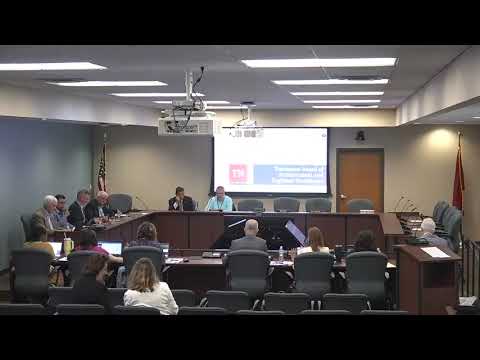
The Tennessee Board of Architecture and Engineering Examiners on Aug. 7 held a public rulemaking hearing and adopted a broad package of rule amendments intended to clarify licensing pathways, continuing education, renewals and definitions for the professions regulated by the board.
The board, sitting in Nashville and meeting electronically, heard staff read the proposed amendments into the record, received limited questions from board members and approved the rules by roll-call vote.
Why it matters: The package updates regulatory language across multiple chapters and is the product of an extended review process. It affects the board's interpretation of education paths to licensure, continuing education carryover rules, renewal calculations and how the board defines the practice areas it regulates, including an explicit definition of "practice of interior design." Those clarifications will guide licensees, applicants, education programs and third parties about what activities require a license.
What the rules change (high-level): Staff summarized many edits during the hearing. Key points the board recorded included: - Education pathways: the rules were amended to allow additional pathways to licensure, including recognition of certain postgraduate degrees with engineering curricula as qualifying for engineering licensure pathways. - Renewals and late fees: language that calculated late fees on a fractional-month basis was removed so late fees are determined monthly; language limiting retirement to age 62 was removed. - Continuing education: professional development hours (PDHs) may not be carried into future calendar years for all registration types; evidence-of-preplanning requirements for certain credits were removed. - Definitions and scope: the board added a definition of the "practice of interior design" and included interior designers in several rule sections, but staff removed an inadvertent requirement that would have forced interior designers to hold a separate firm certificate of authorization. - Disciplinary and civil penalties: the rules revised penalty language to specify that civil penalties will range from $500 to $1,000 in the sections affected.
Hearing and comment: Laura Martin, chief counsel for the Department of Commerce and Insurance, opened the hearing, described the statutory hearing process under TCA 4-5-204 and read the proposed rule text and summaries into the record. Staff said they received written questions and made a limited set of clarifying edits before final adoption (notably the removal of the firm-permit requirement for interior designers that had been unintentionally created when interior designers were included throughout the rules).
Board discussion centered on duplication of interior-design language (some sections repeat language already present in a standalone interior-design chapter) and on ensuring the authority citations matched the currently applicable statutes. Board members asked for and received staff confirmation that references to the now-sunsetted professional privilege tax had been removed where appropriate.
Votes and additional statements: The board adopted the rule package by roll-call vote; the transcript records a unanimous affirmative roll call on the primary adoption motion. The board also adopted related regulatory statements required by government committees (regulatory flexibility addendum and an impact-on-local-government statement) and submitted the required responses for the Joint Government Operations Committee.
Next steps: Staff will route the adopted rules through the department and the attorney general's office for the required legality review. Once approved by the attorney general, the rules will be filed with the Tennessee secretary of state and (per statutory timing) will become effective 90 days after filing unless otherwise stayed.
Quote: "The purpose of these definitions is to offer more clarity to licensees and nonlicensees about what the board considers to be the practice of the professions of the board," Laura Martin said while reading the hearing notice and rule summaries into the record.
Ending: The hearing concluded with no written public comments filed during the meeting and staff noting they would submit the adopted rule package for the attorney general's review and secretary-of-state filing.