Get Full Government Meeting Transcripts, Videos, & Alerts Forever!
Get email alerts on the Tobacco Retail Licensing topic
No spam. Unsubscribe anytime.
Committee backs tobacco, nicotine and vapor retail licensing bill with fines, annual checks and a new ABC division
Summary
Senate Bill 100 would create a tobacco, nicotine and vapor products licensing division within the Department of Alcoholic Beverage Control, require retailer licenses for all nicotine products, impose annual compliance checks, and set escalating fines and criminal penalties for violations; the Senate committee gave the bill a favorable report.
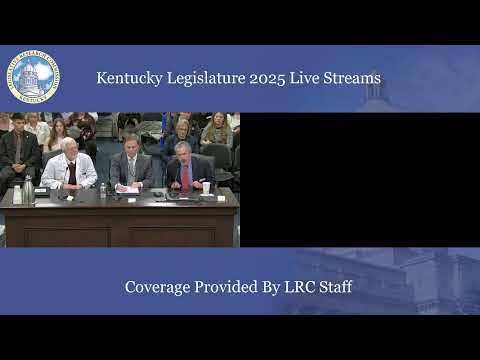
The Senate Standing Committee on Licensing and Occupations voted to report Senate Bill 100 favorably on Feb. 18, 2025, approving a substitute (PSS 1) that would create a retail licensing and enforcement regime for tobacco, nicotine and vapor products in Kentucky.
Sponsor Sen. Jimmy Higdon described the bill as a supply‑side enforcement measure to reduce youth nicotine use and “stop the supply of vapes and cigarettes to underage” customers. The bill would establish a Division of Tobacco, Nicotine and Vapor Products within the Department of Alcoholic Beverage Control (ABC). Under the bill as presented to the committee, that division would develop administrative regulations, conduct inspections of premises where products are manufactured, stored or sold, and perform annual compliance checks of retailers.
Key elements described in the hearing include: - Licensing and fees: Any person, firm or corporation selling tobacco, nicotine or vapor products must obtain an annual license. The sponsor said the annual license fee would be $250 and there would be a $50 application fee, comparable to a beer license. - Enforcement and penalties: Escalating penalties for retail violations were described: a first offense for selling to underage persons would prompt a $100 fine to the sales clerk and a written warning to the owner; second and third violations would carry larger fines (sponsor described $500 and $1,000 for retailers at subsequent violations); a fourth violation could result in license revocation and a two‑year bar on reapplication. The sponsor also described criminal penalties for operating without a license — e.g., first offense class B misdemeanor, second offense class A misdemeanor and third/subsequent offenses class D felonies — and heavy fines for wholesalers who distribute unauthorized products (the sponsor referenced $5,000 for a first citation and $15,000 for subsequent citations). The bill also authorizes ABC investigators to seize contraband as part of enforcement. - Compliance funding and education: The sponsor said 50% of collected fines would fund enforcement and 50% would support youth education programs about nicotine and vaping. The department would publish and monthly update a list of licensed retailers. - Youth penalties and diversion: The bill allows requests that persons under 21 found in possession be referred to community service or tobacco‑cessation programs; sponsor indicated that language may be strengthened later from “may” to “shall.”
Youth testimony: The committee heard from Delaney Crump, a freshman and youth advisory board member for the University of Kentucky’s “I Can End the Trend” program. She described industry marketing, flavored products and nicotine’s effects on developing brains: “Nearly 1 in 10 middle school students and 1 in 5 high school students use e‑cigarettes,” she told the committee, and urged stronger enforcement of the Tobacco‑21 law and annual compliance checks.
Retail perspective: Tony Florence of the Kentucky Smoke Free Association, who owns vapor stores and a distribution center, said he supports licensing as a way to bring “accountability to the industry” and to identify bad actors. He raised definitional concerns about the bill’s scope — specifically language that could sweep hemp or future medical‑marijuana vapor products into the definition of unauthorized products — and suggested the effective date might be delayed to allow for pending U.S. Supreme Court action regarding the FDA’s premarket tobacco product application (PMTA) process.
Sponsor Sen. Higdon said the measure is targeted at bad actors and that the majority of retailers follow the law. He closed by telling the committee the bill “has teeth” and “This bill is about holding bad actors accountable.”
The committee adopted the substitute and gave SB 100 a favorable report. Committee members from both parties expressed support in floor explanation statements, and senators urged complementary prevention and cessation resources for youth.
What’s next: With a favorable committee report, SB 100 will move to the full Senate for further consideration and amendment.