Get Full Government Meeting Transcripts, Videos, & Alerts Forever!
Get email alerts on the Strategic Planning topic
No spam. Unsubscribe anytime.
Parkland commission workshop focuses on long-term vision, demographic shifts and Hendricks land legacy
Summary
At a Feb. 19 workshop, commissioners discussed strategic-plan priorities including preserving Parkland's "country elegant" character, preparing amenities for changing demographics and opening dialogue about the future of the privately owned Hendricks property.
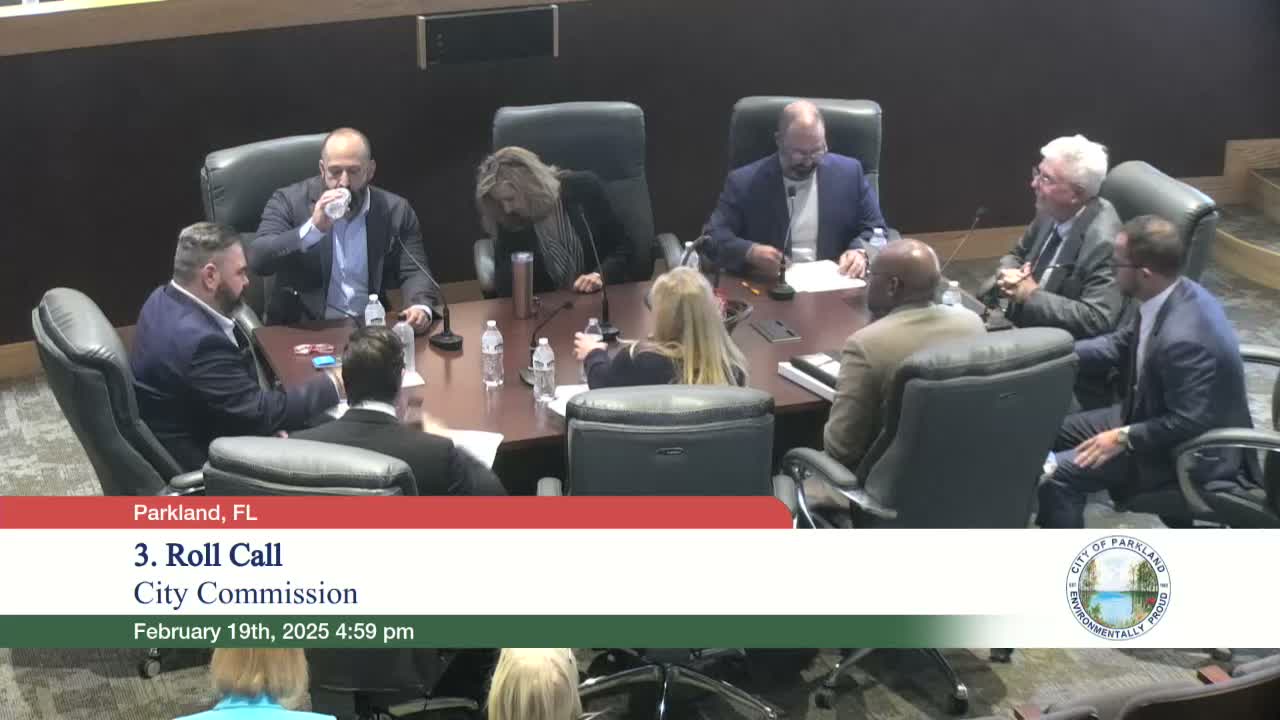
The City Commission of Parkland held a strategic-plan workshop on Wednesday, Feb. 19, where commissioners and staff discussed demographic trends, ways to preserve the city's character and how to engage with the owners of the large Hendricks property as its future is considered.
Facilitator Herb opened the discussion by asking the commission to step back and define the "vision" the city is trying to achieve. "I want this community to stay safe," Herb said, and he urged the commission to consider both short-term choices and longer-term demographic shifts that could produce more "empty nester" households over time.
The discussion centered on three themes: the possibility of gradual demographic change, how to keep Parkland distinctive as it grows, and the future of the roughly 700-acre Hendricks property along the city's northwest boundary. Commissioners said Parkland remains heavily family-oriented today — evidenced by capped recreational leagues and high park and school use — but they noted population additions in new subdivisions that may alter needs over decades.
Commissioners praised existing efforts such as the village project and additional parks as ways to diversify amenities. Several speakers argued the city can grow without sacrificing the "small-town" feel by focusing on high-quality design, landscaping, public art and preservation of open space. One commissioner summarized the aspirational brand as "country elegant," meaning the city would keep rural and equestrian elements while accommodating higher-level services and carefully designed retail.
The commissioners also discussed the Hendricks property, which multiple speakers described as private land with multi-generational ties. Participants agreed the city ought to prepare for several possible futures, including continued farming, a sale to a large developer, or an annexation scenario. Commissioners and staff reported ongoing, informal contacts with the landowner and recommended proactive outreach focused on legacy and preservation options rather than only financial inducements. As one participant put it, the commission should consider ways to "honor the history and legacy" of the land in any future negotiation.
No formal policy or binding agreement was adopted at the workshop. Commissioners requested that these topics — branding, parks and programming choices, and options for engaging the Hendricks family about legacy and annexation frameworks — be carried forward to the April strategic-planning session for further review.
Commissioners and staff asked staff to assemble background materials and demographic projections to inform the April session and to continue contact with the Hendricks family to explore interest in legacy-preserving options.
The discussion closed with commissioners reaffirming that Parkland's schools, parks and design decisions will shape whether new and existing residents choose to remain as the community evolves.