Get Full Government Meeting Transcripts, Videos, & Alerts Forever!
Get email alerts on the Public Safety Policing topic
No spam. Unsubscribe anytime.
DESPP outlines staffing shortfalls, duty‑reassignment plan and crisis‑response goals; lawmakers press for DRE training and roadmap for co‑responder expansion
Summary
Commissioner Ronnell Higgins and Connecticut State Police Colonel Daniel Lachman briefed the committee on a trooper shortfall (about 200 vacancies), a plan to move troopers out of administrative roles and replace them with civilian hires to reduce overtime, a 7.5% OT reduction in recent months, co‑responder pilot activity funded by federal grants,
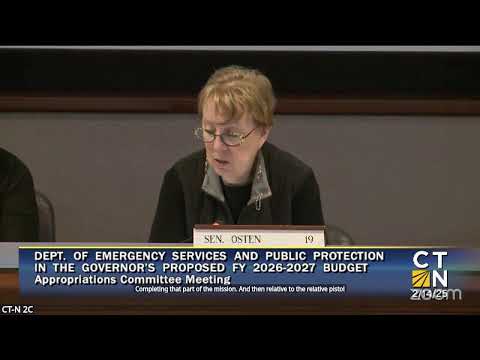
Department of Emergency Services and Public Protection Commissioner Ronnell Higgins and Connecticut State Police Colonel Daniel Lachman told the Appropriations Regulation and Protection Subcommittee on Feb. 14 that severe staffing shortages and operational demands are driving an effort to reassign duties, reduce overtime and expand crisis‑response models.
Higgins said the department currently fields about 928 troopers and estimated roughly 200 vacancies across the State Police. He described a multistep plan to identify administrative positions occupied by sworn troopers and replace those roles with qualified civilian hires so troopers can return to patrol duties. “We’re gonna do an analysis to determine how we can get troopers that are currently occupying administrative roles that don’t necessarily require a sworn member to do back into positions in the field and identify civilians that can do that work,” Higgins said. The governor’s budget reflects a duties‑assessment reduction ($3 million year‑one, $6 million year‑two) tied to that plan.
Colonel Lachman told lawmakers the department has already cut overtime about 7.5% over a recent three‑month period through schedule adjustments, tighter approval controls and expanded use of technology and intelligence units. “We’re utilizing a data driven approach… we did direct saturation patrols to those areas, and we’ve had some great success,” he said, describing targeted enforcement to reduce reckless driving and auto theft in partnership with municipal police and task forces.
On crisis response, Higgins said an existing federally funded co‑responder model currently operates in four troops; the department supports expanding co‑responder coverage but noted federal grants subsidize much of the existing effort. Higgins and Lachman also discussed drug‑recognition expert (DRE) training: Connecticut State Police currently have 14 DRE‑trained troopers and the department is considering creating in‑state training capacity to serve Connecticut and local police agencies rather than sending officers out of state.
Why it matters: the State Police shortage and overtime levels affect highway safety, criminal investigations and response to emergencies. The department faces near‑term budget pressures but sees a potential multi‑year path to reduce overtime and redeploy sworn personnel where they provide the most public safety value.
Follow‑up and requested materials: lawmakers asked the department for a detailed plan and timeline for the duties‑assessment reassignments, a cost estimate for expanding co‑responder coverage across more troops, a DRE training cost estimate and an update on pistol‑permit backlog figures. Lawmakers also requested equipment and barracks upgrade lists for local working‑group review.
Ending: The department agreed to provide the requested staffing analyses and program cost estimates for committee working groups, with an eye toward balancing service needs and fiscal constraints.