Get Full Government Meeting Transcripts, Videos, & Alerts Forever!
Get email alerts on the After School Program topic
No spam. Unsubscribe anytime.
Committee reviews $300 annual fee proposal to offset county subsidy for middle‑school after‑school program
Summary
At the Oct. 7 Health and Human Services Committee meeting staff presented a proposal to introduce a $300 one‑time annual fee for the Fairfax County middle‑school after‑school program, exempting students eligible for free and reduced‑price meals. Staff estimated roughly $1.1 million in revenue and recommended reducing the NCS general fund transfer;
Fairfax County Health and Human Services Committee members heard a staff proposal on Oct. 7 to reduce the county subsidy for the middle‑school after‑school program by charging families a $300 one‑time annual fee, with students eligible for free and reduced‑price meals exempted. County staff estimated the fee could generate about $1.1 million annually and proposed reducing the Neighborhood and Community Services (NCS) general fund transfer by that amount; staff also recommended, beginning in fiscal 2027, that the remaining $2.8 million be included as an annual transfer to Fairfax County Public Schools (FCPS).
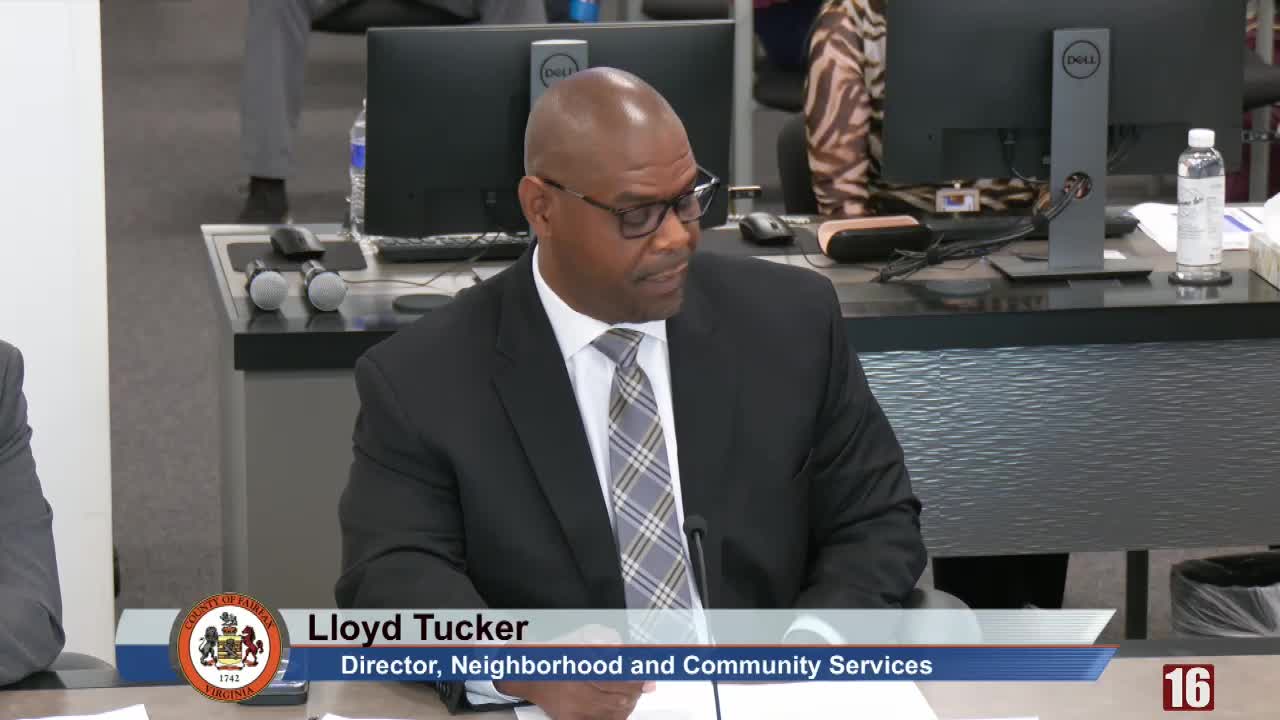
The recommendation grew from a Board of Supervisors directive to explore ways to reduce the net cost of the program. Lloyd Tucker, Director of Neighborhood and Community Services, said NCS funds primarily cover the salaries and benefits for the after‑school specialist positions while FCPS covers hourly staff, snacks, equipment, vendor programming and late bus transportation. Tucker summarized that NCS general fund expenditures supporting the program are roughly $3.9 million annually.
Chad Preston, Deputy Director of NCS, presented program participation data and explained why staff favored a single annual fee rather than a sliding income‑based scale. Preston said attendance data for the 2024–25 school year show frequent drop‑in usage: about 69% of participants attended fewer than 19 days in the year and roughly 81% attended fewer than 30 days. He said the administration assumed that many low‑attendance families would not pay a fee and that students qualifying for free and reduced lunch would be exempt. "We recommend the one‑time annual fee charged to families," Preston said, noting the county and schools could use the existing MySchoolBucks system to collect fees.
FCPS program administrator Dr. Mark Emery told the committee the school system values the program’s outcomes and is "really opposed to charging fees for a public school program," though he said school staff worked with county staff on an "equitable plan." Emery and other presenters cited analysis that students who attend 30 or more days show better academic and behavioral outcomes; Emery said regular after‑school participation correlated with higher daytime attendance and fewer behavior referrals.
Supervisors pressed for more detail. The committee chair and several members asked for participation broken down by school, saying participation varied widely across schools and that comparison by site was necessary to assess equity and program reach. One supervisor noted that the presentation's summary table could be misread as implying 100% of middle‑school students participate; presenters clarified FCPS has about 27,000–28,000 middle‑school students and participation is a subset of that population. Committee members also asked whether FCPS costs—particularly the late‑bus expense the presentation identified as about $4.8 million—had been reviewed for efficiency and whether program staff assignments duplicated district or county roles.
Staff described assumptions behind the revenue estimate: exempting free/reduced lunch students, using MySchoolBucks to collect fees, and estimating nonpayment among low‑attendance tiers (Preston said the analysis treated those with 1–19 days as unlikely to pay and assumed roughly 60% of the 20–29 day tier would not pay). Committee members asked staff to provide a clearer tiered revenue model and the underlying calculations.
Several supervisors urged additional analysis before any decision. Requests included: per‑school participation and attendance trends; program outcomes tied to attendance (grades, behavior, chronic absenteeism); capacity and staffing requirements if participation increased; how teacher‑led academic support and sports were funded and whether they would continue under a fee model; and a more detailed breakdown of the $1.1 million revenue estimate. Dr. Emery and staff indicated many programmatic decisions — including whether to charge a fee — remain FCPS decisions.
The committee took no vote. Members asked staff to return with school‑level participation data, a transparent revenue model and a clearer description of administrative steps (including how MySchoolBucks would identify fee‑exempt families and how late‑bus and other FCPS fixed costs would be treated). Several supervisors recommended exploring non‑fee efficiencies and closer coordination between county providers and FCPS to improve equity in participation before adopting a fee.
The committee meeting adjourned with staff directed to provide follow‑up information and to accept written questions from supervisors.