Get Full Government Meeting Transcripts, Videos, & Alerts Forever!
Get email alerts on the Curriculum Development topic
No spam. Unsubscribe anytime.
Greenwich summer curriculum institute: new courses, aligned pacing guides and modern band at high school
Summary
District staff reviewed K–12 curriculum work from the summer institute, including updated pacing guides, new and revised units across world language, ELA, math, science and social studies, and a new modern band honors course at Greenwich High School.
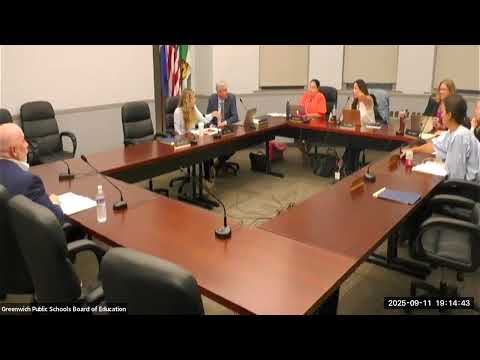
Greenwich School District staff reported on the 2025 Summer Curriculum Institute at the Sept. 11 board meeting, describing cross-department work to revise pacing guides, align units and launch new course offerings — including a modern band honors course at Greenwich High School.
Leah Stillman, the district’s new K–12 arts coordinator, described the new modern band course, an honors quarter-credit class initially enrolling about 40 students. Stillman said students must have already completed the district’s full-time six-block music class to enroll. The course will form student ensembles (vocalist, guitar, bass, drums and auxiliary), teach improvisation, songwriting, sound reinforcement and audio engineering techniques, and require students to plan and perform four shows during the year. Stillman said the district selected MusicFirst, a cloud-based platform, to support student composition and teacher assessment.
Other summer projects spanned departments. World-language staff revised K–5 curriculum and adopted a new middle-school text; high-school language teachers refined Spanish courses and sought appropriate texts for native-Spanish programs. ELA teams built new writing units for grades 3–5, integrating grammar instruction, student-facing research resources, and district-level graphic organizers. Middle-school ELA will send “home letters” at the start of units to improve home–school communication. Math staff refined precalculus and calculus resources and reported continued success in the district’s early-entry (“0 block”) high-school math pipeline. Science teachers worked to increase hands-on labs in AP courses and create lab books and scaffolds for on-level biology and practical chemistry. Social-studies faculty put a new requirement into the sophomore American history research paper: students must add a field-engagement component, such as an interview or museum visit; honors electives will include in-class essays and oral components to limit misuse of AI.
Multiple departments said the summer work intentionally focused on vertical alignment (K–12) so students progress through consistent expectations. Staff repeatedly framed the changes as reducing teacher preparation burdens — providing pre-vetted lesson slides, student-facing Padlets and pacing guides so teachers can spend more time on instruction.
Board members asked about staffing and sustainability, especially for media/ library supports and co-teaching models; staff said rollout plans considered current staffing and scheduled further evaluation during the year.
The board did not take formal votes on curriculum items during the Sept. 11 presentation; department leaders said they will return with additional materials and student outcomes later in the school year.