Get Full Government Meeting Transcripts, Videos, & Alerts Forever!
Get email alerts on the Sales Tax Transportation Infrastructure topic
No spam. Unsubscribe anytime.
Charleston County asks residents to weigh in on proposed half‑cent sales tax to fund roads, transit and green space
Summary
County staff outlined a 25‑year, $4.25 billion outreach plan funded by a proposed half‑cent sales tax, seeking public input on investment priorities including pavement preservation, transit and greenbelts; officials noted legal limits on using sales tax money for flood mitigation unless paired with road projects.
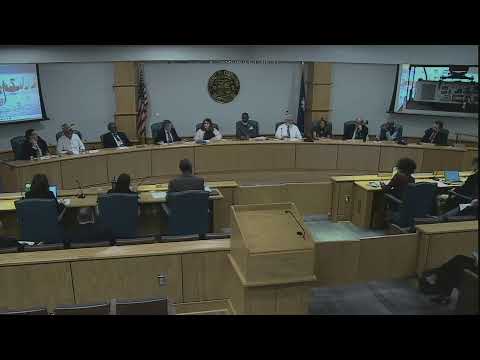
County staff presented an outreach plan to Charleston County Council on outreach and proposed investment priorities tied to a potential half‑cent local sales tax, asking municipalities and residents which categories — roads, transit, greenbelts and bicycle/pedestrian improvements — they would like to prioritize.
The presentation said the program is being framed as a 25‑year, $4.25 billion package or a 25‑year term, whichever comes first. Staff asked residents to submit preferences through an online questionnaire by Dec. 1 and said the county will compile responses and return to council in January 2026.
The staff presenter said the sales tax has been able to leverage outside funds, estimating about $1.2 billion in federal and state matching dollars raised through prior sales tax investments. "We estimate about half or 50¢ of every dollar actually comes from outside of Charleston County residents," the presenter said, noting tourists and commuters contribute to the tax base.
Pavement preservation was a highlighted need. The presenter said Charleston County's percentage of pavement in better condition compares favorably to the rest of the state and attributed that to investments since 2004 and a 2016 resurfacing program. Staff said resurfacing currently runs about $10 million a year when combined with C funds and estimated the county will need roughly $30 million to $32 million a year going forward to maintain pavement condition.
Transit and the Lowcountry Rapid Transit project were cited as direct beneficiaries of sales tax funding. The presenter said bus service miles and passenger trips have increased substantially over the past 20 years and that fleet, shelter and route improvements have been funded through the program.
Staff described outreach activity to date: the project website recorded about 2,100 unique users in roughly a week after launch, and the online questionnaire had 863 participants at the time of the presentation. Staff said three municipal meetings had already been held (Folly Beach, Town of James Island, Town of Ravenel) and additional meetings were scheduled, including planned visits to Meggett, Seabrook and the City of Charleston. The presenter said the county will "use every opportunity we can to get the word out," including a 17 at Main Road briefing the following week.
Council members raised flood mitigation during the sales tax discussion. Council member Grabrowski asked whether increasing the greenbelt allocation could be used creatively to address flooding alongside roads. The presenter responded that the outreach is seeking all ideas but that any uses must operate "within state law" and the county will review eligibility.
Council member Moody (speaking during the same discussion) said the Department of Revenue had told the county that sales tax proceeds generally "could not be used for flood mitigation unless it was related to a road project," citing the need to tie drainage work to capital road projects to keep the funding eligible.
County counsel Kobrowski was asked about greenbelt program rules and deferred to staff member Aaron Davis for details. The presenter told council staff will research the legal parameters and return with more information.
The presenter described the online questionnaire tool as a $100 budget slider allowing respondents to distribute hypothetical dollars across investment categories rather than selecting percentages, an approach staff said makes public preferences easier to aggregate.
Staff reiterated the input deadline of Dec. 1 and invited residents, HOAs and municipalities to participate in upcoming workshops and scheduled briefings. The presenter concluded the formal presentation by inviting questions.