Get Full Government Meeting Transcripts, Videos, & Alerts Forever!
Get email alerts on the School Budget topic
No spam. Unsubscribe anytime.
Scotia-Glenville board adopts $614,964 spending cap after heated debate over cuts to reading support and building maintenance
Summary
The Scotia-Glenville Central School District Board of Education voted to adopt a $614,964 spending cap for the 2025–26 budget revote after extended discussion of two scenarios: one that preserves two reading teachers and a librarian and one that shifts deeper cuts to buildings, grounds and transportation.
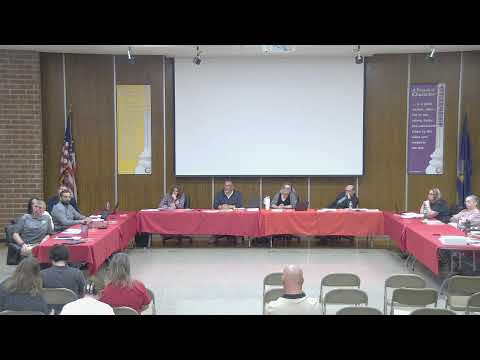
The Scotia-Glenville Central School District Board of Education on March 30 adopted a spending cap of $614,964 for the 2025–26 budget revote, ending several weeks of public debate over two competing scenarios for closing a roughly $2.8 million gap in the district’s finances.
The vote fixes the dollar amount the district will present to voters on June 17 while leaving board members the option to choose how that money is allocated. Board members spent most of the meeting weighing two paths: “Option B,” which preserves instructional staff including two reading teachers and a librarian, and “Option A,” which aimed to keep those positions by making larger cuts in general support, building-and-grounds services and transportation.
Why it matters: Board members and district administrators said the district’s fund balance will drop below 1% for the first time in 20 years unless cuts or other steps are taken. Administrators warned that the alternative — a contingent budget if the revote fails — would impose much deeper, legally constrained cuts. Parents and residents told the board preserving reading support was essential for students recovering from pandemic learning loss.
Superintendent Susan and Drew, an administrator with budget responsibilities, told the board the two scenarios arrive at the same levy limit and the same spending increase but distribute reductions differently. “They end up with the same monetary value. They just get there in two different ways,” Superintendent Susan said, explaining the district must adopt the spending cap so the newsletter, ballots and absentee ballots can be prepared for the June 17 vote.
Public speakers and several board members urged preservation of reading supports. Amy Marlette of 506 Mohawk Avenue told the board the budget situation had been public since November and criticized the pacing of board discussions: “Back in November, you received an email from the business manager that said, ‘Hey, we have a $2,800,000 budget deficit,’” Marlette said. She argued the board should consider closing or repurposing a building to reduce the district’s footprint.
Parent Justin Cook also urged the board to prioritize programs that support student achievement and recovery: “Reading teachers are not classroom teachers ... It was reading teachers that helped [my daughter] get back on track,” Cook said.
Administrators detailed how Option A would preserve three instructional positions but would require “bare bones” cuts elsewhere. Drew said reductions would fall mostly in general support, building and grounds and transportation. He warned many reductions are not “locked in” savings and depend on favorable circumstances such as lower overtime needs, fewer contract transportation runs and modest enrollment changes.
Board members pressed for specifics. Questions focused on concrete line-item reductions administrators proposed: a $30,000 reduction in monitors (fewer substitute monitors called in), roughly $95,000 trimmed from equipment and building-and-grounds contractual lines, and a $150,000 decrease in contract transportation (district-wide outside runs for students placed at out-of-district programs). Administrators said two years ago the district spent roughly $400,000 on contract transportation and that current budgeting for that line is about $187,000.
Administrators cautioned there is minimal cushion across many lines. “We went bare bones on the general support because that's what we're doing to try to support the instruction, but there will be repercussions of this,” Superintendent Susan said, listing impacts that include reduced custodial coverage, slower response to maintenance requests and earlier closures of district offices to the public because of reduced central-office staffing.
Several board members said they preferred Option B because its effects would be more visible in classrooms and direct to students, while Option A’s impacts — fewer grounds and maintenance hours or eliminated discretionary purchases — would be less obvious to parents. “If this budget goes down and we have to go to a contingent budget, you are going to hate it,” Susan warned.
Votes at a glance - Motion to accept report of inspectors of the budget and election: approved. - Final adoption of the 2025–26 budget revote with a spending cap of $614,964: approved (motion made and seconded during the meeting; board voted to adopt the spending cap amount). - Property tax report card for the 2025–26 school year: approved. - Acceptance and appropriation of donations and gifts (listed on the agenda): approved. - Communications, staffing items and placements of students with disabilities (as listed on the agenda): approved (one board member recorded an abstention on a specified sub-item).
What’s next: With the spending cap adopted, district staff will finalize the budget newsletter and prepare ballots and absentee materials for the June 17 revote. Administrators said that once a budget is adopted, they retain the authority to move funds within the spending cap through transfers; by contrast, a contingent budget would legally limit that flexibility.
Board discussion at the meeting also began to sketch a timeline for a district committee to work on longer-term options such as repurposing or closing a school; several board members said any decision to close or repurpose a building should include public engagement and clear planning to avoid moving students multiple times.
The board closed the meeting after a final public comment period that included additional appeals to prioritize reading support and programs that help students catch up after the pandemic.