Denver DOTI outlines 2026 budget priorities, service impacts and program rollouts
Loading...
Summary
Denver Department of Transportation & Infrastructure officials told the City Council budget committee they preserved core services while shifting staffing and funding amid fiscal constraints; officials detailed sidewalk fees, solid-waste performance, Colfax BRT phasing, sidewalk and bridge investments, and changes to right-of-way enforcement and a
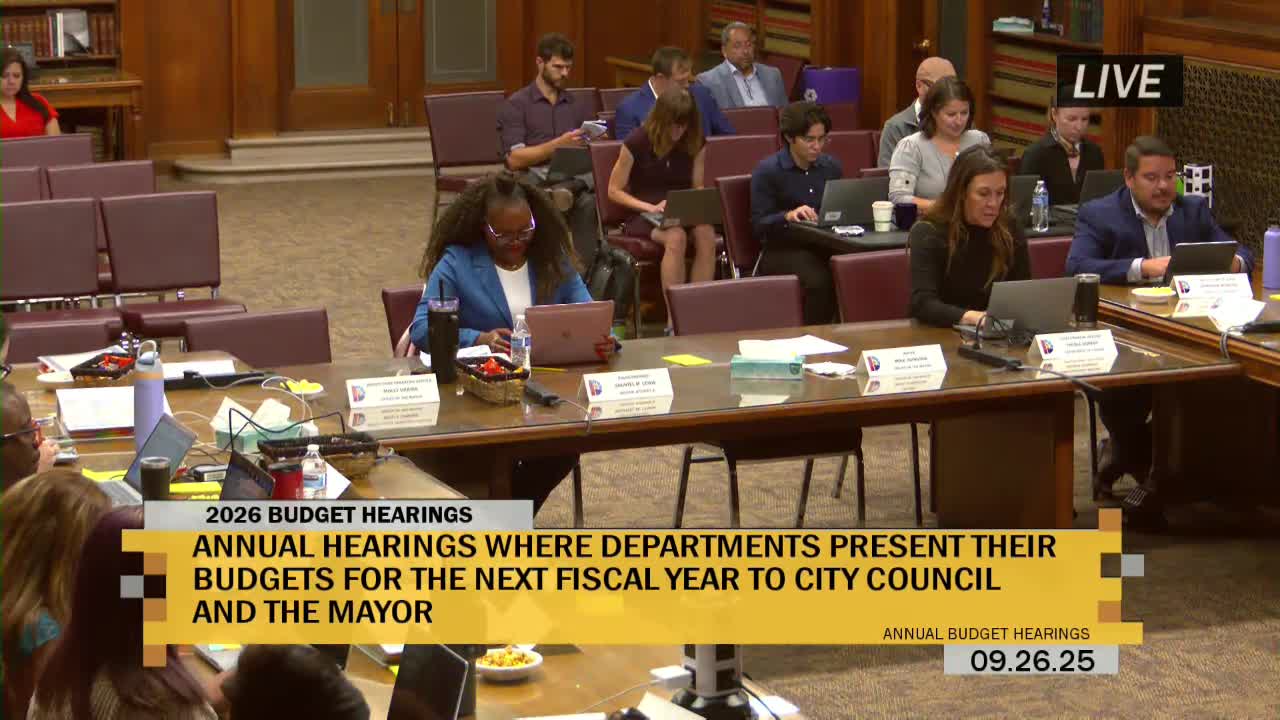
Denver — The Department of Transportation & Infrastructure (DOTI) told the City Council budget committee on Sept. 26 that its 2026 budget preserves core services such as solid-waste pickup, snow removal and project delivery while bearing staffing reductions, shifted vacancies and program reorganizations that will slow some response times.
DOTI Executive Director Amy Ford said the department’s operating budget for 2026 is roughly $426,000,000 and that leaders prioritized keeping frontline services intact even as vacancy reductions and a small number of layoffs required reorganizing deputy roles and moving some personnel into enterprise funds. "We went in and we looked at crucial and critical services. We did not touch our solid waste programs," Ford said. "We did not lay off project delivery personnel. We did not lay off program managers. We did not lay off construction managers."
The department presented specific program effects, near-term goals and follow-ups requested by council members. DOTI officials emphasized three priorities: maintain core delivery of daily services, protect project delivery so key capital projects reach completion, and align investments with equity zones and climate goals.
What DOTI will continue and what will change
Ford said DOTI preserved trash collection and snow removal and is maintaining most frontline operations, while reallocating or eliminating some vacant supervisory and administrative positions. She told the committee DOTI aims to "start 6 projects and open 16 projects" in the coming cycle and cited partial openings anticipated next year for Colfax Bus Rapid Transit (BRT) and the I‑25/Broadway corridor.
The presentation included multiple program-level numbers and near-term service effects: DOTI reported a 99% solid-waste route completion rate for the current year (exceeding an earlier 95% goal), a fleet equipment availability of about 77%, and an estimated pavement condition index near the mid-70s. Capital maintenance in the budget was listed at about $81,000,000 with a roughly $7,000,000 increase targeted to paving preservation. DOTI also said 75% of its mapped capital projects are in the city’s equity zones.
Sidewalk fund rollout and pace
DOTI told the committee it began collecting sidewalk fees this year and expects annual revenue in a full year cycle of roughly $37,000,000 (the partial-year receipts were described as about $28,000,000). Ford said the department is using a program-management partner to complete a sidewalks master plan by year’s end and to sequence spot repairs, targeted projects and larger gap-filling work (she identified Globeville, Elyria and Swansea for larger projects). "We're in specific neighborhoods doing sidewalk repair programs at Sloan's Lake and Berkeley and Cap Hill," Ford said, and DOTI called for a follow-up packet with maps and project schedules requested by council members.
Solid waste, pay-as-you-throw funding and service changes
DOTI officials said they did not cut contracted services for solid waste and credited program changes with improving performance: cart-delivery turnaround was reduced from prior extremes to about a two-week turnaround, and overall route completion reached 99%. However, Finance and DOTI staff described a structural funding gap in the pay-as-you-throw model. DOTI Deputy Chief of Staff Dominic Moreno said the program currently relies on one-time transfers; DOTI Deputy Manager for Wastewater and Solid Waste (Rich Villa was named in the presentation) and the CFO staff said the program remains short of self-supporting revenue. Council members asked for spreadsheets breaking out sources, transfers and uses for sidewalk and solid-waste funds; DOTI and budget staff said they would provide that detail.
Right-of-way enforcement, street sweeping and ticket disputes
Council members raised repeated concerns about right-of-way enforcement, abandoned vehicles and longer 311 response times. DOTI COO Cindy Patton and Deputy Manager for Right of Way Matt Breiner described a staffing and process shift tied to vacancies and changes in the municipal court magistrate procedures for contesting parking citations. Patton said the department had promised not to dispatch enforcement agents to routes that were not swept because of limited sweeper availability; she said sweeper availability has improved but is not fully restored. "If that route is not being swept, we're not going to send out an enforcement agent," Patton said.
Breiner described administrative handling of non-dispute ticket issues within DOTI and said citizens who wish to contest a citation must file with the courts for a hearing; DOTI will try to handle administrative corrections (for example, ownership or clerical errors) before a court filing is necessary. "If a person has sold their vehicle or if they have refund or some error made that's not related to the disputing of the citation itself, that is something our team is trying to field before moving it on to the courts for that final hearing opportunity for the citizen," Breiner said. Council members asked DOTI to provide the URL and instructions for disputed-ticket filings.
Colfax BRT, construction impacts and business outreach
DOTI updated the committee on Colfax BRT construction and said a partial corridor opening is planned for next year. Ford and staff described extensive business outreach and construction phasing intended to reduce disruption to businesses and to open finished segments quickly. Ford said DOTI is working to limit the time contractors occupy private lots and to create short-term parking solutions where feasible; council members urged more proactive notices to businesses and residents about closures and parking impacts.
Bridges, wastewater and green infrastructure
DOTI said it increased bridge investments in both capital discretionary and capital maintenance budgets and highlighted large projects such as Quebec Street bridge work. Officials described bridge funding as a multi-year encumbrance program requiring right-of-way and acquisition dollars and said they would continue to triple-check prioritization against asset condition data.
On wastewater and green infrastructure, DOTI said enterprise spending covers stormwater and sanitary capital programs including the ongoing Montbello Channel work and the Globeville levee projects that DOTI expects to continue into 2027. The department said Metro Wastewater Recovery’s treatment fees and inflation are driving part of the operating budget increase for wastewater. Ford also described a new "rapid response" green-infrastructure maintenance effort to sustain pervious infrastructure and park-adjacent assets.
Safe Routes to School and mode-shift efforts
Council members pressed DOTI on Safe Routes to School funding and requested a consolidated list of which schools will receive investments and what capital and non-capital supports (crossing guards, flashing beacons, education) will be provided. Ford said DOTI bundles several funding streams—local SRF, federal grants and CDOT grants—and estimated total Safe Routes investments discussed in the meeting at roughly $650,000 once local and federal sources are combined; she said DOTI would follow up with a clear, itemized breakdown.
Staffing, vacancies, and project delivery risks
DOTI repeatedly told council members that frontline project delivery and area engineers were largely preserved but that the department eliminated or transferred a number of vacant supervisory and administrative roles. Ford said budgeted staff fell from 847 positions in the prior appropriation to 696 budgeted positions in 2026, with DOTI planning to fill many vacancies over time. Council members warned that fewer engineers and construction managers could slow project delivery and increase a project backlog; DOTI acknowledged the risk and said bond projects would be prioritized for delivery and that the department is exploring contracting and program‑management approaches to augment in-house capacity.
What council members requested and next steps
Multiple council members asked for follow-ups and additional data: a spreadsheet of fund sources/uses for sidewalk and solid-waste programs, a Safe Routes to School breakdown by school and cost, the courts' dispute filing URL for parking citations, and district‑level sidewalk project lists. DOTI committed to providing the requested packets and mapping, and staff said they would return with more detailed breakouts linking operating-budget figures to the six‑year capital improvement program.
Discussion vs. decisions
The committee hearing was a budget briefing and did not record formal council votes. DOTI presented proposed allocations and program scopes; council members asked questions and requested follow-up materials. No formal actions or ordinances were adopted during the session.
Why this matters
The presentation laid out trade-offs municipal leaders face when balancing core daily services with long-term capital investment. Council members repeatedly returned to constituent-facing impacts—sidewalk gaps, abandoned vehicles, school crossings and business disruption during construction—while DOTI emphasized efforts to protect essential services and move capital projects forward amid constrained staffing and rising treatment and inflationary costs.
Ending
DOTI staff closed by reiterating the department’s commitment to delivering core services and to follow up with the requested information. Officials told the committee they would provide maps and spreadsheets showing how the sidewalk fee and solid-waste funding streams will be spent and clarified next steps for Safe Routes to School and disputed-ticket procedures.