Get Full Government Meeting Transcripts, Videos, & Alerts Forever!
Get email alerts on the Parks And Placemaking topic
No spam. Unsubscribe anytime.
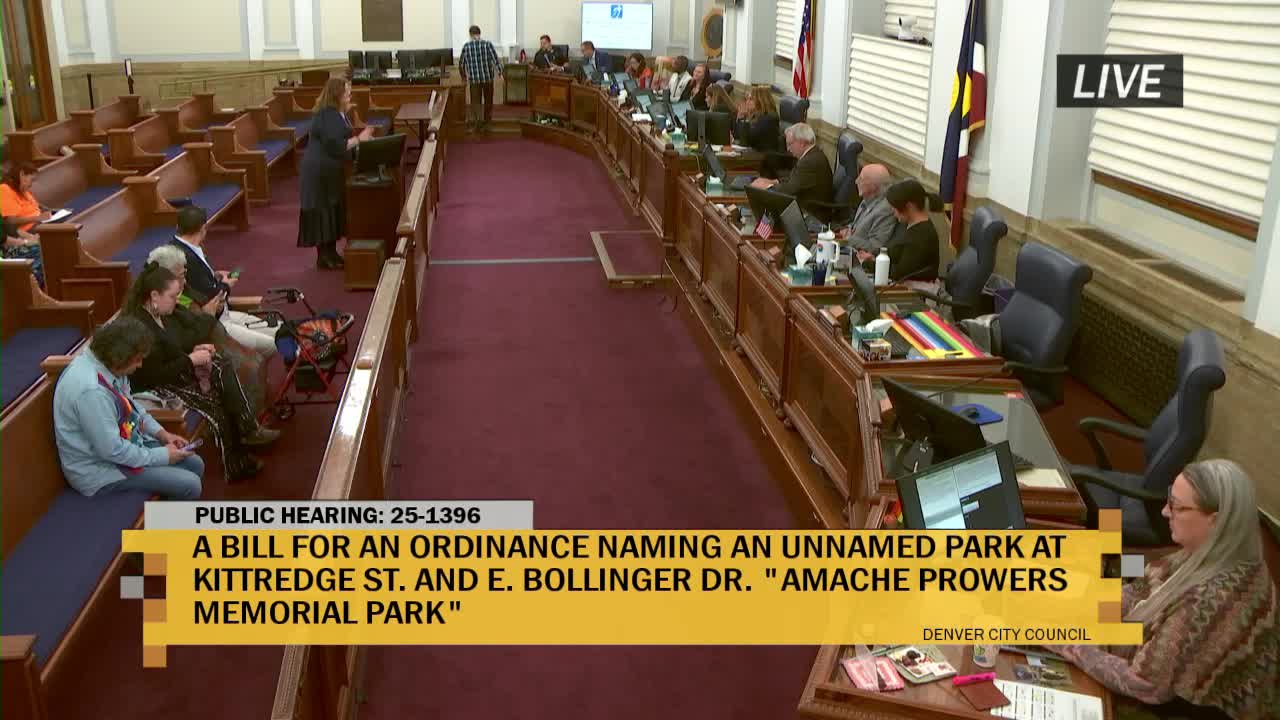
Council names new Far Northeast Denver park 'Amache Prowers Memorial Park'
Summary
Denver City Council voted to name a planned 10‑acre park in Far Northeast Denver 'Amache Prowers Memorial Park'; proponents described the park as a community gathering space and cited the site's historical connections to the Cheyenne leader Amache Prowers.
Denver City Council on Oct. 6 voted unanimously to name a new park in Far Northeast Denver "Amache Prowers Memorial Park," honoring Amache Prowers, a Cheyenne woman noted in historical records for advocacy and cross-cultural work in Colorado’s 19th‑century history.
The council adopted the naming by a recorded 10‑0 vote. The park site is in Council District 11; city staff and the applicant described it as a roughly 10‑acre community park in the Green Valley Ranch/Chambers area (the ordinance reports the park at the northwest corner of Kittredge Street and Bollinger Drive / Bowling Drive, in Far Northeast Denver).
Why it matters: Council members and multiple public speakers framed the naming as recognition of Indigenous history on land now governed by the city and as a corrective to long-standing erasure of Native histories in public spaces. Several descendants of Amache Prowers and members of Indigenous communities testified in favor of the naming.
What staff and proponents said: Suzanne Menser, attorney representing the Avion Metropolitan District (the project’s metropolitan district), presented the project and said the park had a construction timeline that began this summer with anticipated completion in about a year (the presenter said construction is anticipated to be completed in July 2026). Menser described the partnership financing for the park and said the project had a total park budget described in the meeting as “just about $6,000,000,” and that the former developer had contributed $2,000,000, the metropolitan district about $1.5 million and the city about $4,000,000 (figures were presented verbally and the sums as stated in the meeting do not reconcile to a single total; council members and staff discussed the funding stack). The park design was described by the presenters as including a central gathering circle intended for community events.
Public comment: Seven speakers and several Indigenous descendants addressed council in favor of the naming. Yolanda Bluehorse (enrolled member of the Rosebud Sioux Tribe) said naming the park would "acknowledge the original stewards of this land" and help reverse erasure of Native voices. Teddy McCullough (Coyote Valley Band of Pomo Indians) and other speakers invoked the Sand Creek Massacre history and the importance of public recognition; several speakers described Amache Prowers’s life, including testimony before Congress after Sand Creek and her role as a cross-cultural mediator. Rosalie Taubel identified herself as a direct descendant of Amache and said family members would attend the park opening.
Council comments and vote: Multiple council members spoke in support. Council member Dilmore thanked community members and partners who cobbled together financing and emphasized the need to remember Indigenous stories. Council member Flynn said the naming would help ensure the woman’s story is preserved and told. Council pro tem Romero Campbell, Council member Parody and others praised the partnership among the metro district, developer and Parks & Recreation staff. The clerk recorded a 10‑aye roll call and the ordinance passed.
Next steps and construction timeline: Presenters said construction began in summer 2025 and anticipated completion in approximately July 2026; a formal grand opening and additional community programming were discussed as forthcoming. Parks and Recreation and the metro district will coordinate final design, cultural interpretation and an opening celebration with the family and Indigenous community members.
Ending: The naming marks the first park adoption in Denver, as described by presenters, to bear the name of an Indigenous woman. Council members and community advocates said they hope the naming prompts more public recognition of Indigenous histories in the city’s parks and public spaces.