Get Full Government Meeting Transcripts, Videos, & Alerts Forever!
Get email alerts on the Solid Waste Collection topic
No spam. Unsubscribe anytime.
Coastal Waste presents root‑cause fixes after North Miami Beach residents report missed pickups and illegal dumping
Summary
Coastal Waste and Recycling told the City Commission it has completed a root‑cause analysis and raised steps — daily documentation, bilingual tagging, route supervisors and coordination with city staff — to address residential, commercial/multifamily and bulk collection problems.
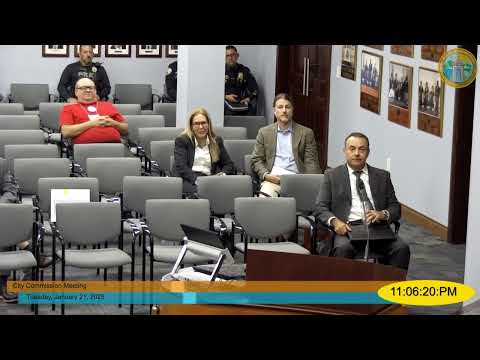
Coastal Waste and Recycling presented a plan on Jan. 21 to improve collection service in North Miami Beach after increases in missed pickups, spillage and illegal dumping prompted public complaints and city staff follow‑up.
Coastal’s senior leadership acknowledged service failures between Thanksgiving and year‑end and described weekly coordination with city staff since Dec. 20. The company introduced a set of operational changes: dedicated route supervisors, driver tools and training for on‑route cleanup, daily non‑collection reports to the city, improved tagging for contamination and noncollection (now trilingual: English, Spanish, Creole), and property‑level outreach for commercial and multifamily customers to “right‑size” service levels.
The company’s presentation distinguished three areas of service problems:
- Residential collection: Coastal said overloaded carts and materials left outside carts caused spillage and missed pickups. The company plans to tag problems, document the issue with numbered tags and daily reports, and work with staff to suggest additional carts or pickups where needed.
- Commercial and multifamily: Coastal showed photo evidence that identical service levels had been applied to properties with widely differing unit counts and trash volume. The company said it will use documented before/after photos and unit counts to recommend increased service levels and to partner with staff and property managers to adjust contracts.
- Bulk and illegal dumping: Coastal emphasized that bulk collection for multifamily is not an automatic scheduled service — properties must call in — and that alleyways are the primary illegal‑dumpsite problem. Coastal proposed tagging illegal piles, sending before/after photos to the city, and re‑establishing a previously discussed plan to address illegal piles with a combination of contractor and city resources.
Commission reaction and follow‑up: Commissioners pressed for durable public education, better cart decals to reduce contamination, stronger enforcement on illegal dumping, and consideration of cameras for repeat dumping sites. Coastal offered to donate 25 cameras for pilot deployment; commissioners said they want a plan showing who will monitor footage and how enforcement will be handled. Commissioners also asked staff and Coastal to consider drop‑off/drop‑zone locations for residents and to explore interlocal options with Miami‑Dade County for access to transfer stations.
Why this matters: Residents described sustained trash and illegal dumping that affect neighborhood quality of life. Coastal’s operational changes and the city’s promise to coordinate code and sanitation enforcement aim to reduce recurring problems; camera deployment, drop‑off sites and contractual enforcement were discussed as next steps.
Clarifying details: Coastal said it will send daily documentation and photographs to city staff for problem locations; it improved its miss/contamination tag to include Spanish and Creole translations; and it will partner with code enforcement when increased service levels are refused by property managers.
Ending: Coastal and city staff agreed to maintain weekly (sometimes daily) operational coordination and to pilot targeted fixes — additional carts, property outreach, the tagging system and camera deployment — while the city evaluates enforcement and drop‑off options.